

South Korea's Entry into the United Nations Security Council as a Non-permanent Member and International Cooperation
Cho Han-bum
Senior Research Fellow, Korea Institute of National Unification
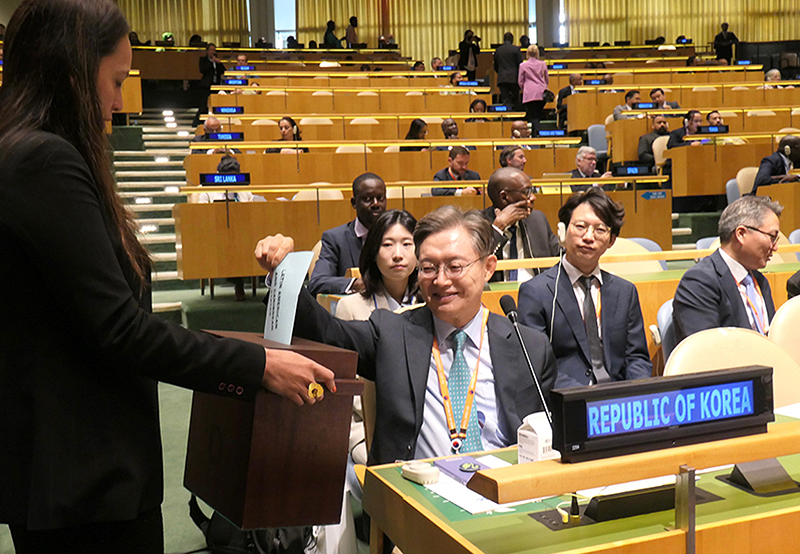
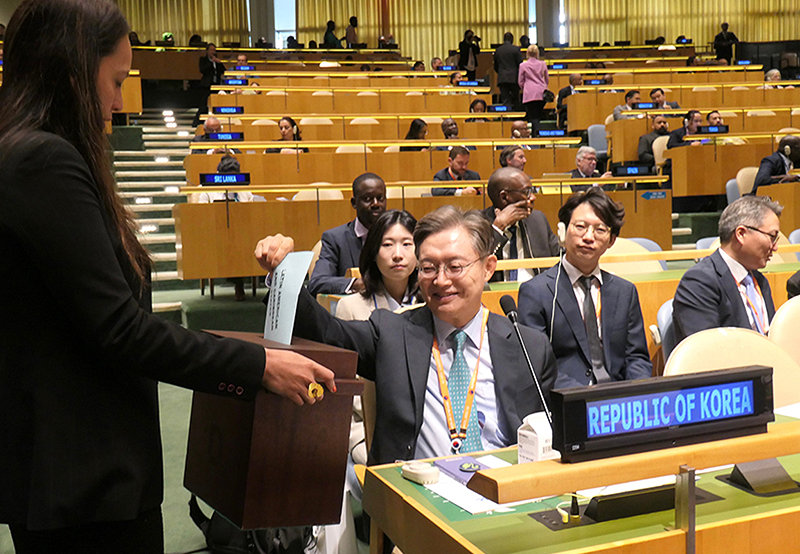
The new Permanent Representative of the Republic of Korea to the United Nations, voting for the election of the Non-permanent Member of the United Nations Security Council. ㅡ Ministry of Foreign Affairs
On June 6, the Security Council convened a plenary meeting to conduct the election of non-permanent members for the 2024-2025 term. South Korea, being the only candidate from the Asia-Pacific region, secured its position with resounding support from 180 out of 192 member states, excluding North Korea and others. This victory means that South Korea will soon resume its membership in the United Nations Security Council for the third time, an achievement of significant diplomatic value. This is particularly noteworthy given the escalating threats posed by North Korea's nuclear threats and the evolving landscape of global security dynamics.
South Korea, positioned as a middle power nation, boasts the 10th largest economy and the 6th largest defense capability in the world. The global community has been captivated by the remarkable phenomenon known as the Korean Wave, showcasing South Korea's cultural influence on a global scale. Moreover, South Korea's dominance in cutting-edge technologies such as semiconductors and batteries remains unrivaled, while its defense industry has proven its mettle through active involvement in the Ukrainian War. Demonstrating its presence beyond regional boundaries, South Korea has firmly established itself as a global player. In line with this, the Yoon Suk-yeol government is steering the country towards a comprehensive global strategy, with the aim of assuming the role of a pivotal state in the international arena. To solidify this pivotal status, it is crucial for South Korea to expand its responsibilities and roles within the international community. In this regard, South Korea's entry as a non-permanent member of the United Nations Security Council holds great significance.
Over the past three and a half years, humanity has faced an unprecedented challenge with the ongoing COVID-19 pandemic, while global security crises have intensified due to the Ukrainian War. The urgency of the climate crisis and the complexities of establishing a stable global supply chain further compound the situation. International cooperation is crucial not only in addressing traditional security threats but also in tackling emerging security challenges and navigating the demands of the new economic era. Resolving the Ukrainian War and recovering from its aftermath require a concerted effort from the international community. South Korea, drawing from the assistance it received during the Korean War, must fulfill its responsibilities as a non-permanent member of the United Nations Security Council and actively contribute to addressing and resolving the Ukrainian issue.
South Korea's inclusion as a non-permanent member of the United Nations Security Council holds the potential to expedite international cooperation in establishing a rule-based global order. The current global landscape reveals a discernible trend of reconfiguration, with the democratic camp led by the United States and the authoritarian camp centered around China and Russia. China, aiming to assert its dominance, is actively seeking to alter the status quo in the East and South China Seas, employing an assertive form of diplomacy known as "wolf warrior diplomacy" to safeguard its diplomatic, security, and economic interests. Russia, isolated due to its unlawful incursion into Ukraine, is bolstering its ties with China. Notably, authoritarian states such as North Korea, Iran, and Syria have aligned themselves with China and Russia. In response to these challenges, the democratic camp endeavors to establish an international order grounded in values and principles. South Korea's participation as a non-permanent member of the United Nations Security Council presents a significant opportunity to reinforce solidarity and collaboration within the democratic camp.
The significance lies in the timely opportunity to address the urgent issue of the North Korean nuclear crisis. The United Nations Security Council is undoubtedly the highest body responsible for international peace and security matters. On June 25, 1950, the day the Korean War broke out, the Security Council swiftly convened a meeting, categorizing North Korea's invasion as a breach of peace and authorizing the dispatch of United Nations forces to South Korea. Furthermore, the Security Council has implemented extensive sanctions on North Korea, adopting Resolution 2397 in 2017, in response to its first nuclear test in 2006. Additionally, the Security Council aims to address North Korea's human rights concerns through mechanisms such as the Special Rapporteur on the Situation of human rights in the Democratic People's Republic of Korea. Non-permanent members of the Security Council possess the same voting and speaking rights as permanent members, enabling South Korea's entry to serve as an effective opportunity to address the North Korean nuclear crisis and actively engage in resolving human rights issues within the country.
Non-permanent members face inherent limitations as they lack the power of veto over substantial resolutions. The authority to veto resolutions in the United Nations Security Council rests solely with the permanent members, commonly referred to as the P5 (United States, United Kingdom, France, China, and Russia). Achieving consensus is essential for the adoption of resolutions, meaning that a single opposing vote can effectively block their passage. Regrettably, despite numerous violations of United Nations resolutions by North Korea since 2017, no additional sanctions or condemnations have materialized due to the non-cooperation of China and Russia. This phenomenon surrounding the North Korean nuclear issue is expected to persist, particularly given the ongoing Ukrainian War and the intensifying strategic competition between the United States and China.
It is important to note that during the United Nations Security Council meeting held on May 31 in response to North Korea's military satellite launch, Deputy Director Kim Yo-jong expressed opposition. The effective utilization of such United Nations Security Council meetings can play a significant role in promoting international cooperation and increasing pressure on North Korea regarding its actions. South Korea's position as a non-permanent member of the United Nations Security Council should be utilized to exert pressure on China and Russia, urging them to take responsible actions given North Korea's clear violations of United Nations resolutions through military satellite launches, missile tests, and nuclear experiments. Additionally, strengthening international cooperation is essential for effectively addressing and finding practical resolutions to the human rights issues in North Korea.
In order to address the urgent challenge of the North Korean nuclear crisis and tackle the complex global crises at hand, international cooperation becomes paramount. South Korea's accession as a non-permanent member of the United Nations Security Council presents a valuable opportunity to bolster its standing as a pivotal global player.
-
PREV [North Korea Glossary]
-
NEXT [NK Focus]