

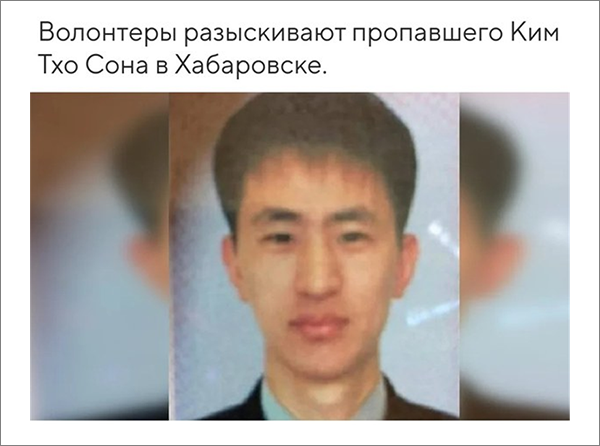

Kim Myungsung
North Korean Exchange Student Missing in Khabarovsk, Russia: Russian Security Authorities Searching for His Whereabouts
It has been reported that a North Korean exchange student has gone missing in Khabarovsk, Russia, on July 8th, and Russian security authorities are searching for their whereabouts. This incident follows the disappearance of the family of a North Korean diplomat stationed in Vladivostok in June, raising possibilities of defection.
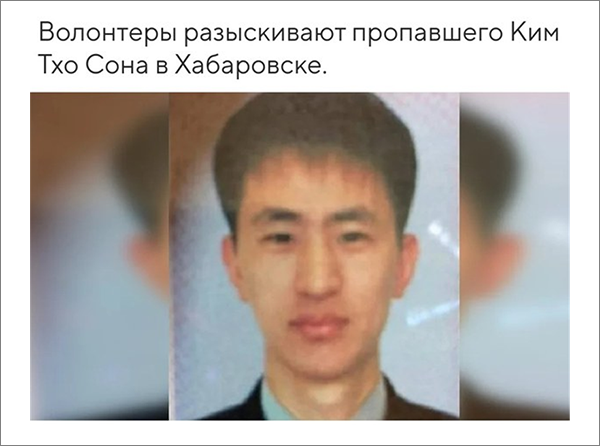
Photo: Flyer for missing North Korean exchange student Kim Tae-sung, featured in the Russian media Novosti / RFA
According to Radio Free Asia (RFA) on the 11th, the local newspaper "Novosti" in Khabarovsk reported on the case of a missing North Korean exchange student. The report stated that the North Korean consulate in Russia has publicly appealed for assistance in locating a 25-year-old man named Kim Tae-sung. It was mentioned that the Khabarovsk security authorities are actively searching for Kim Tae-sung and have released a photo of him to the media. The article also highlighted that Kim Tae-sung was a talented individual who had come to study at the Far Eastern Federal University in Khabarovsk before the COVID-19 pandemic and had received an excellent education in North Korea.
The current whereabouts of Kim Tae-sung remain unknown, and if his intention was to defect, it is possible that he has already left the neighboring area. In late June, the family (wife and his son) of the owner of the North Korean restaurants "KOPE" and "Duman River Restaurant" in Vladivostok also went missing, leading to speculation about defection. According to a source, there is growing concern among trade representatives and workers from North Korea who have been sent to Russia, as there is a prevailing belief that the border between North Korea and Russia may soon open. These individuals are increasingly pessimistic about the prospect of returning to North Korea and being isolated from the outside world. With the gradual opening of North Korea's borders, there is a possibility of more defections by North Korean workers dispatched to Russia before their scheduled return.
‘North Korean Young Leaders Assembly Meeting' Held in Washington D.C.
On July 10th (local time), ten North Korean defectors in their 20s and 30s engaged in passionate discussions about "freedom," "democracy," "human rights," and "dreams" in fluent English and Korean at the North Korean Human Rights Committee (HRNK) office in Washington, D.C. This gathering was named the "North Korean Young Leaders Assembly." These young individuals, leaving behind painful moments of defection, are dedicated to preparing for the era of reunification and the freedom and hope of those who remain in North Korea. Their intention is to signify their preparation for the future of a unified Korean Peninsula, rather than identifying themselves solely as defectors.
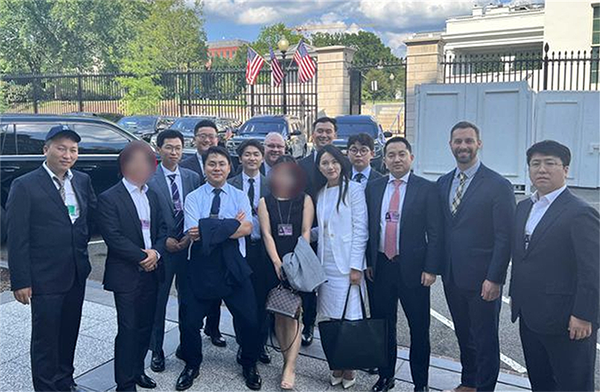
Photo: On 10th, North Korean defectors gathered in front of the Eisenhower Executive Office Building in Washington, D.C., for the 'North Korean Young Leaders Assembly' / The Chosun Ilbo
More than half of the ten individuals are fluent in English, with some having studied at prestigious institutions such as Columbia University, New York University, and possessing little to no accent. Others have settled in Korea and the United States, working in professions such as lawyers, software engineers, and architects. The meeting was led by researcher Lee Hyun-seung from the Global Peace Foundation, who stated, "Our dream is for North Korean residents to enjoy freedom and human rights in a free and unified Korea, just like us." Attorney Lim Cheol, who attended the meeting, is a North Korean defector from North Hamgyong Province. After settling in South Korea at the age of 15, he graduated from Korea University School of Law and Seoul National University School of Law.
Harry Kim, who graduated from Kim Chaek University of Technology with a degree in computer science and engineering, also shared his belief that although there are many issues in North Korea such as human rights and nuclear concerns, the solution lies only in the democratization of North Korea. He had gained freedom after being dispatched overseas, awakening to the reality and obtaining US citizenship through the local US embassy after defection in 2015. Following the meeting, they moved to the White House to hold a roundtable discussion with the Director of the National Security Council (NSC) for the Korean Peninsula for one hour and thirty minutes. Until the 14th, they met with Senator Marco Antonio Rubio, Congressman Kim Young-oak, Ambassador Cho Hyeon-dong, and Ambassador Hwang Joon-kook at the United Nations during their visit to Washington and New York.
Ryanggang Province Opens Samjang Customs House - Hyesan Customs Still Closed
Recent reports indicate that the Samjang Customs House in Taehongdan County, Yanggang Province, was opened by North Korea in early July. This comes after the previous opening of customs in Musan County, North Hamgyong Province, at the end of June. However, it has been observed that the nearby Hyesan customs in Ryanggang Province have not yet been opened. Ryanggang Province holds great significance as the birthplace of Kim Jong-il, and numerous locations within the province are regarded as "revolutionary sites" associated with the Kim dynasty. Nevertheless, since 2016, there has been a substantial increase in the number of North Korean defectors from Ryanggang Province, leading to its reputation as a "defector's sanctuary." According to data from the Ministry of Unification, North Hamgyong Province had the highest number of defectors between 1998 and 2015, but since 2016, Ryanggang Province has consistently topped the list. This shift has resulted in a transformation of the province's evaluation from a "holy land of revolution" to a "holy land of defection."

Photo: View of Changbai Korean Autonomous County in Jilin Province, China & Hyesan city in Ryanggang Province, North Korea (the area across the river) / Yonhap News Agency
According to sources in North Korea, the opening of the Hyesan customs has been delayed. Despite earlier speculation about its opening in mid-July, the situation is still uncertain and subject to change. In the meantime, North Korea has announced the mobilization of party members from various regions for the construction of rural homes in Ryanggang Province, as reported by the Rodong Sinmun on the 11th. This move is believed to have multiple objectives, including enhanced surveillance and the utilization of the Yalu River border area for economic and propaganda purposes.
Kim Yo-jong's Use of "Republic of Korea" Instead of "South Korea": A Shift in Two Korea Policies
Kim Yo-jong, the Deputy Director of the Workers' Party of Korea (WPK), has attracted attention by using the term "Republic of Korea" instead of "South Korea" in her recent speeches for two consecutive days. In the speeches delivered on the 10th and 11th, Kim Yo-jong criticized the reconnaissance activities of the US Air Force and referred to the Republic of Korea Joint Chiefs of Staff as the "military leadership of the Republic of Korea."
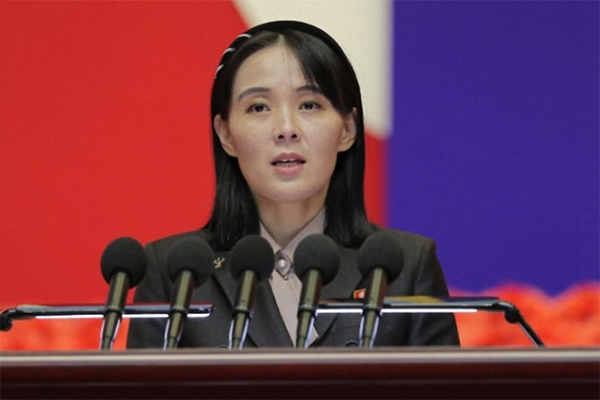
Photo: Kim Yo-jong, Deputy Director of WPK / Korean Central Television
Kim Yo-jong's speeches and other prominent North Korean media and official documents have rarely utilized the term "Republic of Korea." Instead, North Korea has traditionally referred to South Korea as simply "South Korea" or derogatorily as the "South Korean Puppet." This choice of terminology reflects North Korea's viewpoint of regarding South Korea as a temporary and unique relationship in the pursuit of reunification, comparable to how South Korea designates North Korea as a "target of unification" or "fellow ethnicity." However, analysis suggests a significant shift in North Korea's policy regarding South Korea, as Kim Yo-jong, acting on behalf of Kim Jong-un, Chairman of the State Affairs Commission, has officially incorporated the term "Republic of Korea" into her speeches. This marks a departure from the previous stance of considering South Korea as a separate country. The adoption of the term "Republic of Korea" in North Korea's discourse signifies a shift towards emphasizing "hostile coexistence" as part of the "Two Korea" policy. This shift is a response to the increasingly dim prospects for negotiations between South Korea and North Korea, as well as between North Korea and the United States. In the past, North Korea, through the Ministry of Foreign Affairs, rejected the plan for Hyundai Group Chairman Hyun Jeong-eun's visit to North Korea, categorizing it as a matter to be handled between nations rather than by inter-Korean organizations such as the National Committee for the Peaceful Reunification of the Fatherland. Notably, the announcement even employed the term "entry," which is not commonly used to refer to South Korean individuals.
-
PREV [NK Focus]
-
NEXT [Defectors' Podium]