

Kim Jong-un's Anxiety Fuels Consecutive Military Satellite Failures, Driving Launch Despite Technical Challenges
North Korea's recent attempt to launch its second military satellite on August 24th ended in failure, marking the second such failure in just 85 days following the initial setback on May 31st. According to reports from the South Korean Joint Chiefs of Staff, North Korea's space vehicle, known as 'Chollima-1,' carrying the military satellite 'Manrikyong-1,' took off around 3:50 AM. However, it faltered during its three-stage flight due to a critical error in the emergency explosion system. Intriguingly, North Korea chose to communicate this failure solely through its external media outlet, the Korean Central News Agency, keeping its domestic audience in the dark—a sign that they were hesitant to acknowledge this second failure to their citizens, given their earlier notification of the first unsuccessful launch. Additionally, North Korea dropped hints about a possible third military satellite launch scheduled for October.

North Korea unveiled the launch of the 'Chollima-1' satellite launch vehicle carrying its first military reconnaissance satellite, 'Manrikyung-1', on the 1st, as reported by the Korean Central News Agency. The rocket was launched from a new site in Dongchang-ri, Cheolsan County, Pyonganbuk-do, on the 31st of last month but crashed into the West Sea due to engine failure (Photo by Korean Central News Agency).
The decision to pursue another satellite launch a mere 85 days after the initial technical failure underscores North Korea's mounting apprehension resulting from the strengthening military collaboration among South Korea, the United States, and Japan. This anxiety is further compounded by Kim Jong-un's ambition to secure notable achievements in anticipation of the 75th anniversary of the regime's establishment on September 9th.
Following the 'Washington Declaration,' which led to the establishment of the 'Nuclear Consultative Group' between South Korea and the U.S., leaders from these two countries, and the detailed plans for bolstering their response to North Korea's nuclear capabilities in the 'Camp David Agreement’ along with Japan. It is widely believed that North Korea, sensing a heightened threat due to the deepening coalition against it, felt compelled to take military countermeasures. As the regime's 75th anniversary looms, North Korea may have expedited the satellite launch to secure visible achievements internally without addressing the underlying technical issues. Furthermore, the continuous testing of new weaponry by North Korea since the previous year may have left them with limited options, with the military satellite being one of the few viable choices, further contributing to Kim Jong-un's unease.
Kim Jong-un has displayed interest in military satellites from the early days of his rule. During the 8th Congress of the WPK in 2021, he incorporated military satellites as one of the five pivotal tasks in the five-year plan aimed at strengthening defense capabilities. Military satellites play a crucial role as essential assets for preemptive nuclear strikes, serving as command and communication systems vital for nuclear weapons. They also offer surveillance and reconnaissance capabilities, providing strategic advantages against South Korea and the United States.
Another motivation behind North Korea's hasty attempt to relaunch the military satellite appears to be an endeavor to pacify growing public discontent stemming from deteriorating living conditions. Despite facing severe economic sanctions and experiencing the failure of economic plans, North Korea's unwavering focus on nuclear and missile development has exacerbated dissatisfaction among its citizens with Kim Jong-un's leadership. According to the National Intelligence Service, the number of deaths in North Korea reached 245 by July this year, more than double the average of the past five years. With the North Korean economy witnessing its most significant contraction since the 1990s, concerns regarding threats to the regime have grown as citizen dissatisfaction approaches a critical threshold.
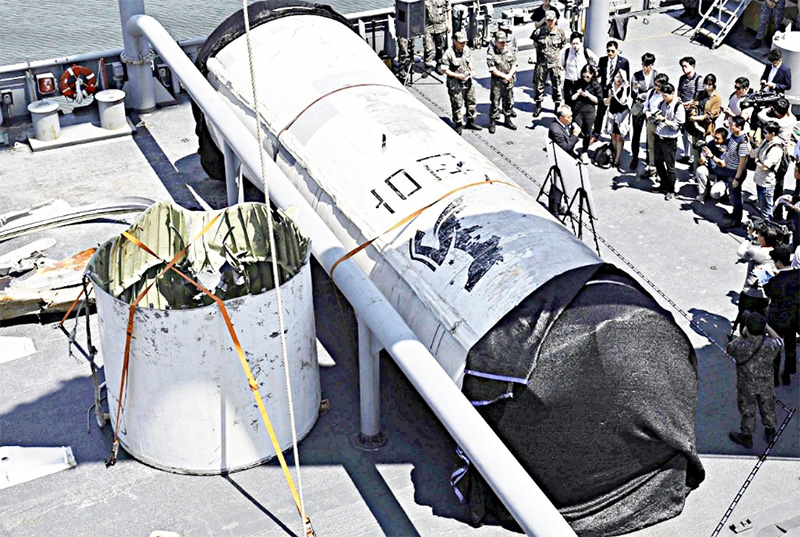
The May 31st launch failure of Military Satellite No. 1 was described as the 'most severe defect' in the field of defense. (Photo by AP News)
Kim Jong-un has persistently pursued nuclear and missile development while demanding sacrifices from the citizenry, and now the need to deflect blame or garner public support has become imperative. During a recent visit to a flood-damaged site in Onchŏn County, South Phyongan Province, Kim Jong-un directed criticism towards Premier Kim Tok-hun, accusing him of "ruining national economic projects." Despite facing criticism for neglecting public welfare and channeling resources towards missile launches, North Korea's provocative actions are expected to persist. With North Korea signaling a third launch in October, potential scenarios include further ICBM tests, exercises involving new tactical missiles, or even rash regional provocations.
In the lead-up to the second military satellite launch, during the 8th Plenary Meeting of the 8th WPK, attended by Kim Jong-un, it was affirmed that they would "steadfastly adhere to the path of nuclear weapons development and the strengthening of nuclear capabilities." The statement emphasized their commitment to safeguarding the revolutionary achievements of Juche with tangible progress in enhancing their nuclear arsenal.