

<Kim Myungsung’s Inside North Korea>
North Korea grapples with managing South Korean culture while preserving its regime.

Kim Myungsung
⦁ Kim Jong-un and Daughter Visit Navy Command…Criticizing South Korea, US, and Japan as 'Gangster Bosses'
⦁ Over 300 People Forcibly Relocated in North Korean Border Region for Illegal Cell Phone Possession
⦁ North Korea's Military-Style Return Order: Packing Up a Day Early to Prevent Defections in China
Kim Jong-un and Daughter Visit Navy Command…Criticizing South Korea, US, and Japan as 'Gangster Bosses'
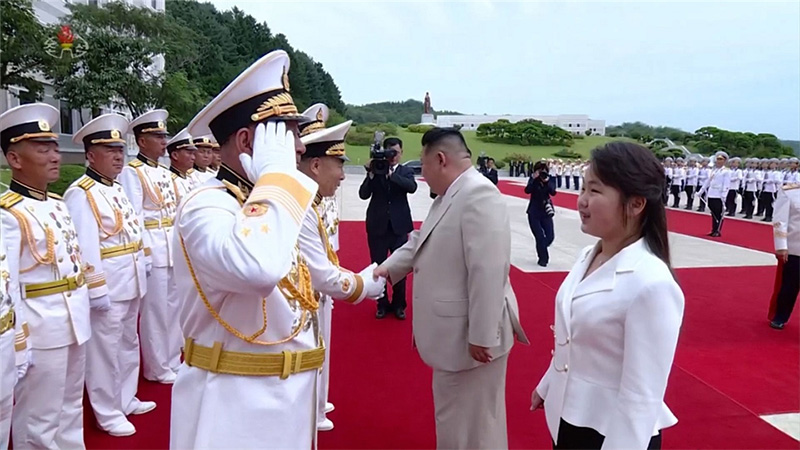
North Korean leader Kim Jong-un recently made his first-ever visit to the Korean People's Army Naval Force (KPANF) since coming to power. What makes this visit even more remarkable is that he was accompanied by his daughter, Kim Ju-ae. However, it was not just the presence of Kim's daughter that stirred the international community but also the scathing criticism he directed at the leaders of South Korea, the United States, and Japan during their talks at Camp David in the US. Kim Jong-un referred to them as "gangster bosses," setting off a storm of controversy.
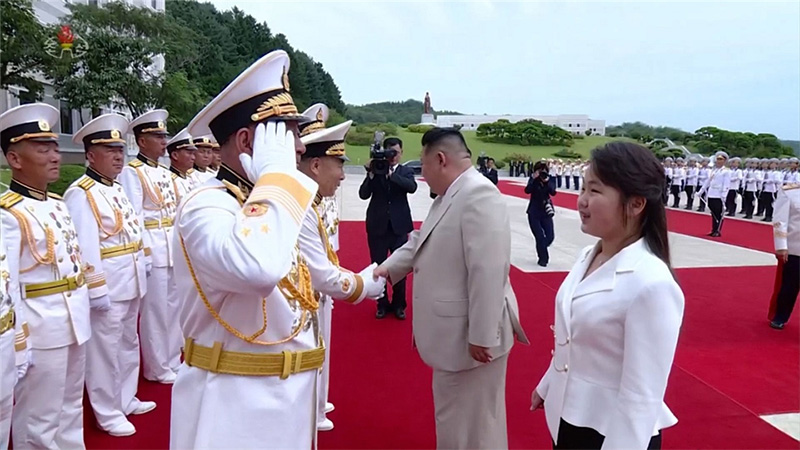
Korean Central Television reported that on the 27th, Kim Jong-un, Chairman of the State Affairs Commission of North Korea, visited the Navy Command to celebrate North Korean Navy Day (28 Aug) with his daughter Ju-ae. Navy Commander Kim Myong-sik is seen saluting Kim Jong-un's daughter 'Ju-ae'. (Photo by Korean Central Television)
On the 29th, the Korean Central News Agency reported a noteworthy event involving Kim Jong-un. In anticipation of North Korea's Navy Day, Kim paid a visit to the naval headquarters on the 27th. During this visit, he remarked, "Lately, the leaders of the USA, Japan, and the Republic of Korea, the 'gangster bosses,' have come together to announce and kickstart various joint military exercises among the three nations." It marks the first instance of Kim publicly addressing South Korea as the 'Republic of Korea.' Prior to this, Kim Yo-jong, Deputy Director of the WPK, and Kang Sun-nam, Minister of Defense, had employed the term 'Republic of Korea' when criticizing South Korea, signaling a shift in North Korea's rhetoric towards its southern neighbor.
Kim Jong-un's recent visit to the naval command marked a significant departure from his past actions. It was his first Navy Day visit since taking power in 2012, and he directly congratulated the celebration, an unusual move noted by an official from the Unification Ministry.
On the same occasion, Kim outlined a policy shift towards expanding tactical nuclear weapons operations and supplying new armaments to various military units. He also stated that the navy (KPANF) would play a key role in the national nuclear deterrent, hinting at potential tactical nuclear weapon deployment. Additionally, he observed a training launch of a strategic cruise missile capable of carrying tactical nuclear weapons during an inspection of the 2nd Surface Ship Brigade of the PLA East Sea Fleet.
Over 300 People Forcibly Relocated in North Korean Border Region for Illegal Cell Phone Possession
Recent reports reveal that more than 300 individuals were forcibly relocated from North Korea's border region to rural areas in the first half of this year due to anti-socialist activities, including illegal possession of cell phones and smuggling. In Chŏngjin City, North Hamgyong Province, despite the strict enforcement of the Reactionary Ideology and Culture Rejection Law, 46 residents who were caught watching South Korean dramas were arrested in a mass crackdown. This signifies North Korea's determination to prevent internal information leaks, curb external information inflow through illegal cell phones, and eliminate the influence of the Korean Wave (Hallyu) that has gained popularity among the younger generation.

Photo: Pyongyang residents using mobile phones. / Yonhap News Agency
According to sources familiar with North Korea's situation, the over 300 residents living in border regions of Ryanggang and North Hamgyong provinces were caught using illegal mobile phones to communicate with foreigners. They were subsequently relocated to remote areas like Kapsan County in Ryanggang and Kim Chaek City in North Hamgyong. Those expelled were found to be involved in connecting defectors' families with their relatives in South Korea and engaging in smuggling activities, often charging fees for their services. The North Korean Ministry of Social Security, akin to the police department, had previously issued stern warnings against illegal mobile phone usage through public announcements.
Particularly alarming, residents who leaked national secrets, lecture materials, public announcements, internal documents, and videos to external sources faced investigations by the Ministry of State Security and were incarcerated in political prisoner camps. A source revealed that, "Earlier this year, a resident of Ryanggang was apprehended and sent to a prison camp for filming a public announcement from the Ministry of Social Security and sending it to South Korea."
46 youths in Chŏngjin City, North Hamgyong Province, were reportedly arrested in the first half of this year for watching South Korean dramas. According to sources, some of the 46 detainees managed to secure their release by paying a bribe of 10,000 yuan (approximately 2 million won), while those unable to pay faced more severe penalties. In accordance with the Reactionary Ideology and Culture Rejection Law, they were sentenced to one year in prison for each South Korean drama episode watched, with one university student receiving a 15-year sentence for possessing and viewing 15 episodes. All of them have allegedly been confined to the infamous Chŏngŏri Concentration Camp.
North Korea's Military-Style Return Order: Packing Up a Day Early to Prevent Defections in China
Recent reports indicate that North Korea, following the approval of the return of its overseas residents, is implementing a military-style return process aimed at preventing any defections. There are claims that the forced repatriation of defectors detained in China has already commenced. As North Korea reopens its borders, concerns are mounting that the dreaded forced repatriation of defectors is becoming a harsh reality.
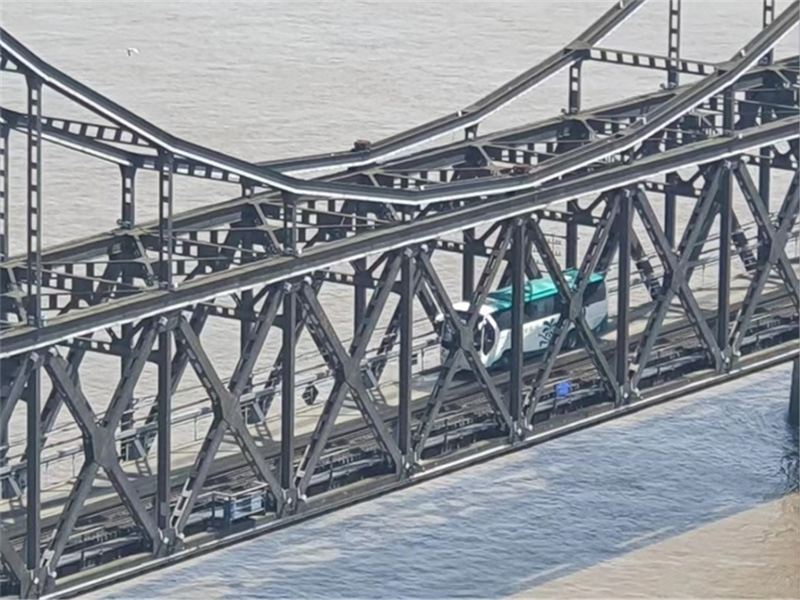
Photo: Bus returning from Sinŭiju City to Dandong City with North Korean personnel on the morning of August 29 / Yonhap News Agency
A source based in Dandong, China, revealed on the 4th, "On August 31, North Korean restaurant workers deployed in Dandong received orders to pack their belongings a day prior to their scheduled return." The source further explained, "Under the watchful eye of the State Security Department, dozens of them assembled and then boarded a ship bound for North Korea." The advance announcement of the return date is viewed as a precautionary measure to deter potential defections.
There are reports of ongoing replacements in personnel from the Ministry of State Security that monitor overseas North Koreans. The source said, "Last week, replacements from the Ministry of State Security came to China to hand over duties." It is understood that North Korea plans to repatriate about 10,000 overseas personnel after officially reopening its borders. North Korea formally reopened its borders, which had been closed since last month, after 3 years and 7 months, and North-China flight routes have also resumed.
There are growing concerns that forced repatriation of North Koreans detained in China may have commenced. Suzanne Scholte, a representative from the U.S.-based North Korean human rights group "Fighters for a Free North Korea," sent an emergency email to Voice of America (VOA) on August 31 (local time), stating, "On August 29, two buses carrying refugees crossed a bridge from Dandong to Sinŭiju City, putting the lives of approximately 90-100 refugees in jeopardy." The organization also provided two videos received from a credible source that depict the buses crossing a railway bridge.
-
PREV [NK Focus]
-
NEXT [Issue Brief]