

China's Image at Risk as Kim Jong-un Visits Russia:
Deepening Relations with North Korea and Russia Could Pose Diplomatic Challenge
In 2018, Kim Jong-un initially chose China for his first foreign visit. However, due to the COVID-19 pandemic, he shifted course and embarked on his initial overseas journey to Russia. This change has ignited discussions about North Korea's 'pendulum diplomacy,' a strategy that alternates between its key allies, Russia and China. It diverged from expectations that Kim Jong-un would prioritize Beijing as his first destination, especially after border restrictions were lifted. Instead, his surprising choice of Russia left China taken aback. Consequently, some experts suggest that China, responsible for over 95% of North Korea's foreign trade and a significant political supporter, may have seen a decline in its diplomatic standing.
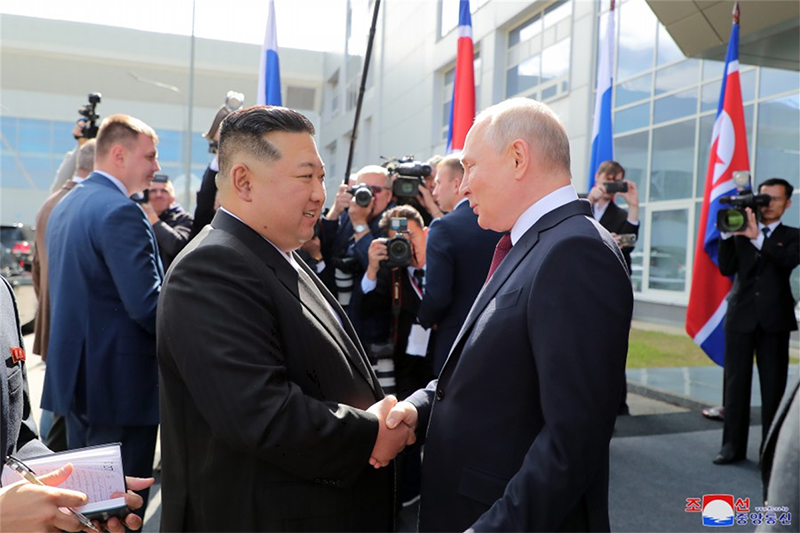
<Photo> Kim Jong-un, the North Korean leader, is seen here shaking hands with Russian President Vladimir Putin during his visit to the Vostochny Cosmodrome in Amur Oblast on the 13th. / Korean Central News Agency
Kim Jong-un's visit to Russia underscores the convergence of interests between the two nations. Russia, grappling with a shortage of weapons finds itself in need of advanced military technology, satellites, and energy resources, all of which North Korea can potentially provide. Against the backdrop of escalating tensions between the U.S. and China, coupled with Russia's activities in Ukraine, North Korea has positioned itself within what it deems a 'new cold war regime.' The regime continues its quest for developing Intercontinental Ballistic Missiles (ICBMs) aimed at the U.S. and tactical nuclear weapons targeting South Korea. This geopolitical context has created an opportunity for South Korea, the U.S., and Japan to bolster their cooperation significantly. North Korea had initially expected robust support and economic assistance from China for its provocations. Still, signs of easing tensions between the U.S. and China, such as U.S. Secretary of State Antony John Blinken's visit to Beijing and his meeting with Chinese President Xi Jinping in June, coupled with China's response to North Korea's overtures, may have influenced North Korea's pivot toward Russia.
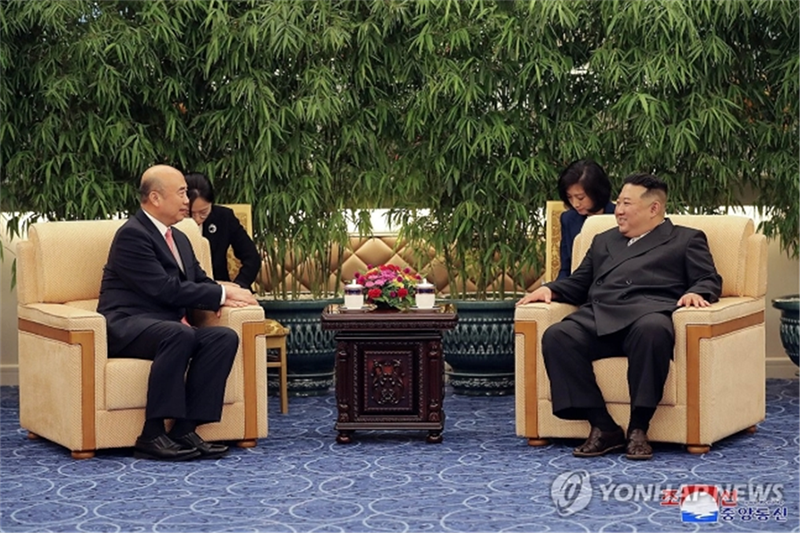
<Photo> On the 8th, in commemoration of the 75th anniversary of his regime's establishment, North Korean leader Kim Jong-un engaged in discussions with a Chinese party and government delegation led by Liu Guozhong, China's Deputy Premier of the State Council, during their visit to North Korea. / Korean Central News Agency
Some say that Kim Jong-un's decision to visit Russia before China may reflect his dissatisfaction with China's recent stance. In response to the shifting dynamics, China, recognizing North Korea as a long-standing ally, has initiated efforts to appease its neighbor. China's concern is that neglecting North Korea might result in a reduction of its influence over the regime. Deputy Premier Liu Guozhong of China, leading a Chinese delegation to North Korea on the occasion of the 75th anniversary of North Korea's regime, met with Kim Jong-un and expressed intentions to provide support, including food and fertilizer. Additionally, there is speculation that China might convene a tripartite summit involving North Korea, China, and Russia during the upcoming forum in October.
For China, given the intensifying competition with the U.S., a closer North Korea-Russia relationship offers strategic advantages in countering American influence in the region. Certain segments of Chinese media attribute the burgeoning North Korea-Russia ties to the "frequent military exercises between South Korea and the U.S." These media outlets criticize the development and argue that China could employ the North Korea-China-Russia triangle to counteract the influence of the U.S. and to maintain a balance of power in Northeast Asia. In particular, China may leverage its cooperation with North Korea and Russia to counteract U.S. support for Taiwan.
However, China's stance on the North Korea-Russia alliance is far from straightforward and reflects complex internal considerations. China has adopted an indifferent stance toward Kim Jong-un's recent visit to Russia, emphasizing that it's a bilateral matter between North Korea and Russia. Notably, state-run Chinese media outlets like Xinwen Lianbo provided limited coverage of Kim Jong-un's meeting with Putin, and the Xinhua News Agency refrained from offering comments on the summit, instead relying on foreign sources for reporting. This suggests that China may be cautious, concerned that a closer North Korea-Russia relationship could be detrimental to its own interests. Historically, China has used its influence over North Korea as a diplomatic tool, particularly against South Korea, the U.S., and Japan. If North Korea grows closer to Russia, China's leverage may diminish. China's reluctance to engage actively in the Ukraine conflict and the possibility of being drawn into the conflict as North Korea and Russia strengthen their ties present a challenging dilemma for China. The prospect of supporting Russia, which is struggling in the Ukraine war, and North Korea, grappling with economic difficulties due to sanctions and prolonged COVID-19 lockdowns, is a weighty burden for China. China, facing its economic challenges, is caught between the desire to avoid entanglement in the Ukraine conflict and the fear of international isolation due to its proximity to North Korea.
If China were to lead efforts to form an anti-Western front, aimed at countering the U.S. while strengthening the North Korea-China-Russia alliance, it could potentially face even greater challenges. As the South Korea-U.S.-Japan alliance strengthens, the consolidation of the North Korea-China-Russia camp could result in China facing backlash from European nations like France and Germany, with which it has maintained cordial relations. Such a scenario could place China in a more defensive position in the ongoing U.S.-China competition. The intensification of North Korea-Russia ties has possibly prompted China's proactive diplomacy, shuttling between the U.S. and Russia. As China aspires to become a major global player, strengthening its ties with North Korea, a nation facing international criticism for its nuclear ambitions and human rights concerns, as well as with Russia, could potentially tarnish China's image.
To navigate this situation effectively, China may need to work on improving relations with South Korea and the U.S. to some extent. Additionally, it is hoped that China will actively engage in the South Korea-China-Japan summit scheduled for later this year, contributing to the easing of tensions in Northeast Asia and fostering economic cooperation.