

A Closer Look at Kim Jong-un's Limited Public Appearances in October: Is a Satellite Launch on the Horizon?
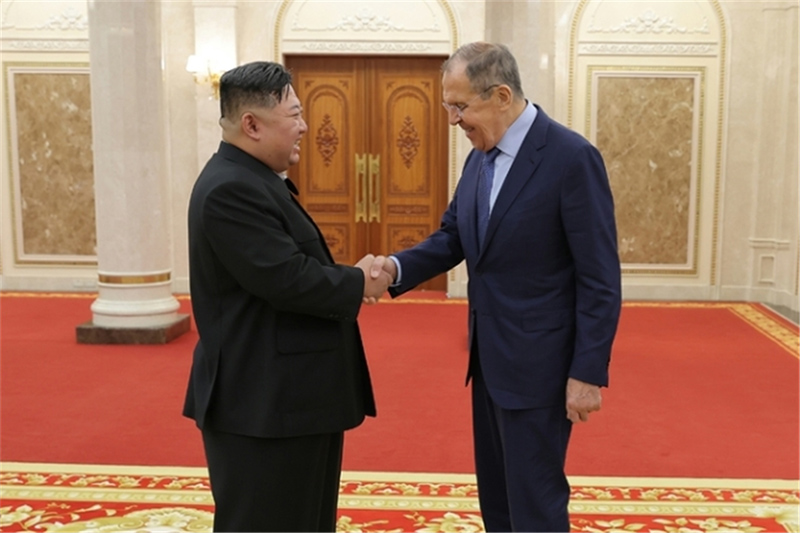
October has seen a noticeable decline in Kim Jong-un's public appearances. His sole known engagement was with Russian Foreign Minister Sergey Lavrov during a visit to Pyongyang City on the 19th. For the rest of the month, Kim has kept a low profile, even missing the 78th anniversary celebrations of the Party Foundation Day on the 10th.
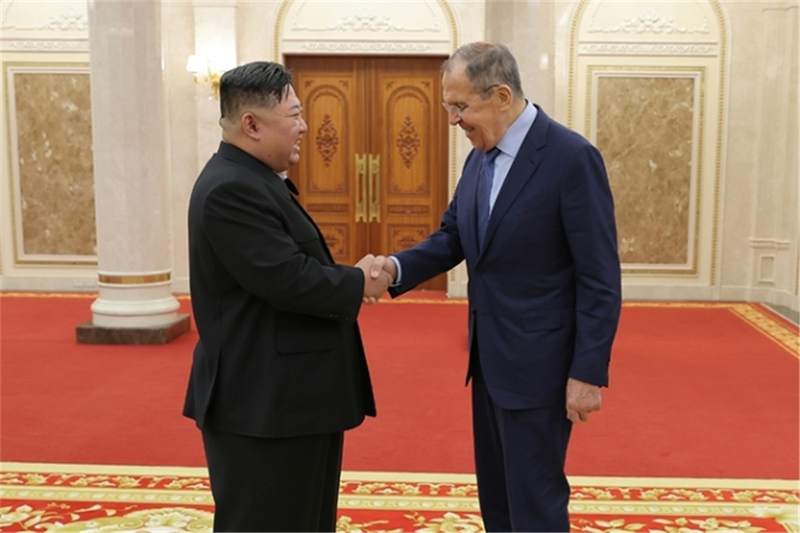
Kim Jong-un engaged in discussions with Russian Foreign Minister Sergey Lavrov, captured in a photo dated October 20, 2023. / Rodong Sinmun
The scarcity of public appearances has led to widespread conjecture about Kim's current focus and potential future plans. Analysts are pondering whether he is channeling his efforts towards the imminent launch of a reconnaissance satellite, frequently overseeing the developments with the help of Russian satellite technicians. Despite this, the anticipated third launch of a reconnaissance satellite, slated for October as per North Korea's public declarations, has yet to materialize, sparking a variety of theories about the reasons for this postponement.
An examination of the state media outputs from North Korea in October highlights that Kim's meeting with Sergey Lavrov was his only public engagement, as documented by Rodong Sinmun on the 20th. The same media outlet reported on a series of non-public activities undertaken by Kim, including dispatching a reply message to the General Secretary of the Lao People's Revolutionary Party on the 21st, sending a message to Russian President Vladimir Putin on the 12th in celebration of 75 years of diplomatic ties between North Korea and Russia, laying a wreath in honor of the late Workers’ Party of Korea Secretary Kim Yong-il on the 2nd, and extending greetings to Chinese President Xi Jinping on the 74th anniversary of China’s founding on the 1st. Compared to his active public presence in the months of July, August, and September, Kim’s level of engagement in October can almost be described as reclusive.
Kim Jong-un has a history of disappearing from the public eye for extended periods. After his visit to the Kumsusan Palace of the Sun to kick off the new year, he went unseen for 36 days. He finally made a public appearance at the military parade marking North Korean Army Foundation Day on February 8th. From March onward, he resumed his usual provocations, which included launching short-range missiles at South Korean military installations and conducting artillery firing exercises.
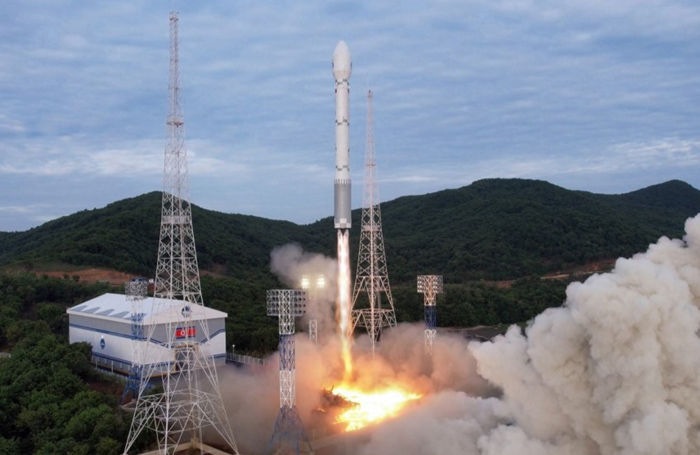
A photo captures North Korea's reconnaissance satellite launch attempt on May 31st, a mission that ultimately concluded in failure. / Korean Central News Agency (KCNA)
A subsequent period of inactivity followed his visit to the National Space Development Agency on April 18th, lasting about a month. During May, while Kim was absent from public view, North Korea proceeded to test-fire a Hwasong-17 type Intercontinental Ballistic Missile (ICBM) aimed at the United States and conduct short-range missile launch drills aimed at South Korea.
Some speculate that his absence in October could be attributed to his involvement in preparations for a satellite launch. Despite North Korea’s explicit intentions to execute a third reconnaissance satellite launch within the month, the event did not transpire.
On the final day of October, October 31st, there were no observable indicators at the Sohae Satellite Launching Station in Cholsan County, North Phyong-an Province, suggesting an imminent launch. Usually, in the lead-up to a satellite launch, North Korea demonstrates distinct preparatory activities. These activities include a noticeable increase in staff presence at the launch site, the commencement of fueling procedures, and the dissemination of alerts to international organizations such as the International Maritime Organization (IMO). Considering that launch preparations, particularly the liquid fueling phase, typically span about a week, the likelihood of the third launch attempt occurring within the month of October appeared to be slim.
North Korea revealed its October satellite launch plans through the Korean Central News Agency (KCNA), unavailable to its citizens, showing little regard for public opinion in scheduling such events.
Cho Han-bum, a Senior Research Fellow at the Korea Institute for National Unification, noted, "Considering August’s failed launch, North Korea likely faced significant challenges fixing the technical issues in time for an October launch. Kim Jong-un’s lack of public appearances during the month suggests the satellite launch may have been postponed."
Some analysts speculate that the delay in North Korea's third launch could be tied to its military-technical cooperation with Russia.
Technical assistance for the satellite has been highlighted as a key area of cooperation. According to an intelligence source, Russian technicians are believed to have been sent to North Korea to aid in the satellite launch.
Cho added, "Given Putin’s pledge to support the satellite launch, North Korea seems to be taking this opportunity to upgrade their basic satellite’s capabilities and get ready for a subsequent launch." He also mentioned that authorities from South Korea and the U.S. had previously deemed the 'Manrikyong-1' satellite — which fell into the West Sea during its initial launch in May — to be rudimentary and devoid of any military utility.
Faced with the urgent need for a successful satellite launch, North Korea may have chosen to seek satellite launch assistance from Russia, rather than food aid.
Speculation around the time of the North Korea-Russia summit in September suggested that North Korea might trade conventional weapons for food aid and strategic weapon-related technical support from Russia. Nevertheless, Russia's offer of food aid was declined by North Korea. Russian Ambassador to North Korea, Aleksandr Matsegora, confirmed this on the 17th to TASS, mentioning that North Korea had a satisfactory harvest this year.
However, this claim of a successful harvest is contradicted by North Korea's substantial food imports from China throughout the first three quarters of this year. Reporting on the 28th, Voice of America, citing data from China's General Administration of Customs, revealed that North Korea had imported food worth $71.08 million (152,216 tons) from China between January and September. This amount is 13 times the total imported during the same period last year, which was $5.66 million. The surge in rice imports, despite official North Korean media boasting a bountiful harvest, points to persistent food shortages in the country.
Even with the food scarcity in North Korea, the rejection of Russian food aid suggests a more pressing need for technical support for the satellite. Kim Jong-un's desperation is apparent in the hastened announcement of the third launch in October, just two months after the failed attempt in August. Typically, it would take about six months to plan a relaunch after a failed satellite launch. Nevertheless, North Korea is pressing forward, motivated by political considerations.
However, the lack of a satellite launch in October suggests that North Korea might be taking extra time to fix the problems encountered during the second launch. Shortly after that failure, they cited an 'emergency explosion system error during the third stage of flight' as the issue, downplaying it as a minor glitch. Nevertheless, there is speculation that the problems could be more complex than they have let on. Solving the reliability issues of the engine is already a significant challenge, and there’s speculation that the team might have promised an October launch as a way to avoid responsibility.
Producing a new satellite body might also be contributing to the delay. Given that the previous two satellites were likely lost in the failed launches, a new satellite body would need to be created for the third launch, and it’s possible that this has not yet been completed.
Cho commented, "Even though the launch did not happen in October, North Korea is highly likely to attempt a satellite launch with improved technical capabilities within this year, possibly during the winter months, similar to their actions in 2012."