

North Korea Shocked by South Korea-Cuba Diplomatic Relations:
Diplomatic Isolation Likely to Worsen
Lee Seung-hyun
Research Fellow at the SAND Institute
South Korea recently established diplomatic ties with Cuba, the sole Latin American and Caribbean nation with connections to the United States. This historic event, occurring after 65 years, is anticipated to affect North Korea significantly, given the discreet nature of the announcement aimed at avoiding backlash. Despite their shared ideologies of socialism and anti-Americanism, Cuba's decision to align with South Korea over North Korea is expected to deepen the latter's diplomatic isolation.
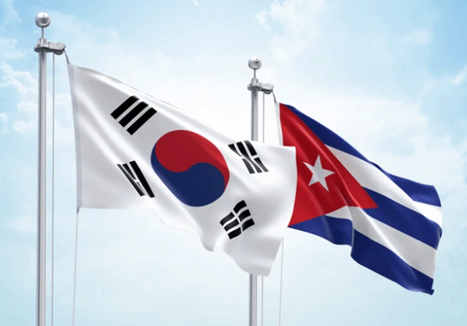
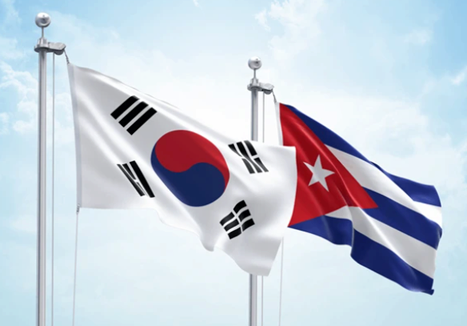
Flags of South Korea and Cuba, which established diplomatic relations on the 14th
With diplomatic ties established, Cuba became South Korea's 193rd diplomatic partner, a noteworthy development given Cuba's decades-long affiliation as a fraternal ally of North Korea for seven decades. Despite their shared socialist and anti-American ideologies, Cuba's decision to opt for diplomatic relations with South Korea is expected to further isolate the latter diplomatically.
In 1949, Cuba acknowledged South Korea, but in 1960, it severed ties with South Korea and allied with North Korea after Fidel Alejandro Castro Ruz’s revolutionary rise to power. Throughout the Cold War, the two nations upheld a close bond based on the friendship and shared anti-American stance of leaders Kim Il-sung and Fidel Alejandro Castro Ruz. In 1988, as Cold War tensions eased, Cuba boycotted the 1988 Seoul Olympics in solidarity with North Korea, despite the participation of other socialist nations like the Soviet Union and China.
Even after the Cold War, Cuba remained supportive of North Korea, which had faced international isolation due to its nuclear and missile development. In 2018, Cuban President Miguel Diaz-Canel visited North Korea, meeting Kim Jong-un to further strengthen their relationship.
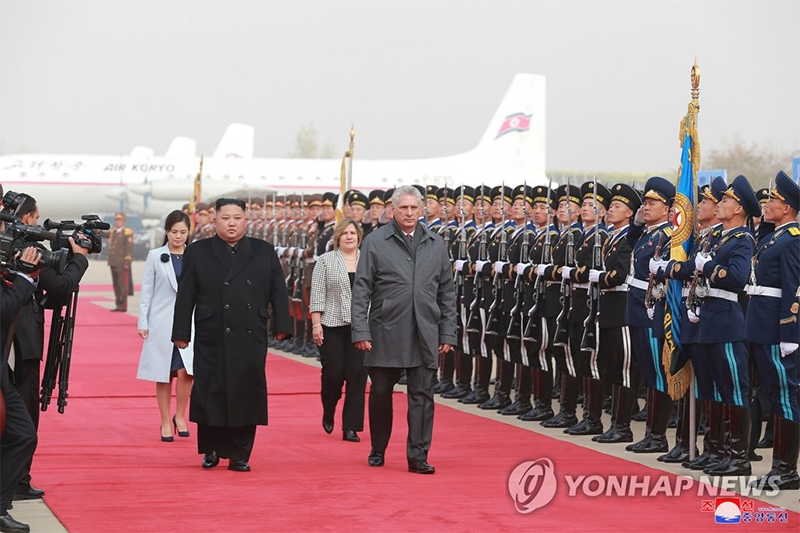
Cuban President Miguel Diaz-Canel, then Chairman of the State Council, visits Pyongyang in November 2018, inspecting an honor guard with North Korean leader Kim Jong-un. / Photo by Korean Central News Agency
North Korea, in turn, didn't hold back in praising Cuba. When Miguel Diaz-Canel succeeded Raul Modesto Castro Ruz as the Secretary-General of the Communist Party of Cuba in April 2021, Kim Jong-un sent consecutive congratulatory messages. He also extended condolences during incidents like the hotel gas leak explosion and the oil tanker explosion in Cuba the following year.
This year on January 1st, Kim sent a lengthy congratulatory message to President Miguel Diaz-Canel on the occasion of the 65th anniversary of the Cuban Revolution. North Korea's major media outlets, including Rodong Sinmun, regularly express support for Cuba's diplomatic policies or highlight remarks from key figures.
South Korea's discreet approach to establishing diplomatic relations with Cuba was influenced by the strong bond between them, aimed at preventing North Korean influence. North Korea appeared unaware of the final stages of discussions on South Korea-Cuba diplomatic relations. North Korean state media, including Rodong Sinmun, didn't cover the sudden establishment of diplomatic ties between South Korea and Cuba. Even when news reached Pyongyang of the Cuban ambassador's invitation to a diplomatic reception, it wasn't mentioned. Observers speculate that North Korea's discomfort with the new relations between South Korea and Cuba stems from feeling excluded, contrasting with the past when news about Cuba's absence was scarce.
The establishment of diplomatic relations between South Korea and Cuba is viewed as further evidence of North Korea's increasing isolation in the international community. Faced with sanctions due to its nuclear development, North Korea reduced the number of its overseas missions by nine out of 53 in the first half of last year. South Korea's diplomatic ties with Cuba, a crucial ally, have only intensified North Korea's isolation.
North Korea might have been just as taken aback by South Korea's normalization of relations with the Soviet Union in 1990 and China in 1992. Considering Kim Jong-un's special treatment of Cuba, this perceived betrayal may be especially hard for North Korea to swallow.
It is also expected to deliver a significant blow to Kim Jong-un's diplomatic ambitions, particularly his goal of forming a new anti-South Korea alliance. This development is especially impactful as it contradicts North Korea's portrayal of inter-Korean relations as "hostile relations between two states." Cuba's decision to align with South Korea rather than supporting Kim Jong-un's anti-South Korea stance is a direct blow.
While North Korea may express discontent towards Cuba amidst its shock, there's speculation that it will refrain from a severe reaction considering its relationships with other friendly nations. Some analysts suggest that North Korea is unlikely to respond aggressively enough to risk losing one of its few remaining allies.
Following Cuba's decision, North Korea is now turning its focus to strengthening ties with Russia, which it refers to as a "fraternal country," in an attempt to offset what it perceives as a "betrayal" by Cuba. This highlights the depth of North Korea's shock at losing a longstanding ally.
North Korea's surprise and confusion were evident not only after the announcement of diplomatic relations with South Korea but also when Kim Yo-jong, Deputy Director of the WPK, mentioned the possibility of a summit between North Korea and Japan, a country previously regarded as a "thousand-year enemy."
In response, South Korea's presidential office interpreted this recent diplomatic shift as the final blow to communist bloc diplomacy, including relations with past Eastern bloc countries. They emphasized that it clearly demonstrates who holds the upper hand in the course of history, anticipating significant political and psychological repercussions for North Korea.
Cuba's decision to forge diplomatic ties with South Korea despite facing strong opposition from North Korea carries significant implications. The driving force behind Cuba's decision lies in its severe economic hardships. Economic struggles have led to mass emigration from Cuba, and in July 2021, the country witnessed its largest anti-government protests since its inception. To address these serious economic challenges, Cuba opted to align with South Korea.
The Kim Jong-un regime may sense a crisis if it fails to address economic problems domestically. Recent educational materials for their citizens from North Korea indicate the emergence of organized dissenting political groups and instances of mass unrest among exploited Chinese overseas workers, highlighting severe internal issues.
The underlying cause of North Korea's economic struggles stems from the Kim regime's wasteful diversion of resources into nuclear weapons development, despite facing condemnation from the international community. Moreover, labeling South Korea as an enemy and threatening preemptive nuclear strikeshas made it increasingly challenging for even fraternal countries like Cuba to support its reckless actions. Cuba's decision to sever ties highlights the consequences of the regime's actions.
As Kim Jong-un's regime continues nuclear development and provocations against South Korea, it will likely face increased international sanctions, isolation, and eventual downfall.