

Responding to US-South Korea Joint Drills, North Korea
Implements Resident Movement Controls
and Conducts Outdoor Exercises
During the US-South Korea "Freedom Shield" drills (April 4-14), North Korea reportedly enforced movement controls and performed blackout and evacuation exercises, elevating internal tension. Amidst this, North Korea appeared to adopt a quieter approach, possibly due to major events like China's Two Sessions and Russia's presidential election, while internally intensifying its security measures.
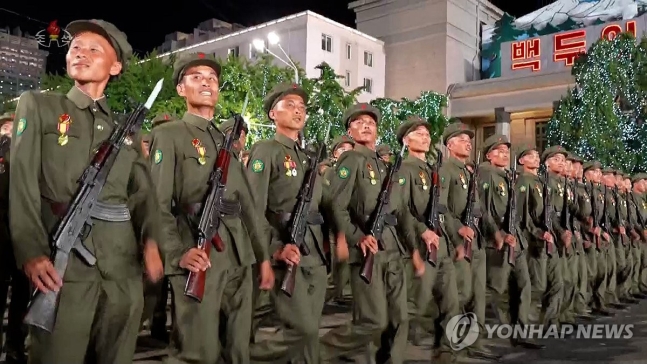
<On the 9th, Korean Central Television aired a noon recording of the Civil Defense Military Parade in Pyongyang's Kim Il Sung Square, celebrating the 75th founding anniversary of North Korea / Photo by Korean Central Television, Yonhap News Agency>
On the 15th, sources from North Hamgyong Province reported that North Korea, during the US-South Korea drills, conducted blackout and anti-aircraft exercises with civilian participation on the 12th and 13th. A Ministry of National Defense statement on the 5th criticized the joint drills, revealing the organization of internal emergency evacuations and sheltering exercises.
The sources further disclosed that on the 11th, North Korean authorities carried out blackout drills, instructing residents to cover windows and prevent light leakage upon hearing sirens.
The morning of the 12th saw the mobilization of the Worker-Peasant Red Guards and Red Youth Guards, simulating enemy air raids, fully outfitted and taking strategic positions, while the elderly, women, and children equipped with essential supplies organized a climb into the mountains.
These residents endured the night outdoors, engaging in evacuation drills, descending only after the air raid alert was lifted at 3:30 p.m. on the 13th.
Reports indicate that North Korea imposed a lockdown, barring residents from leaving their homes as the US-South Korea military drills started on the 4th, citing rising tensions. This abrupt mandate forced those away to swiftly return. The unexpected restriction, especially for those out for business or official reasons, led to considerable disarray.
This sudden order caused significant disruptions, especially for those out on business or official duties, leading to temporary paralysis in transportation, distribution, and market supply, eliciting public dissatisfaction towards the unannounced movement restrictions.
North Korea also showed a militaristically sensitive response to the "Freedom Shield" drills, with heightened internal controls.
The day following the onset of the US-South Korea drills, on the 5th, the Ministry of National Defense spokesperson vehemently criticized the "reckless military exercises" by the US and South Korea. The statement highlighted, "We face severe consequences due to the security instability from their wrong choices, as they escalate their open threats and invasion attempts against a sovereign state."
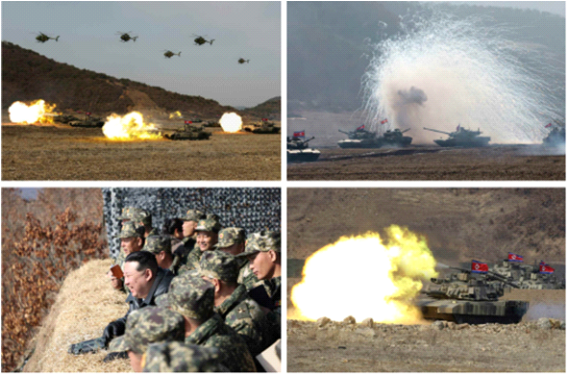
<On March 14, 2024, North Korean leader Kim Jong-un joined troops in training exercises on a new model tank / Photo by Rodong Sinmun>
State media, including the Korean Central News Agency and Rodong Sinmun, reported on the 14th that Kim Jong-un unveiled new tanks, reinforcing the resolve for war against the South, and escalating wartime rhetoric. Additionally, North Korea launched several ballistic missiles into the East Sea on the 18th, three days after the drills concluded, escalating military tensions on the Korean Peninsula.