

2024 North Korea’s Political Situation and Key Activities of High-Ranking Officials, Focused on Kim Jong-un’s Public Appearances

Lee Seung-hyun
Ph.D in Public Administration (Research Fellow at the SAND Institute)
drharacearthur@gmail.com
In 2024, as in previous years since 2020, North Korea did not deliver a formal New Year’s address by Kim Jong-un. Instead, during the 9th Plenary Meeting of the 8th Central Committee of the Workers' Party of Korea, held from December 26 to 30, 2023, North Korea officially described inter-Korean relations as "hostile relations between two states" and "a relationship between nations at war." Various policies and initiatives were implemented to enforce the meeting's decisions.
In January 2024, North Korea took concrete steps to institutionalize its hostile stance toward South Korea. This included announcing plans to dismantle the Monument to the Three-Point Charter for National Reunification in Pyongyang, revising unification-related constitutional clauses, and disbanding inter-Korean agencies.
Kim Jong-un personally inspected critical facilities, including the Key Military Vehicle Production Plant and Key Munitions Factory, and oversaw the test launch of the newly developed submarine-launched strategic cruise missile Bulhwasal-3-31. North Korea’s military also conducted hypersonic medium-range solid-fuel ballistic missile tests and strategic cruise missile exercises.
Concurrently, Foreign Minister Choe Son-hui visited Russia and China to strengthen ties with these nations. Domestically, Premier Kim Tok-hun and Chairman of the Standing Committee of the Supreme People's Assembly Choe Ryong-hae led efforts in economic and social sectors.
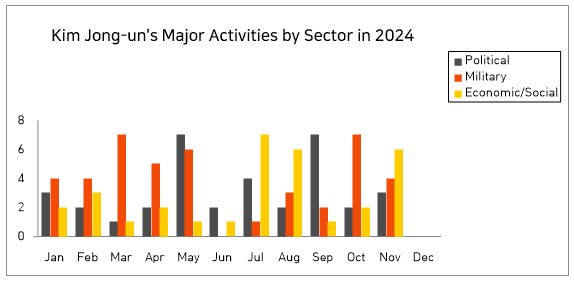
In February, Kim Jong-un made eight public appearances, with a notable focus on economic matters. Out of the total, six were related to economic site inspections and celebratory visits, while two centered on military activities.
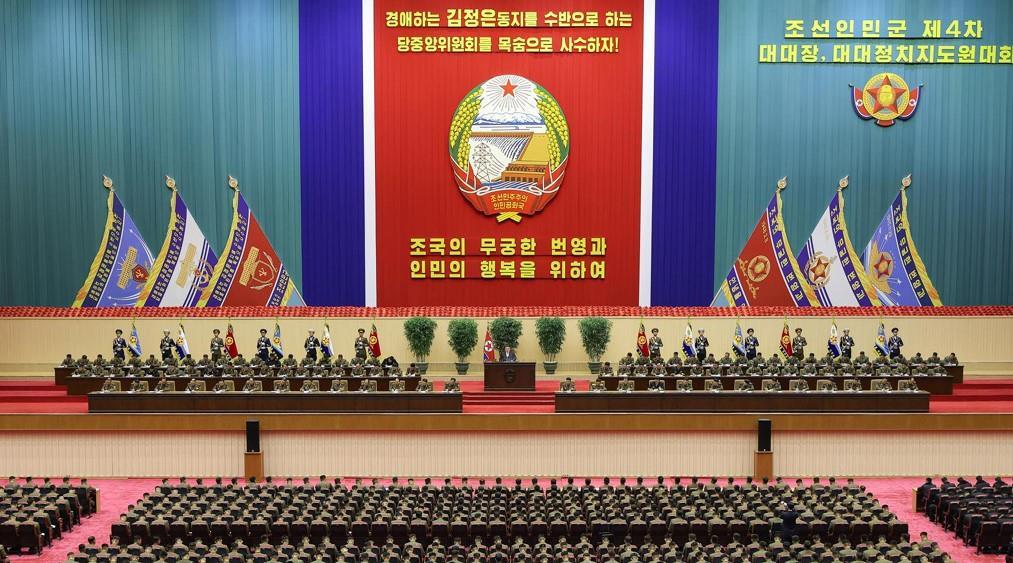
Kim Jong-un delivering a speech at the North Korean Army Battalion Commanders and Political Instructors Conference on the 15th.
/Korean Central News Agency
North Korea further entrenched its hostile stance by abolishing laws and agreements related to inter-Korean cooperation, including the Inter-Korean Economic Cooperation Law and Mount Kumgang Tourist Special Region Law. To enhance internal control, a Party Discipline Training Workshop was held, while the leadership showcased ties with Russia by publicizing President Vladimir Putin’s gift of a luxury Aurus vehicle.
Militarily, North Korea conducted three rounds of missile tests between January 28 and February 2, and Kim Jong-un emphasized naval enhancements, citing the need to "expand the role of nuclear deterrence." Economically, he promoted the 20x10 Regional Development Policy, shifting the burden of economic challenges to local regions.
March saw Kim Jong-un engage in eight public activities, with a pronounced military focus. Seven events were military-related, including inspections of artillery, armored forces, and special operations units. This emphasis reflected North Korea’s recognition of the significance of conventional and special forces, particularly in light of the prolonged Russia-Ukraine and Israel-Hamas conflicts.
In April, Kim Jong-un’s military activities remained prominent. Of his nine public appearances, five were military-related, while the remaining four were evenly divided between economic and social sectors. Kim oversaw tests of hypersonic missiles, 240mm multiple rocket launchers, and a simulated nuclear counterattack exercise, signaling preparations for the South Korea-U.S. joint drills. Economically, he attended the groundbreaking ceremony for the Hwasong Area Phase 2 project, which involved constructing 10,000 housing units, reinforcing his image as a leader committed to the people’s welfare.
In May, Kim Jong-un’s public engagements increased to 11, with military and political activities each accounting for five appearances. North Korea escalated tensions through short-range ballistic missile tests, solid-fuel missile launches, and inspections of arms production facilities, while also preparing to launch a reconnaissance satellite. These activities were aligned with North Korea’s hostile stance toward South Korea.
In June, Kim Jong-un’s public activities decreased to three: two in the political sector and one in the economic sector, likely due to a focus on Russian President Vladimir Putin’s visit to North Korea. The two leaders signed the Comprehensive Strategic Partnership Treaty, strengthening their alliance. Meanwhile, North Korea continued provocations against South Korea, including trash balloon launches and hypersonic missile tests, further escalating regional tensions.
During the second half of 2024, North Korea intensified provocations toward South Korea amid the U.S. presidential election, including continued trash balloon launches and the deployment of special forces to support Russia in the Ukraine war, highlighting stronger North Korea-Russia military ties. In July, Kim Jong-un made 12 public appearances: one military, four political, and seven economic-social. North Korea promoted Kim’s leadership through propaganda efforts, such as distributing portrait insignia to further his idolization.
In August, Kim Jong-un made 11 public appearances: two political, three military, and six economic-social. Following significant flood damage, he announced a major disaster recovery initiative, calling for a “mobilization of national capabilities,” focusing on domestic recovery and projecting an image of a leader who cares for the people. While rejecting international humanitarian aid, he emphasized self-reliance to bolster internal cohesion and control. Militarily, Kim showed little reaction to the South Korea-U.S. Ulchi Freedom Shield (UFS) exercises but attended events showcasing weapon modernization, including a new ballistic missile system delivery, kamikaze drone tests, and 240mm multiple rocket launcher inspections.
September saw a sharp military focus, with seven of Kim’s 10 public activities dedicated to military events, two to political matters, and one to economic-social affairs. North Korea escalated tensions with South Korea by launching trash balloons and testing 600mm multiple rocket launchers, along with new ballistic and strategic cruise missiles. Additionally, in conjunction with the upcoming U.S. election, North Korea unveiled its highly enriched uranium (HEU) production facility for the first time.
In October, Kim Jong-un conducted 11 public activities: two in the political sector, seven in the military sector, and two in the economic-social sector, reflecting a similar pattern to September. The Supreme People’s Assembly formally enshrined “hostile state relations” with South Korea in the constitution, further reinforcing this antagonistic stance. This move sought to bolster internal unity by increasing vigilance against external threats.
Militarily, North Korea deployed its People’s Army special forces to the Russia-Ukraine war, strengthening ties with Russia to gain battlefield experience and advance its 2013 “Three-Day War Operation Plan.” In response to South Korea’s drone leaflet operations over Pyongyang, North Korea issued major statements from the Ministry of Foreign Affairs, Kim Yo-jong, and the Ministry of National Defense, while bolstering Pyongyang’s air defense capabilities.
In November, Kim Jong-un made 13 public appearances: three political, four military, and six economic-social, with a focus on achieving year-end economic goals. Militarily, North Korea criticized the U.S.-South Korea-Japan aerial joint exercises, conducted a kamikaze drone performance test, and hosted the Defense Development 2024 arms exhibition. Politically, it published a white paper from the Institute for Research on the Enemy regarding the October “drone incident.” Strengthened ties with Russia included the signing and ratification of a North Korea-Russia treaty and the 11th North Korea-Russia Economic Joint Committee meeting.
As of December 15, Kim Jong-un has made no public appearances. Economically, he emphasized implementing the Workers' Party Plenary Meeting decisions and the “20x10 Regional Development Policy” to achieve 2024 goals. Politically, North Korea strengthened ties with Russia, marked by the Russian Defense Minister’s visit. On South Korea's “December 3 Martial Law,” North Korea remained silent for a week before starting continuous reporting on December 11, likely formulating a strategy while lacking full understanding of the situation. It is leveraging South Korea’s turmoil to criticize liberal democracy and reinforce political indoctrination.
In conclusion, North Korea’s policies in 2024 showed a focus on military activities during the first half of the year, shifting to greater emphasis on economic matters in the second half. However, significant spikes in military activity, particularly in October following the South Korean drone incident, were notable. This indicates that South Korea’s strategic indifference to North Korean provocations may help maintain regional stability. Moving forward, South Korea should prioritize vigilance against military threats while maintaining political indifference to avoid escalating tensions.
<Table 1>