


North Korea's Hypersonic Ballistic Missile Development

Jang Cheol-wun
Korea Institute for National Unification
North Korea kicked off 2025 by escalating military tensions on the Korean Peninsula with successive ballistic missile launches. On January 6, it conducted a test launch of a "new hypersonic medium- and long-range ballistic missile," followed by the launch of several short-range ballistic missiles on January 14.
Interestingly, North Korea chose to publicize the January 6 hypersonic missile test through Rodong Sinmun, while the short-range missile launches on January 14 went unreported in its media. This difference implies that the hypersonic missile test was considered more significant. Against this backdrop, this article offers a brief examination of North Korea's hypersonic ballistic missile development.
North Korea's first missile launch of 2025 was a "new hypersonic medium- and long-range ballistic missile." Rodong Sinmun reported on January 7 that the test was carried out by the Missile General Bureau under Kim Jong-un’s virtual observation. The missile was described as part of a national defense development initiative, featuring "new carbon fiber composite materials" in its engine and body construction.
North Korea claimed the missile, launched from the outskirts of Pyongyang, reached Mach 12, hitting altitudes of 99.8 km and 42.5 km during its flight, before striking a virtual target 1,500 km away in international waters. However, South Korea’s Joint Chiefs of Staff reported a different flight range, estimating the missile traveled approximately 1,100 km.
However, the hypersonic missile’s low-altitude flight may have evaded South Korea’s detection systems, leading to incomplete tracking of its trajectory. Aside from the flight distance, there are few differences between South Korea's assessment and North Korea's claims.
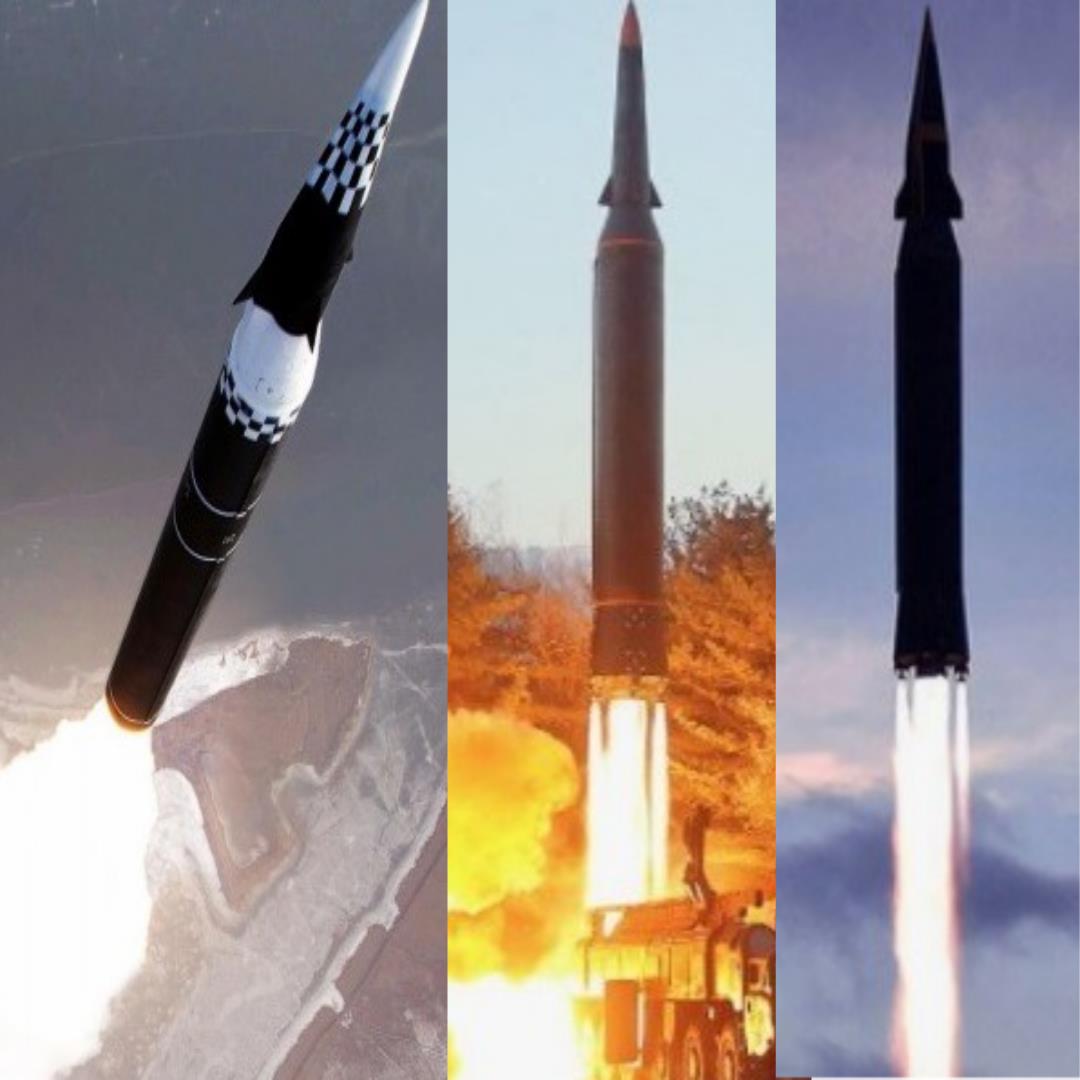
North Korea's focus on hypersonic missile development aligns with its five-year national defense strategy announced at the 8th Congress of the Workers' Party in 2021. The hypersonic warhead program is one of the "five key tasks" in this plan.
North Korea first tested a hypersonic ballistic missile, the "Hwasong-8," on September 28, 2021, and conducted another test in January 2022. Both tests involved liquid-fueled medium-range ballistic missiles equipped with hypersonic warheads.
On January 14, 2024, North Korea transitioned to using solid-fuel ballistic missiles, which offer greater survivability, for mounting hypersonic warheads.
About three months later, on April 2, 2024, North Korea tested the "Hwasong-16B," a new medium- and long-range solid-fuel ballistic missile equipped with a hypersonic glide vehicle. On April 3, North Korea announced that the missile reached peak altitudes of 101.1 km and 72.3 km before precisely hitting a target 1,000 km away in the East Sea.
Photos published by Rodong Sinmun show little visible difference between the hypersonic ballistic missile launched on January 6, 2025, and the Hwasong-16B launched on April 2, 2024. However, North Korea’s claim of using "new carbon fiber composite materials" in the engine and body of the January 6 missile is particularly notable.
North Korea has reportedly been researching advanced carbon fiber materials since the early 2000s as part of its national science and technology plan. These materials are lighter, more durable, and heat-resistant compared to conventional metals. In 2017, Kim Jong-un highlighted plans to use carbon-carbon composites in missile components, including warheads and nozzle throats.
It is likely that North Korea incorporated advancements in carbon fiber composite material research into its hypersonic missile development. This could explain why the missile launched on January 6, 2025, was lighter and achieved greater speed and range compared to the one launched on April 2, 2024.
After witnessing the January test, Kim Jong-un stated that "only a few countries worldwide possess such weapon systems" and described the missile’s development as "a defensive effort, not an act of aggression."
He also claimed the missile could "penetrate dense defense systems and inflict significant military damage," adding that it would "serve as a reliable deterrent against Pacific-region adversaries threatening North Korea’s security."
Hypersonic warheads, actively developed by advanced missile powers such as the United States, Russia, and China, differ significantly from traditional ballistic missile warheads.
Hypersonic warheads travel at speeds over Mach 5 in the lower atmosphere and perform unpredictable maneuvers, such as "pull-up" movements. These features make their trajectory hard to predict, posing significant challenges for detection and interception.
Given these factors, North Korea seems to be developing ballistic missiles with hypersonic warheads to bypass South Korea’s layered Korea Air and Missile Defense (KAMD) system and the United States' multi-layered missile defense (MD) systems, renowned for their advanced capabilities.
North Korea's hypersonic ballistic missiles remain at the "test launch" stage, indicating that their development is still incomplete. Additional time will likely be needed to finalize development, begin mass production, and deploy the missiles for operational use.