

Analysis of North Korea’s
Publicized “Nuclear-Powered Strategic Submarine”
- Is North Korea Really Constructing Its Final Nuclear-Armed Strategic Submarine? -

Choi Il
Director of the Submarine Research Institute
(PhD political science, Retired Navy Captain, First Commanding Officer of ROKS Son Won-Il)
On March 8, 2025, North Korea publicly unveiled a ‘nuclear propulsion’ submarine through the Rodong Sinmun.
The Reality of the Publicized Submarine
North Korea has named this newly revealed vessel the "Nuclear-Powered Strategic Missile Submarine." This is the first time North Korea has used the term "nuclear-powered submarine," a term that is also uncommon in South Korea.
In English, submarines are categorized based on propulsion systems as either nuclear-powered or conventional (diesel-electric) submarines. Additionally, since submarines require energy not only for propulsion but also for onboard systems, the term nuclear-powered submarine is often used to emphasize the use of nuclear energy. In South Korea, this is typically referred to as a "nuclear submarine."
Although "nuclear-powered submarine" is not a commonly used term, it essentially means the same as a "nuclear submarine." Thus, North Korea's terminology aligns with what is typically referred to as either a "nuclear propulsion submarine" or a "nuclear submarine."
Now, what does "Nuclear-Powered Strategic Missile Submarine" mean? At the September 2023 launch ceremony of the Hero Kim Kun Ok, North Korea described it as a "tactical nuclear attack submarine." Tactical nuclear weapons refer to small nuclear warheads mounted on ballistic or cruise missiles, whereas strategic guided missiles refer to large nuclear-capable ballistic missiles.
Ultimately, a Nuclear-Powered Strategic Missile Submarine refers to a nuclear-powered submarine armed with nuclear-tipped strategic ballistic missiles (SLBMs), which is commonly known as a nuclear-powered ballistic missile submarine (SSBN).
Why North Korea is Building an SSBN
North Korea's ultimate objective is to develop the capability to launch nuclear strikes against the U.S. mainland. If the United States perceives a direct nuclear threat to its homeland, it may hesitate to intervene in a Korean Peninsula conflict, potentially enabling North Korea to pursue its goal of unifying the peninsula under its control.
While North Korea is extending the range of its ICBMs (Intercontinental Ballistic Missiles) to reach the U.S., an even greater threat would be a submarine launching nuclear ballistic missiles from waters near the U.S. coastline.
North Korea's Pukkuksong series SLBMs are designed for such underwater launches. The country aims to operationalize an SSBN that can carry multiple SLBMs and conduct extended-period missions, further strengthening its nuclear deterrence.
Analysis of the Released Submarine Footage
Size
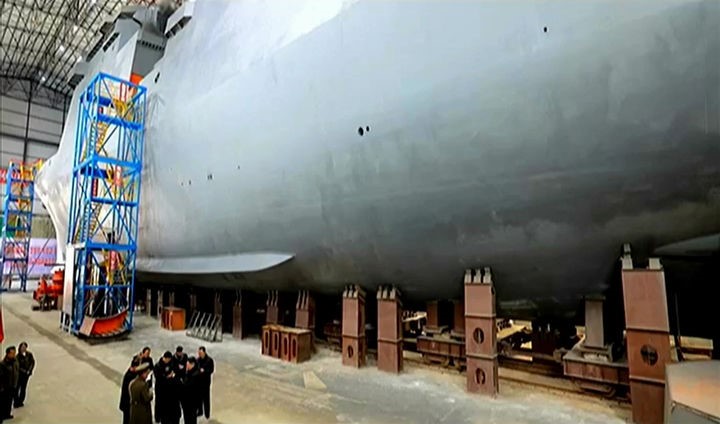
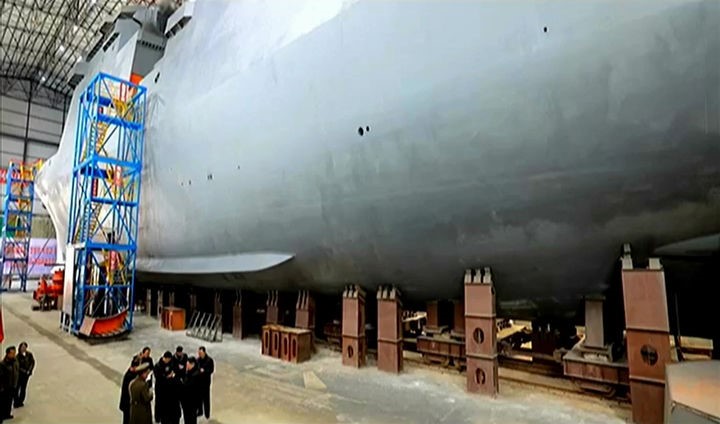
North Korea released two submarine images, but its full length is unclear. Based on individuals' height and proportions, the diameter is estimated at about 12.5 meters.
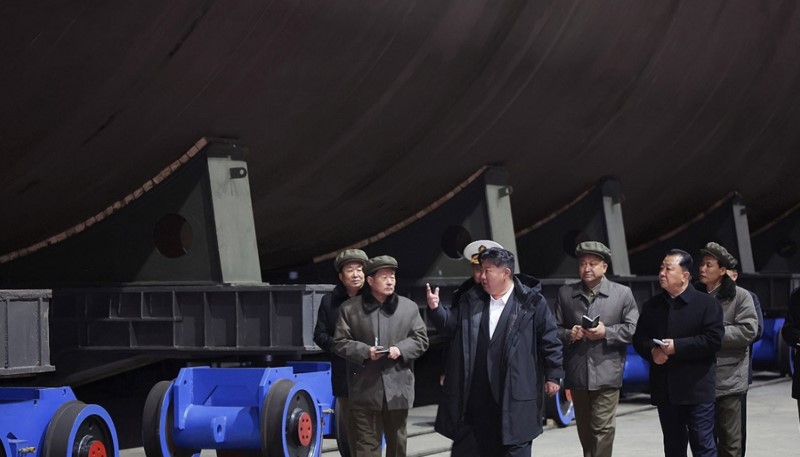
This measurement is comparable to existing SSBNs worldwide. The UK’s Vanguard-class SSBN (16,000-ton submerged displacement) has a 12.8-meter diameter, while France’s Triomphant-class (14,300 tons, submerged) measures 12.5 meters. China’s Jin-class (11,000 tons, submerged) has a diameter of 11.8 meters, and the U.S. Virginia-class nuclear-powered attack submarine (SSN) is 10 meters wide. Although the submarine’s length remains uncertain, its diameter suggests a displacement exceeding 10,000 tons.
Construction Progress
Poor image quality and angles make analysis difficult, but the submarine doesn’t seem to be under active construction. A construction site is usually busy, yet the images suggest otherwise.
If it were near completion and preparing for launch, its hull would appear more refined, but instead, it looks far from finished. The current state suggests that construction may have stalled.
If North Korea were truly constructing an SSBN, it would likely adopt a double-hull design influenced by China or Russian collaboration. However, the released images suggest a single-hull structure, raising further doubts.
Additionally, the hull appears overly simplistic, lacking visible sensors or penetration ports. The smooth, unmarked exterior gives the impression of a cylindrical metal casing rather than an actual submarine.
Moreover, despite the poor image quality, the hull appears to have been painted a long time ago, with visible signs of wear. This raises questions about whether the structure is an actual submarine hull or merely a land-based test model.
Reasons for Revealing an Unfinished Submarine
Typically, a national leader attends the launch of a completed submarine, but this time, North Korea revealed an unfinished vessel. The key point in their announcement was that Kim Jong-un personally inspected shipbuilding projects at major shipyards, including a submarine under construction. Facing growing maritime threats from South Korea-U.S. naval exercises, a U.S. aircraft carrier deployment, and a nuclear-powered submarine docking in South Korea, North Korea sees naval modernization as urgent. By showcasing warships, it aims to emphasize its expansion and modernization efforts.
Prospects for Russian Technical Support for North Korean Submarines
If North Korea were to receive compensation from Russia in exchange for dispatching troops to the Russia-Ukraine war, the most likely form of support would be military technology to enhance its naval power, particularly submarine technology.
Possible assistance from Russia could include nuclear reactor technology for submarines, design and construction expertise for nuclear-powered submarines, or even leasing an entire submarine. This support could extend beyond nuclear-powered submarines to conventional submarines as well.
However, it seems unlikely that the submarine North Korea revealed would incorporate a Russian nuclear reactor. The images suggest that its design and construction began before the Russia-Ukraine war, making it improbable that North Korea initiated the project expecting to receive Russian reactor support later.
Conclusion
If North Korea successfully builds an SSBN equipped with SLBMs, it would pose a significant threat not only to South Korea but also to global security. While this warrants close monitoring, it is essential not to overstate the immediate threat.
At the September 2023 launch ceremony of the submarine Hero Kim Kun Ok, Kim Jong-un stated that existing medium-sized submarines (Romeo-class) would be converted into tactical nuclear-weaponed submarines and that future plans included the construction of new submarines, including nuclear-powered ones.
If Kim Jong-un’s plans had been progressing as announced, the Hero Kim Kun Ok should already be operational, with additional units deployed. However, no such developments have materialized.
In this context, North Korea is once again seeking attention with claims of building a nuclear-powered submarine. So far, its provocations have been largely symbolic, with little tangible progress.
The Pukguksong series of submarine-launched ballistic missiles, small ballistic missiles, the nuclear torpedo Haeil, submarine-launched cruise missiles (SLCMs), and the Hero Kim Kun Ok submarine have all been showcased to draw attention, yet none have entered full operational service.
In July 2019, Kim Jong-un publicly inspected a new submarine under construction, but the vessel has since vanished.
While North Korea’s goal of constructing an SSBN is clear, achieving this ambition will take considerable time. Instead of overreacting to its provocations, a rational approach should be taken—one that assesses North Korea’s technological limitations and prepares appropriate countermeasures.