

North Korea’s 80th Party Founding Anniversary: Assessment and Outlook of Its External Messaging

Yonghwan Choi
Institute for National Security Strategy
A Predictable Celebration, Yet Signals Worth Watching
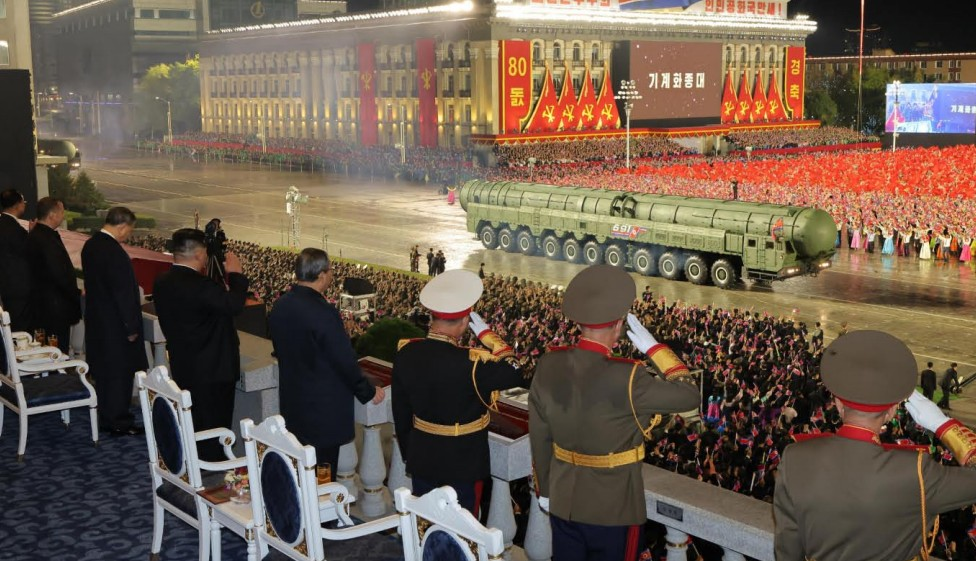
On October 10, North Korea marked the 80th anniversary of the founding of the Workers’ Party of Korea with an elaborate celebration, including a military parade and the unveiling of new weapons systems. Despite the scale of the festivities, international reactions were largely muted. The event’s structure, tone, and messaging aligned closely with expectations. Even the centerpiece—the Hwasong-20 intercontinental ballistic missile (ICBM), described by Pyongyang as its “most powerful nuclear weapon”—was already familiar to the world.
As anticipated, senior delegations from China and Russia attended, and Kim Jong Un was seen at the parade reviewing stand flanked by Chinese Premier Li Qiang and Russian Security Council Deputy Chairman Dmitry Medvedev. While the optics reinforced trilateral solidarity, the imagery was not new—similar scenes were observed during China’s Victory Day parade on September 3.
Nevertheless, several noteworthy elements distinguish this year’s commemoration.
Expanded Diplomatic Outreach to Southeast Asia
While the Chinese and Russian delegations drew the most attention, North Korea also welcomed representatives from Vietnam, Laos, and Indonesia. Vietnam’s Communist Party General Secretary To Lam, Laotian President Thongloun Sisoulith, and Indonesian Foreign Minister Retno Marsudi were all in attendance—reflecting Pyongyang’s interest in expanding diplomatic ties beyond its traditional partners.
In particular, To Lam’s presence beside Kim Jong Un and Premier Li Qiang during the military parade signaled Hanoi’s willingness to balance its outreach to both Koreas. Kim also held bilateral meetings with the Vietnamese and Laotian leaders, and Foreign Minister Choe Son Hui met with Indonesia’s foreign minister—the first such visit from Jakarta in 12 years.

However, these engagements occur in a complex diplomatic context. Vietnam’s leader had paid a state visit to South Korea in August, adopting a Joint Statement on Deepening the Comprehensive Strategic Partnership. Seoul and Hanoi pledged to expand bilateral trade to $150 billion by 2030, as both are each other’s third-largest trading partners. Similarly, South Korea and Indonesia maintain a “Special Strategic Partnership” spanning defense, industry, and culture.
Notably, Vietnam, Laos, and Indonesia are all members of the ASEAN Regional Forum (ARF)—the only regional multilateral security platform that includes both Koreas. Their simultaneous engagement with Pyongyang and Seoul raises questions about how North Korea might seek to leverage Southeast Asian neutrality to expand its diplomatic maneuvering space.
Military Signaling and Technological Showcase
North Korea once again used the occasion to highlight advances in its strategic arsenal. Among the weapons displayed were the Hwasong-20 ICBM, the Hwasong-11M hypersonic short-range ballistic missile, and the Hwasong-16 hypersonic medium-range ballistic missile. The Hwasong-20 drew particular attention amid speculation that it may feature a multiple independently targetable reentry vehicle (MIRV) system.
Yet these systems, while symbolically powerful, are operationally constrained—usable only as “last resort” deterrents. What stood out instead was the relative absence of new conventional weapons systems, despite Kim’s repeated emphasis on modernizing North Korea’s navy, air force, and armored divisions.
During a September 11–12 visit to the Academy of National Defense Science, Kim indicated that the upcoming 9th Party Congress (expected next year) would formally present the “dual advancement policy of nuclear and conventional forces.” Recent efforts to enhance tank units, early-warning aircraft, submarines, and destroyers suggest Pyongyang’s ambition to diversify beyond nuclear deterrence.
However, neither nuclear-powered submarines nor military reconnaissance satellites—projects previously announced at the 8th Party Congress—were visible in this parade, raising questions about their development status.
Muted Rhetoric Toward the U.S. and South Korea
Kim Jong Un delivered multiple public speeches in early October—at the Pyongyang General Hospital completion ceremony (Oct. 7), the 80th Party anniversary event (Oct. 9), and the military parade (Oct. 10). Notably, explicit references to the United States or South Korea were either minimal or absent.
This restraint contrasts with his late-September address to the Supreme People’s Assembly, where Kim reaffirmed that North Korea “will no longer engage in anything” with South Korea and suggested that dialogue with Washington could resume only if the U.S. abandoned its “obsession with denuclearization.” Remarkably, he also referenced his “personal memories” with former President Donald Trump—an unusual personal touch for Kim.
The absence of anti-U.S. or anti-South Korea rhetoric at the anniversary event may reflect tactical restraint. Surrounded by delegations from ASEAN and key trading partners, Pyongyang likely sought to project a more “normal state” image on the multilateral stage. This pattern—harsh criticism at domestic or military-focused events, coupled with moderation in international settings—suggests a deliberate calibration of North Korea’s messaging.
Outlook: Continuity and Caution in North Korea’s Diplomacy
1. Sustained China–Russia Alignment, but Uneasy Balance
North Korea’s alignment with China and Russia will likely persist, though it remains a pragmatic, not ideological, partnership. Beijing has resisted fully embracing a new Cold War bloc structure, mindful of its economic interdependence with the West. In contrast, Pyongyang and Moscow—both under heavy sanctions—seek to expand their “anti-Western” strategic coordination, but with asymmetric motivations and capacities.
Whether this triad evolves into a genuine trilateral partnership or remains an ad hoc alignment of convenience will shape the Korean Peninsula’s strategic environment in the years ahead.
2. Possibility of Renewed U.S.–North Korea Dialogue
Kim’s reference to his personal rapport with former President Trump—his first direct mention of such ties—signals Pyongyang’s lingering interest in leader-level diplomacy. Given Trump’s unique willingness to engage, North Korea may view any potential future Trump administration as a narrow window of opportunity.
However, should U.S.–North Korea dialogue resume, Seoul risks being sidelined, as Pyongyang has repeatedly expressed preference for direct bilateral talks with Washington. South Korea’s challenge will be to ensure that any revival of U.S.–North Korea diplomacy contributes to broader inter-Korean stability, rather than marginalizing Seoul’s role.
3. Emergent Multilateral Diplomacy
Kim Jong Un’s attendance at China’s military parade in September, breaking precedent for North Korean leaders, and the presence of numerous Southeast Asian dignitaries at the 80th anniversary both point to Pyongyang’s tentative reentry into multilateral diplomacy.
Kim Yo Jong’s August 20 statement—referencing a “regional diplomatic stage unfolding with our state at its center”—further underscores this ambition. Should North Korea expand participation in regional forums alongside resumed dialogue with Washington, Seoul and its allies will face new diplomatic and security challenges in managing Pyongyang’s reemergence as a regional actor.
Conclusion
North Korea’s 80th Party founding anniversary underscored both continuity and subtle recalibration in its external messaging. While reaffirming alignment with China and Russia, Pyongyang also tested a more cautious, internationally palatable tone. The regime’s balancing act—between military assertion and diplomatic normalization—warrants close observation as it prepares for the 9th Party Congress and seeks to redefine its role in a shifting regional order.
-
PREV [North Korea Inside]
-
NEXT [North Korea Inside]