

Monthly Trends in North Korea: November 2025
- Institutional consolidation, military signaling, and parallel responses to external pressure -

Lee Seung-hyun
Ph.D in Public Administration
Research Fellow, SAND Institute
North Korea’s political and security dynamics in November 2025 indicate a period in which the regime sought to consolidate internal control mechanisms, reinforce military signaling, and respond assertively to external pressure. According to state media reports, Chairman Kim Jong-un conducted nine public engagements during this month, one fewer than in October.
Despite the slight numerical decline, the substance and sequencing of his activities conveyed a more deliberate and systematized approach to governance. His consecutive visits to key state security institutions, including the Ministry of State Security, the Ministry of Social Security, and the Ministry of Justice, timed around their respective 80th anniversaries, underscored the regime’s emphasis on restructuring internal control systems and tightening ideological discipline.
Kim Jong-un’s public appearances were distributed across the following sectors: military (three), economy/industry (two), society/health (two), and politics/diplomacy (two). Whereas his activities in October leaned comparatively toward economic and social issues, his activities in November highlighted security, military, and judicial affairs as the principal areas of focus.
This shift appears closely aligned with the regime’s three concurrent policy trajectories: strengthening military readiness and operational capabilities; reinforcing institutional power structures and domestic surveillance; and publicizing progress in local development initiatives.
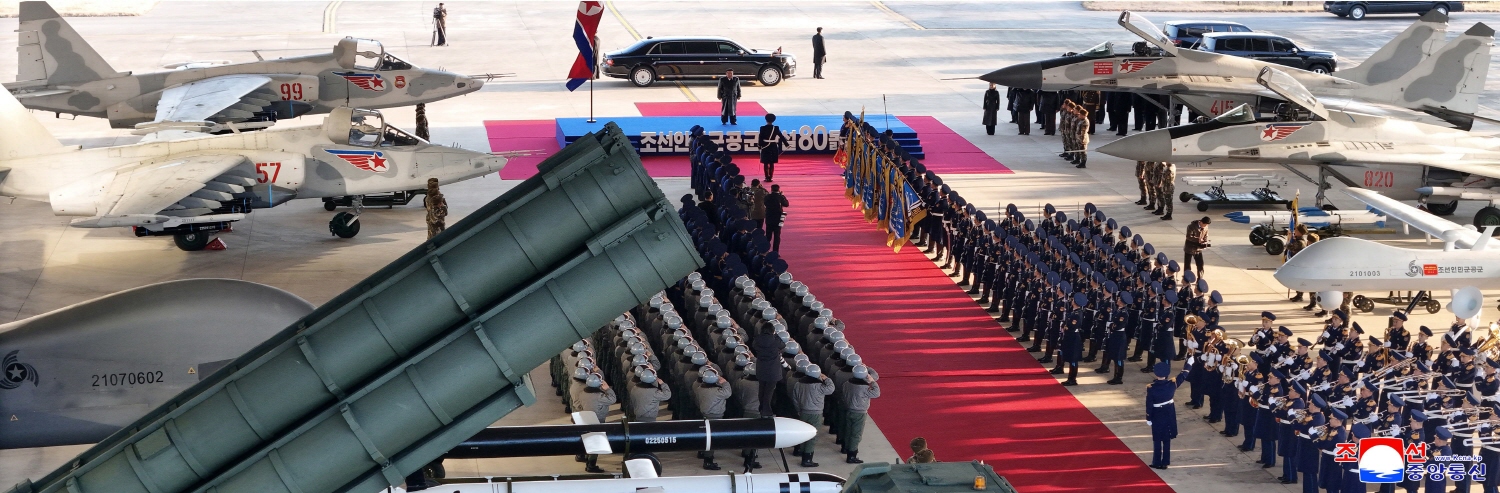
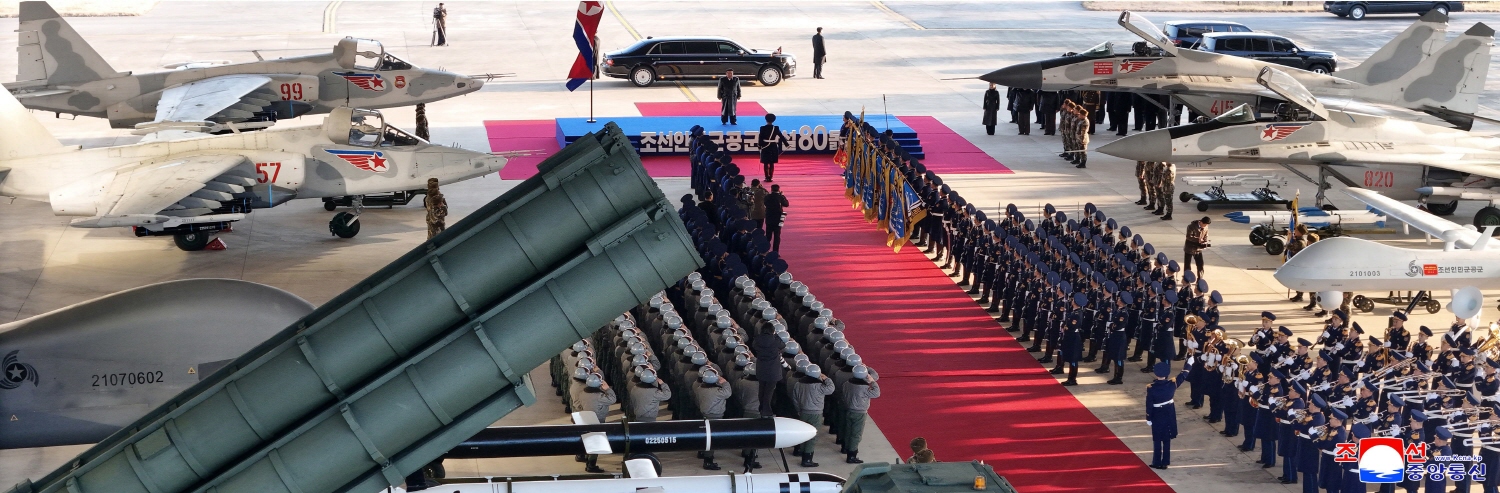
Kim’s visit to the 11th Corps headquarters and his attendance at the Air Force’s 80th anniversary event were especially notable. The subsequent unveiling of strategic weapons and new Air Force platforms suggested heightened military messaging aimed at both domestic and international audiences.
Externally, North Korea maintained a confrontational posture, issuing a series of official statements criticizing U.S.–ROK joint military exercises and additional U.S. sanctions. Statements released in the names of Vice Foreign Minister Kim Un-chol, Defense Minister No Kwang-chol, and Foreign Minister Choe Son-hui suggest a coordinated messaging strategy.
The statement responding to the G7 joint declaration reiterated Pyongyang’s narrative of safeguarding its “nuclear weapons state status” and ensuring “strategic balance,” while warning of unspecified “corresponding countermeasures” against what it characterized as unilateral U.S. actions. Relations with friendly states remained stable; the visit by Laos’ foreign minister was likely aimed at maintaining a minimal but functional level of diplomatic engagement.
In the economic and social spheres, the regime concentrated on highlighting achievements attributed to the 20×10 regional development initiative. Kim Jong-un’s on-site attendance at the completion ceremonies for the Hoeryang County People’s Power Plant and the Gangdong County Hospital received prominent coverage in state media.
Such efforts appear designed to signal that livelihood improvement and local development remain national priorities. However, reporting remained tightly curated, with no acknowledgement of chronic shortages in materials, energy, or distribution capacity.
Harvest consolidation and settlement activities were also mobilized for nationwide propaganda, while a series of scientific, technological, and healthcare exhibitions, as well as cultural and athletic events, were orchestrated to reinforce internal unity.
Taken together, the North Korean leadership appears to have pursued year-end domestic stabilization through four primary lines of effort:
• strengthening institutional control mechanisms;
• upgrading and showcasing military capabilities;
• maintaining a defensive stance in external relations; and
• strategically leveraging local development outcomes to bolster internal legitimacy.
Although the total number of Kim Jong-un’s public appearances declined, his concentrated visits to core power institutions, particularly those responsible for security and judicial affairs, clearly reflect an intention to reaffirm the authority of coercive state apparatuses. Meanwhile, the unveiling of new strategic assets during the Air Force anniversary event conveyed an unambiguous military message.
Looking ahead to the year-end period and early 2026, several indicators merit close monitoring to assess North Korea’s strategic trajectory:
• potential deployment or operational testing of new Air Force and unmanned aerial vehicle (UAV) capabilities;
• changes in the frequency, tone, and targets of external messaging;
• the effectiveness of ongoing regional development initiatives and the scale of subsequent project completions; and
• any renewed increase in Kim Jong-un’s public activity in the military domain.
-
PREV [North Korea Inside]
-
NEXT [North Korea Inside]