

Kim Jong Un Attends Completion Ceremony for Saebyeol Street with Daughter Ju-ae, Underscoring Emerging Succession Signals
North Korea has formally declared that it has fulfilled its pledge to construct 50,000 housing units in Pyongyang, a flagship objective announced at the Eighth Congress of the Workers' Party of Korea in 2021. With the Ninth Party Congress approaching, the timing and presentation of this achievement appear calibrated to frame the past five years as a period of measurable progress in civilian living standards, while simultaneously reinforcing regime narratives of resilience under sanctions.
The unveiling of the Saebyeol Street housing complex—reportedly designated for families of soldiers killed during overseas deployments—served not only as an urban development milestone, but also as a politically resonant gesture of state compensation and recognition.
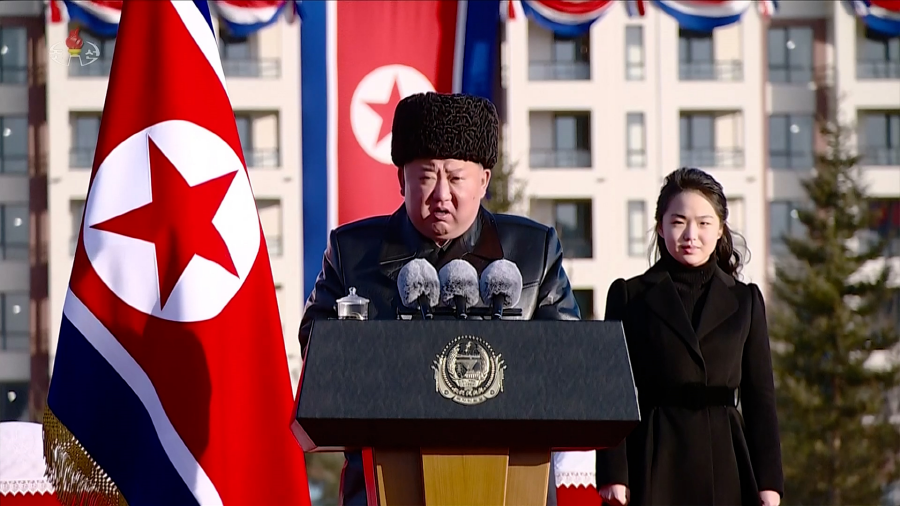
Chairman Kim Jong Un attended the completion ceremony alongside his daughter, Ju-ae, and his wife, Ri Sol-ju. State media highlighted images of Kim engaging directly with residents—embracing new occupants and even holding a puppy during a visit to a commercial facility—scenes that appeared carefully staged to project the image of a leader personally invested in the welfare of ordinary citizens. The visual messaging reinforced portrayals of Kim as both a “people-first” statesman and a paternal, family-oriented figure.
Five-Year Capital Construction Plan Concludes with Fulfillment of 50,000-Unit Target
On February 17, the official party daily Rodong Sinmun reported that the completion ceremony for the fourth phase of the Hwasong District—comprising 10,000 housing units—was held on February 16, marking what it described as the “grand conclusion” of the five-year capital construction initiative. The date coincides with the birth anniversary of Kim Jong-il, a symbolic national holiday, thereby amplifying the political significance of the event.
The 50,000-unit housing campaign has been one of the most visible urban policy commitments endorsed at the Eighth Party Congress. The plan called for the construction of 10,000 apartments annually over five years to alleviate chronic housing shortages in the capital. According to state accounts, Phases 1 through 4 were carried out sequentially in the Hwasong area, beginning with the Songsin and Songhwa districts and culminating in what authorities describe as the project’s successful completion.
The newspaper claimed that “nearly 60,000 residential units and public buildings” had been erected—framing the outcome as an “overfulfillment” of the original target. Such language appears designed to underscore economic performance despite ongoing international sanctions and pandemic-related constraints. Independent verification of occupancy rates, infrastructure reliability, and service provision—particularly electricity and water supply—remains limited, although commercial satellite imagery confirms large-scale structural completion.
In his remarks at the ceremony, Kim characterized the initiative as “not merely a construction endeavor, but a practical demonstration of our party’s people-first ideology.” He credited the outcome to the “absolute loyalty” of builders and workers who implemented party directives “under the most difficult conditions.”
He further argued that the emergence of new streets in Pyongyang constitutes a “measure of the nation’s pace of advancement and level of civilization,” insisting that socialist development must translate into visible improvements in everyday life rather than remain rhetorical.
Looking ahead, Kim signaled that the forthcoming Ninth Party Congress would articulate “even more ambitious goals” for both capital construction and regional development, suggesting that urban infrastructure will remain central to the regime’s performance claims.

Saebyeol Street: Compensation, Commemoration, and Political Messaging
The housing milestone coincided with the inauguration of Saebyeol Street, reportedly constructed for the families of soldiers who perished during overseas deployments, including personnel associated with the Russia–Ukraine conflict. State media reported that Kim attended this ceremony on February 16 with his daughter, Ju-ae. The complex, located in a prime section of the Hwasong District, has been framed as a privileged residential zone.
In his address, Kim described the fallen soldiers as “heroes of our era” who sacrificed their lives in defense of national dignity and honor. He pledged that “the party and the state will never forget their sacrifice” and committed to ensuring that bereaved families receive preferential treatment and sustained societal support. He further asserted that Saebyeol Street would serve not only as housing, but also as an “educational space” where the spirit of heroism would be transmitted to future generations.
This rhetoric suggests an effort to institutionalize the narrative of sacrifice and compensation, transforming potentially sensitive questions about overseas casualties into symbols of loyalty and patriotic virtue. Reports indicate that Kim also inspected commemorative sculptures at the Mansudae Art Studio and visited the construction site alongside senior military officials. Such actions appear intended to embed the project within both military prestige and ideological education.
Analysts assess that visible compensation mechanisms may serve to mitigate domestic discontent and legitimize controversial deployments by framing them as meritorious national service. The allocation of a distinct residential district in Pyongyang—a city where residency privileges are tightly controlled—further underscores the regime’s intent to convey exceptional honor to the families involved.
-
PREV [NK Focus]
-
NEXT [North Korea Inside]