

North Korea Inside
· Kim Jong Un Observes Test Launch of Strategic Cruise Missile
· Kim Yo-jong Warns South Korea-U.S. Drills Could “Lead to Horrific Consequences”
· North Korea Aims to Construct Hundreds of Thousands of New Housing Units Over Five Years

Kim Myong-sung

According to the report, the missiles flew over the West Sea for approximately 11,160 to 11,380 seconds—roughly 2 hours, 48 minutes, and 58 seconds—before striking designated island targets. Photographs released by North Korea showed multiple missiles being launched sequentially from the destroyer.
Military experts assess that the test goes beyond a routine weapons performance check, signaling a deliberate effort to demonstrate a nuclear counterstrike capability at sea, commonly referred to as “second-strike capability.” The Arrow-series cruise missiles developed by North Korea are reported to be capable of carrying the Hwasan-31, which Pyongyang claims is a tactical nuclear warhead.
Kim Jong-un emphasized advancements in the operational capabilities of North Korea’s nuclear forces. He stated that maintaining and expanding a powerful and reliable nuclear war deterrent is a critical strategic task, noting that the components of the country’s nuclear deterrent are now being effectively and rapidly integrated into a highly sophisticated operational system. He further asserted that the national nuclear force has entered a multi-faceted operational stage.
He further emphasized that significant progress has been made in the practical deployment and operationalization of both strategic and tactical strike capabilities, adding that confidence grounded in verified capabilities enables the country to take the initiative in military operations for national defense.
Observers suggest that North Korea’s public emphasis on its sea-based nuclear strike capability may be linked to recent developments in the Middle East. The display is widely interpreted as a signal that, unlike Iran—where senior leadership figures were rapidly targeted and eliminated through U.S. military operations—North Korea possesses credible retaliatory capabilities grounded in its nuclear arsenal. At the same time, it is seen as sending a deterrent message in the context of the South Korea–U.S. combined exercise, Freedom Shield.
Kim Jong-un also outlined armament plans for future destroyers and the broader direction for strengthening naval power. Regarding ship armaments, he directed that high-speed maneuvering vessels under 3,000 tons be equipped with shipboard automatic cannons. For 5,000-ton and 8,000-ton destroyers, he instructed that hypersonic weapon systems be installed in the space designated for shipboard automatic cannons, specifying that this measure should be implemented starting with the third vessel.
He also ordered the completion of evaluations of naval vessels’ operational capabilities, including maneuvering, anti-aircraft, anti-submarine, and mine-warfare systems, with results to be delivered to the navy within the established deadline. In addition, he directed the advancement of another destroyer construction project timed to coincide with the anniversary of the ruling party’s founding on October 10. Tasks to reinforce existing naval bases and establish new infrastructure were also outlined.
Kim Yo-jong, Vice Department Director of the Workers’ Party of Korea, warned on March 10 that the South Korea–U.S. joint exercise, Freedom Shield, could lead to “horrific consequences” if mishandled.
She refrained from directly criticizing the United States, prompting interpretations that she may have deliberately left the door open for potential dialogue with Washington.
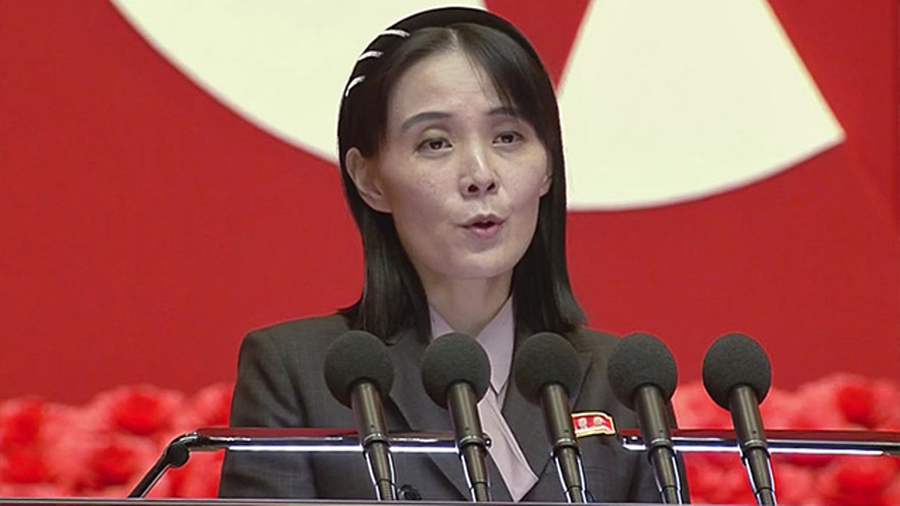
Vice Department Director Kim made these remarks in a statement titled “Our State’s Will to Defend Peace and Security on the Korean Peninsula and in the Region is Firm,” which was released through the Korean Central News Agency (KCNA).
South Korea and the United States are conducting the Freedom Shield exercise from March 9 to 19. This year’s exercise involves approximately 18,000 troops, a scale similar to last year. However, field maneuver training involving the movement of actual forces has reportedly been reduced by more than half compared with the previous year under the Yoon Suk-yeol administration.
Regarding the exercise, Kim stated that it constitutes a provocative and aggressive demonstration by forces simulating and planning confrontation with North Korea, adding that although the exercise is described as “annual” and “defensive,” the openly confrontational nature of the large-scale field maneuvers remains unchanged.
Kim warned that the hostile forces’ military show of force could easily lead to unimaginably horrific consequences, adding that the enemy must never attempt to test North Korea’s patience, will, or capabilities.
She further stated that recent global geopolitical crises and complex international incidents demonstrate that there is no meaningful distinction between defense and offense, or between exercises and actual combat. Kim argued that this reality underscores the necessity of overwhelming, preemptive, and super‑powerful offensive measures rather than proportional responses.
The geopolitical crises and international incidents referenced by Kim are widely interpreted as referring to the ongoing joint military actions by the United States and Israel against Iran and the U.S. operation that resulted in the ouster of Venezuela’s president, Nicolás Maduro.
Unlike past statements condemning South Korea–U.S. joint exercises, Kim did not directly criticize the United States. Instead, she primarily used terms such as “enemy states” and “enemies,” explicitly mentioning “the United States and South Korea” only once.
The statement did not include the term “nuclear force”; rather, it referred indirectly to such capabilities as “the most powerful offensive capability.”
This statement marks Kim’s first public message since her promotion to Director of the General Administration Department at the Ninth Party Congress last month. Analysts interpret this as suggesting that, in addition to overseeing the party’s administration and financial affairs, she may now also be assuming the established role of managing messaging on inter-Korean and U.S. affairs.
North Korea Aims to Construct Hundreds of Thousands of New Housing Units Over Five Years
North Korea has announced a target to construct hundreds of thousands of new housing units over the next five years, marking a significant expansion beyond the 50,000-unit supply target set in 2021.

According to the Rodong Sinmun on March 7, in an article titled “Five Years Ago and Today: What Has Changed?”, the Ninth Party Congress outlined this ambitious goal, aiming to deliver hundreds of thousands of residential units over the next five years.
The newspaper stated that, in response to this vision and blueprint, people across the country are confidently imagining the new streets and villages that will take shape over the next five years, while builders express strong confidence in their ability to complete these large-scale projects.
This marks the first time North Korea has publicly announced housing supply targets—even in approximate terms—since the Ninth Party Congress. At the Eighth Party Congress in 2021, the government set a target of providing 50,000 housing units in the capital, Pyongyang.
Subsequently, approximately 60,000 units were reportedly completed. The Ninth Party Congress also noted that the construction of rural housing in cities and counties had been actively promoted, allowing more than 110,000 agricultural workers to move into newly built homes.
At last month’s completion ceremony for 10,000 housing units in Phase 4 of Pyongyang’s Hwasong District, Kim Jong-un stated that more ambitious milestones and creative goals would be set in the future, though he did not provide specific figures. Reports from the Party Congress similarly referred only in broad terms to capital construction and local development projects as the party’s most important undertakings, alongside references to large-scale construction tasks.
Kim Jong-un’s focus on housing supply was also reflected in personnel appointments within the party leadership. At the Party Congress, Kim Jong-gwan was appointed both Secretary and Department Director of the Workers’ Party; he previously served as deputy prime minister overseeing construction. The Party Congress also saw the establishment of a new Construction Sector Council among the sector-specific research and consultation meetings.
Following the conclusion of the congress, Kim Jong Un visited the Sangwon Cement Complex, urging increased production and emphasizing that even greater tasks and challenges lie ahead for the enterprise during the Ninth Party Congress period.
-
PREV [NK Focus]
-
NEXT [NK Focus]