

Trends in Recent Events Commemorating the 114th Anniversary of President Kim Il-sung’s Birth
North Korea held a range of commemorative events marking the 114th anniversary of President Kim Il-sung’s birth (April 15) and saturated state-run media with content glorifying his legacy.
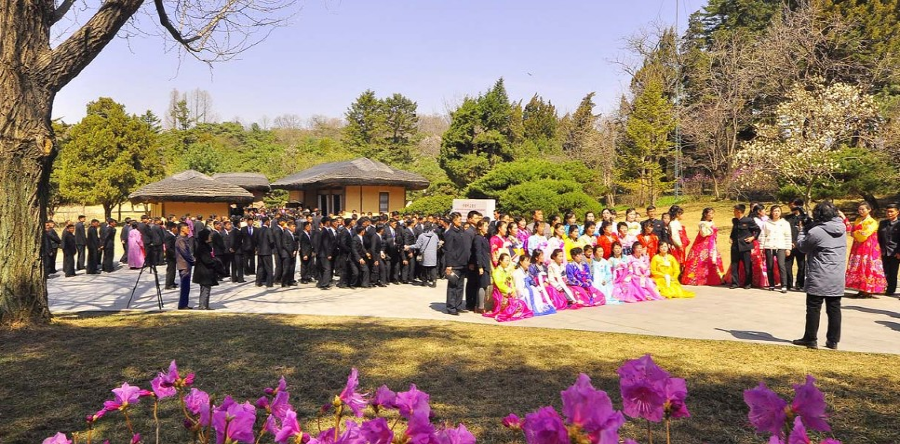
North Korean media emphasized the spirit of “Putting the People First” (Iminwicheon), a governing principle attributed to Kim Il-sung, and called on residents to demonstrate loyalty to the Party and the state. Notably, state media once again refrained from using the term “Day of the Sun,” traditionally associated with Kim Il-sung’s birthday. This shift is widely interpreted as an effort to recalibrate the prominence of past leaders in order to reinforce Kim Jong-un’s independent authority.
In an editorial titled “The ‘People-First’ Ideology of the Great Leader Comrade Kim Il-sung Is the Eternal Political Philosophy of Our Party and State,” published the same day, the Rodong Sinmun, the official newspaper of the Workers’ Party of Korea, asserted that the “People-First” ideology embodies a governing principle in which the people are to be served and regarded as the ultimate source of authority.
The newspaper further emphasized that “the political philosophy of ‘The People Are Supreme,’ which the Great Leader (Kim Il-sung) consistently embodied in Party and state affairs, was faithfully carried forward by the Great General (Kim Jong-il) and continues to be advanced under the leadership of the Respected General Secretary (Kim Jong-un),” thereby underscoring the hereditary continuity of this ideological framework within the Kim family.

The newspaper continued, “Our cause, which steadfastly upholds the ideology of ‘The People First’ as the eternal political philosophy of the Party and the state and as the banner of struggle and progress, is invincible,” and further urged that “we must advance with renewed resolve and confidence to accelerate the realization of the Workers’ Party of Korea’s ideals, which place the promotion of the people’s welfare at the center of its mission, in pursuit of the victory of the Juche revolutionary cause.”
North Korean authorities also appeared to mobilize religious narratives to reinforce the personality cult surrounding Kim Il-sung. On April 9, Rodong Sinmun introduced an anecdote involving a pastor who reportedly referred to Kim Il-sung as “the God of Korea.” This framing appears to be an effort to elevate Kim Il-sung’s status through religious symbolism and reinforce regime legitimacy.
In an article titled “Our Leader, Who Lives Forever in the Hearts of the People: The Great Man’s Sublime View of the People,” the newspaper recounted an episode from the post-liberation land reform period. According to the report, a religious figure residing in Ryonggang County, South Pyongan Province, was designated as a landlord and subjected to property confiscation and relocation orders; however, Kim Il-sung intervened and ordered the restoration of the individual’s land and orchard.
The newspaper further reported that the pastor, moved by the decision, declared, “General Kim Il-sung is truly the God of Korea who looks after all the people.” It added that Kang Ryang-uk, who at the time served as Secretary of the North Korean Provisional People’s Committee, expressed a similar sentiment.
Rodong Sinmun reported that Kang Ryang-uk later stated that this was the day he “witnessed firsthand the true form of the sacred being he had long revered.”
Kang Ryang-uk, a central figure in this narrative, was a pastor during the Japanese colonial period and later became an active supporter of Kim Il-sung during the establishment of the North Korean regime. He subsequently held multiple positions, including Chairman of the Central Committee of the Korean Christian Federation, Chairman of the Korean Social Democratic Party, a delegate to the Supreme People’s Assembly, and Vice President of North Korea, operating across both religious and political spheres.
This episode illustrates the instrumentalization of religion in support of leader veneration, and the characterization of Kim Il-sung as “God” may be interpreted as an attempt to elevate regime loyalty to a quasi-religious level.
Historically, North Korea has described Kim Il-sung as the “Sun of the Nation” and the “Eternal Leader,” and there has been a recent trend toward increased use of symbolic language to reinforce internal cohesion. The current reporting appears to align with broader propaganda efforts aimed at strengthening domestic unity.
At the same time, while Kim Il-sung’s birthday has long been commemorated as the “Day of the Sun” and regarded as the most important national holiday, recent years have seen a marked decline in the use of this terminology, consistent with Kim Jong-un’s apparent efforts to recalibrate the legacy of his predecessors and normalize state symbolism.
North Korean media have largely avoided the term “Day of the Sun” since approximately 2024. A South Korean Ministry of Unification official observed that “the use of terms such as ‘Day of the Sun’ and ‘Day of the Shining Star’ (February 16, Kim Jong-il’s birthday) has been declining,” adding that “as Kim Jong-un’s independent authority is consolidated, the relative prominence of his predecessors appears to be diminishing.”
North Korea had previously referred to April 15 as the “April Holiday” before formally adopting the term “Day of the Sun” in 1997, three years after Kim Il-sung’s death.
Earlier, at the Ninth Party Congress held in February and the first session of the 15th Supreme People’s Assembly convened the previous month, North Korea described Kim Jong-un’s tenure as “a great victory distinct from the preceding 75 years since liberation” and “a national revival unprecedented in the country’s history.” These characterizations have been interpreted as part of an effort to further consolidate the personality cult surrounding Kim Jong-un.
Nevertheless, commemorative activities marking Kim Il-sung’s birthday continue to be conducted on a large scale. Rodong Sinmun reported on April 15 that the Socialist Women’s Union and the Agricultural Workers’ Union held celebratory gatherings the previous day. The Korean Children’s Union also reportedly convened a nationwide joint meeting of its organization to mark the occasion.
The newspaper further reported that officials, workers, soldiers, and students visited the Mangyongdae Native House in Pyongyang, the birthplace of Kim Il-sung. According to the report, approximately 120,000 people visited Mangyongdae this year.
In addition, Rodong Sinmun reported that leaders of several countries sent floral tributes to commemorate Kim Il-sung’s birthday. These reportedly included the presidents of Cambodia (April 7), Laos (April 13), Palestine (April 13), and Nigeria (April 14).
The newspaper also reported that the ambassadors of Vietnam and Cuba in Pyongyang sent flower baskets and congratulatory messages, while the Syrian chargé d’affaires sent a floral tribute, the Nicaraguan ambassador sent a congratulatory letter, and the Indonesian and Brazilian embassies sent flower baskets.
On April 15, citizens visiting Mansudae Hill in Pyongyang laid flowers at statues of Kim Il-sung and Kim Jong-il to mark the anniversary. That evening, beginning at 8:00 p.m., a nighttime celebration and fireworks display featuring youth and students was held at Kim Il-sung Square.
Additional commemorative events included a national food exhibition, a flower festival, and a performance by the art troupe of the Pyongyang Palace of Children and Students.
Meanwhile, Kim Jong-un reportedly provided 316.36 million yen (approximately 2.94 billion won) to the General Association of Korean Residents in Japan (Chongryon) in the form of educational aid and scholarships to mark the anniversary.
Rodong Sinmun reported on April 14 that the funds were provided “to support the democratic national education of Korean children in Japan.”
According to the newspaper, the cumulative total of educational aid and scholarships provided over 172 installments by Kim Il-sung, Kim Jong-il, and Kim Jong-un amounts to 50.3 billion yen (approximately 467.4 billion won).
According to South Korea’s Ministry of Unification, North Korea has provided scholarships to Chongryon annually since 1957, typically timed to coincide with Kim Il-sung’s birthday.
The scholarship provided this year is reportedly the largest to date. Kim Jong-un’s continued emphasis on Chongryon appears aimed at maintaining the loyalty of younger generations. Some analysts also suggest that this focus may be linked to the background of his mother, Ko Yong-hui, who was born into a Korean community in Japan.
At the same time, North Korea–Russia engagement continued during the commemorative period. Workers’ organizations from North Korea and Russia held talks in Pyongyang on April 14 and signed a memorandum of understanding on cooperation.
The Korean Central News Agency reported on April 15 that Ri Won-jong, Chairman of the Central Committee of the General Federation of Trade Unions of Korea, and Sergei Chernogaev, Chairman of the Federation of Independent Trade Unions of Russia, held talks at the Pyongyang Assembly Hall the previous day.
According to the report, the two sides discussed expanding exchanges and cooperation between their respective trade union organizations in line with the evolving trajectory of DPRK–Russia relations and subsequently signed a “Memorandum of Understanding on Friendship and Cooperation.”
On the same day, the Central Committee of the General Federation of Trade Unions of Korea hosted a banquet for the Russian delegation at the Koryo Hotel in Pyongyang.
The Federation of Independent Trade Unions of Russia is reported to be the country’s largest trade union organization, with approximately 19 million members. The delegation, led by Chairman Chernogaev, has been visiting North Korea since April 13.
The General Federation of Trade Unions of Korea is an affiliated organization of the Workers’ Party of Korea (WPK) and is composed of workers, technicians, and office employees aged 30 or older who are not members of the Party and who are not affiliated with other mass organizations such as the Agricultural Workers’ Union or the Socialist Women’s Union. As DPRK–Russia relations have strengthened in recent years, exchanges across various sectors of society have also expanded.
In July of the previous year, a delegation from a North Korean women’s organization, led by Kim Jong-sun, then head of the Workers’ Organizations Department of the WPK, visited Russia and pledged to expand cooperation with Russian women’s organizations.
-
PREV [North Korea Inside]
-
NEXT [North Korea Inside]