

< North Korean Trends in May 2026 >
- North Korea’s Military-Industrial Expansion and the Institutionalization of North Korea–Russia Military Cooperations -

Seung-hyun Lee
Ph.D in Public Administration
Research Fellow, SAND Institute
In May 2026, Chairman Kim Jong-un conducted a total of 11 public activities, including 7 in the military sector and 4 in the political sector. No public activities in the social or economic sectors were confirmed. Compared to April, the proportion of military-related activities increased further, suggesting that North Korea’s policy of “completing war preparations,” which it has consistently emphasized since the beginning of the year, is entering a more practical phase focused on military capability development.
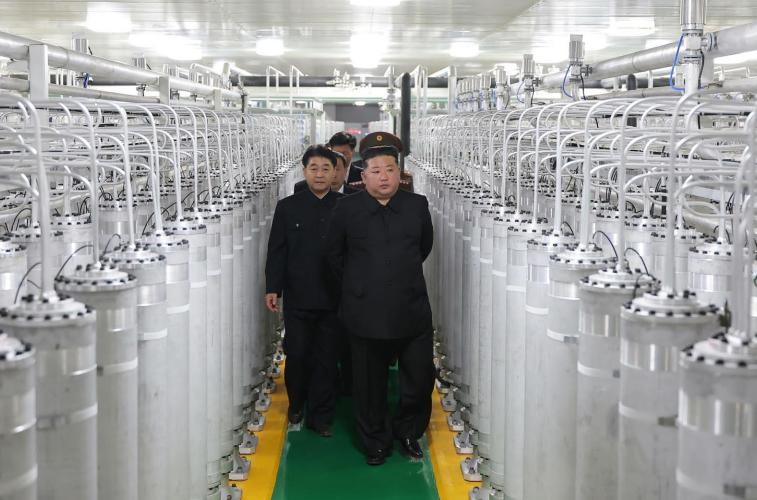
The most notable aspect of North Korea’s developments in May 2026 was Kim Jong-un’s strong focus on the defense industry. Following his on-site guidance at a major defense industrial enterprise on May 6, Kim visited several defense industrial facilities in succession on May 11. During these inspections, he reviewed weapons production, assessed the level of modernization in manufacturing processes, and personally directed the establishment of a comprehensive artillery production system, the construction of a sniper weapons manufacturing facility, and improvements to quality control mechanisms.
These activities suggest an intention not merely to encourage production, but also to simultaneously expand mass-production capabilities for weapon systems and restructure the defense industrial sector. In particular, the repeated on-site inspections of defense industrial facilities since the beginning of the year demonstrate that North Korea has positioned the defense industry as a central pillar of its national development strategy.
The strengthening of naval power also emerged as a prominent feature of North Korea’s military policy in May. On May 7, Kim Jong-un observed a comprehensive maneuverability evaluation of the new destroyer Choe Hyon, personally inspecting the vessel’s maneuverability, navigational stability, and combat system performance. This appears to be a follow-up to his on-site guidance at a major shipyard in March, the public unveiling of a strategic nuclear submarine under construction, and the testing of the destroyer’s weapons systems in April.
Recent developments indicate that North Korea is seeking to transform its navy from a force focused primarily on coastal defense into a key component of its strategic deterrence posture. It is therefore highly likely that efforts to expand both its submarine fleet and surface combat capabilities will continue in the coming years.
The overhaul of the military command structure also emerged as a significant feature of developments in May 2026. On May 17, Kim Jong-un convened a meeting of division and brigade commanders from across the armed forces and called for innovations in military training and strengthened combat readiness in response to changes in the character of modern warfare. In particular, he reiterated the principle that “the army’s foremost revolutionary task is the completion of war preparations” and emphasized the need to establish a training system that is both realistic and scientifically grounded.
These developments suggest that the North Korean military is actively studying and incorporating lessons from the changing battlefield environment shaped by the war in Ukraine. Given that North Korea has recently been overhauling not only its artillery, armored, and special operations forces but also its command structure and logistical support systems, the modernization of the Korean People's Army appears to be extending beyond the expansion of military hardware to encompass a comprehensive reorganization of its overall war-fighting system.
Developments in North Korea–Russia relations continued to constitute a major aspect of North Korea’s external environment in May 2026. During the month, North Korea completed the construction of a Memorial Hall for Combat Merits in Overseas Military Operations and extensively publicized events commemorating Russia’s Victory Day. These actions indicate that Pyongyang is utilizing military cooperation with Russia not merely as an instrument of friendly diplomacy, but also as an important component of regime propaganda.
In particular, there are signs that North Korea is seeking to bolster domestic confidence in the regime by portraying its relationship with Russia as part of a common anti-U.S. and anti-Western front and by highlighting the achievements of bilateral strategic cooperation. Through its partnership with Russia, North Korea appears to be pursuing multiple objectives, including the mitigation of diplomatic isolation and the acquisition of tangible benefits in the areas of military-technical and economic cooperation.
In the economic sector, major reports in May focused on the opening of the 24th Pyongyang Spring International Trade Fair, the completion of the first phase of the Tanchon Power Plant, a large-scale blasting operation at the Musan Mining Complex, and nationwide rice-transplanting campaigns. North Korea also highlighted its economic performance, claiming that it had fulfilled 107 percent of its national economic plan for April.
At the same time, Kim Jong-un’s direct involvement in economic affairs was largely absent, with the notable exception of the defense industrial sector. Most economic projects were implemented under the leadership of the Cabinet and local administrative bodies. This does not necessarily indicate a decline in the importance of economic policy. Rather, it suggests that, as national priorities have increasingly shifted toward strengthening military capabilities, the economic sector has entered a phase focused on policy implementation and execution.
Overall, compared to April, the focus in May shifted further away from political commemorative events and toward military and defense-industrial affairs. Whereas April was characterized by the Day of the Sun celebrations, demonstrations of political solidarity, and concurrent artillery drills and weapons tests, May witnessed the implementation of more substantive measures aimed at strengthening military capabilities, including the expansion of defense-industrial production, the enhancement of naval power, the training of military commanders, and the deepening of military cooperation with Russia.
Although the overall number of Kim Jong-un’s public activities remained largely unchanged, the content and character of those activities became markedly more concrete and operational in nature. This suggests that North Korea’s long-standing emphasis on “completing war preparations” is increasingly being translated into practical measures designed to strengthen its military capabilities and war-fighting capacity.
In summary, North Korea’s key developments in May 2026 centered on the expansion of the military-industrial complex, the modernization of naval capabilities, the deepening of North Korea–Russia military cooperation, and the strengthening of combat readiness across the armed forces. These developments should be understood not merely as demonstrations of military power, but as part of a systematic effort to enhance North Korea’s actual war-fighting capabilities.
Looking ahead, North Korea is likely to continue inspecting and enhancing defense-industrial productivity, strengthening its naval capabilities, and testing new weapons systems, while simultaneously managing summer agricultural activities and pursuing economic objectives. Furthermore, Pyongyang is expected to maintain its strategy of calibrated tension management by strategically leveraging cooperation with Russia to adjust the level of pressure exerted on the United States and South Korea.
From this perspective, May 2026 can be regarded as a turning point at which North Korea further translated its policy of “completing war preparations” into concrete measures and institutionalized its implementation across multiple sectors.
-
PREV [North Korea Inside]
-
NEXT [North Korea Inside]