

North Korea Inside
· Kim Jong-un Expresses Concern Over New Generation of Officials at Central Party Cadre School 80th Anniversary Ceremony
· Kim Jong-un Visits Sinuiju Greenhouse Farm for Third Time This Year With Daughter in Attendance
· North Korean Foreign Minister Says Ties With Russia Are at “Alliance Level” Amid Speculation Over Xi Jinping Visit

Kim Myong-sung
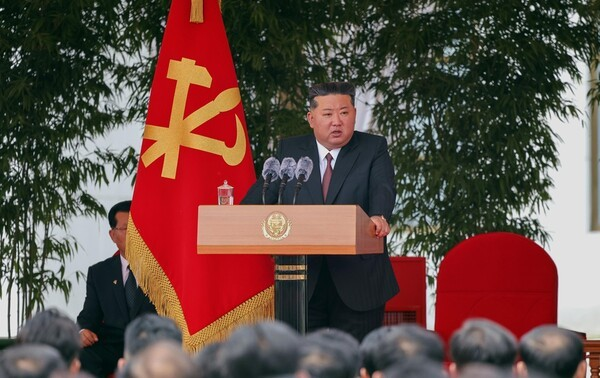
According to Rodong Sinmun on June 2, Chairman Kim paid a congratulatory visit to the Workers’ Party Central Cadre School in Pyongyang the previous day. The Central Cadre School is North Korea’s premier institution for training and retraining Party cadres and is widely regarded as a key incubator for developing the Party’s core leadership talent.
He expressed concern about young cadres in the context of revolutionary generational succession, stating, “Due to the generational succession of the revolution, young people who lack Party discipline and possess sensibilities different from those of the previous generation are forming the main body of the cadre ranks,” and added, “If we fail to properly raise successors, we cannot expect the Party’s future development or the continuity of the revolutionary cause.”
The newspaper reported that Kim pointed to the reality that young cadres who have not experienced the trials of war and post-war reconstruction differ from the older generation in terms of worldview and character, and stressed the need for corrective measures. This is interpreted as an effort to guard against ideological laxity among younger cadres who did not experience the Korean War or the post-war hardship period, and to reinforce systemic cohesion through intensified ideological education.
Kim instructed, “The Central Cadre School must focus on education aimed at instilling our Party’s view of the people in students, alongside the cultivation of Party spirit,” adding, “All students must embody the spirit and demeanor of serving the people with conviction and sincerity.” He also strongly criticized perspectives that prioritize economic and material factors, describing them as “either expressions of ignorance that fail to properly understand what convictions and spirit defend and uphold this country, or the ramblings of individuals who have failed to fully internalize the Party’s people-centered philosophy.”
He described the Central Cadre School as “a political education institution that faithfully serves the cause of Juche-oriented Party building and a strategic stronghold guaranteeing the Party’s existence and development,” emphasizing that “the founding principle that cadre cultivation must take precedence over all other tasks remains an absolute and enduring truth.”
He went on to stress the importance of talent development, stating, “We are now in an era in which human resources, not technological means or natural resources, constitute the nation’s foremost strategic asset.” He also emphasized that, in order to complete revolutionary succession, “the unity of guiding ideology, the unity of leadership-centered principles, and the unity of the leadership system” must be strictly maintained.
After the event, Kim toured the school’s historical exhibition hall and instructed, “The Central Cadre School must play a role in continuously strengthening the leadership and combat capabilities required for the permanent existence and ever-advancing development of our Party.”
On the same day, an exhibition match was held at the school’s sports field featuring North Korean women’s football teams that had recently achieved championship victories on the international stage. The Naegohyang Women’s Football Club, which won the 2025–2026 Asian Football Confederation (AFC) Women’s Champions League (AWCL) held in South Korea, faced the North Korean national team, winners of the AFC U-17 Women’s Asian Cup held in China.
Before attending the match, Kim met with players and coaching staff to personally convey congratulations and encouragement. He expressed his expectation that they would continue to achieve success in international competitions and bring honor to the country.
The match was attended by Ri Yong-sik, president of the Central Cadre School, along with school officials, students, and individuals recognized for their contributions to education. Accompanying Kim on the visit were Party Secretaries Kim Jae-ryong, Ri Il-hwan, Jeong Kyong-taek, Ri Hi-yong, Kim Song-nam, Ju Chang-il, and Kim Jong-gwan.
Marking the 80th anniversary of the Central Cadre School, North Korea held a series of commemorative events—including artistic performances, sports competitions, and exhibitions of educational achievements—at Party schools in Pyongyang and across provincial and municipal regions, underscoring the central importance of the Party cadre training system.
North Korean State Affairs Commission Chairman Kim Jong-un, accompanied by his daughter Ju-ae, conducted on-site guidance at a large-scale greenhouse farm in Sinuiju, North Pyongan Province, emphasizing the expansion of agricultural production and the advancement of science- and technology-based farming. As North Korea promotes the Sinuiju Greenhouse Farm as a flagship achievement of its “improvement of people’s livelihoods” and “regional development policy,” observers note that Kim has visited the site for the third time this year.
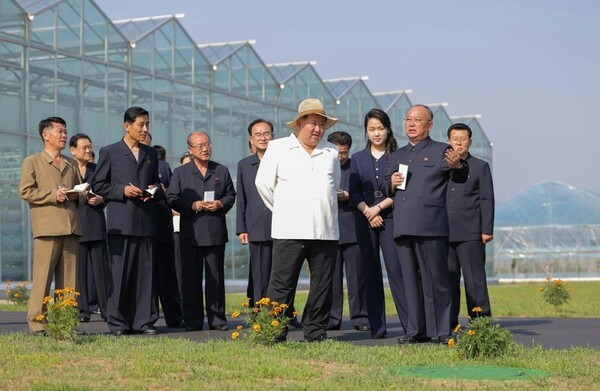
North Korean State Affairs Commission Chairman Kim Jong-un, accompanied by his daughter Ju-ae, conducted on-site guidance at a large-scale greenhouse farm in Sinuiju, North Pyongan Province, emphasizing the expansion of agricultural production and the advancement of science- and technology-based farming. As North Korea promotes the Sinuiju Greenhouse Farm as a flagship achievement of its “improvement of people’s livelihoods” and “regional development policy,” observers note that Kim has visited the site for the third time this year alone.
The Korean Central News Agency reported on June 1 that Kim visited the Sinuiju Greenhouse Complex the previous day to inspect production conditions, agricultural scientific research, and management operations. His wife, Ri Sol-ju, and daughter Ju-ae accompanied him on the visit.
In photos released by North Korean media, Kim was seen inspecting the site with his hands behind his back, while Ju-ae walked alongside him with her hands clasped in front of her. Accompanying officials, including Cho Yong-won, President of the Presidium of the Supreme People’s Assembly; Kim Jae-ryong, Party Organization Secretary; and Ri Il-hwan, Party Propaganda Secretary, stood at attention or took notes, highlighting a contrasting visual dynamic.
The news agency reported that after touring various hydroponic and soil-based greenhouses, experimental cultivation facilities, and rapeseed fields, Kim expressed satisfaction upon receiving a report that hundreds of tons of vegetables were being harvested daily. He subsequently called for diversification of crop varieties, the application of science- and technology-based cultivation methods, and intensified competition among farms.
He also instructed that the share of mechanization in agricultural operations be expanded and that transportation automation be advanced to improve production efficiency. In addition, he outlined tasks including the expansion of storage and distribution infrastructure, the establishment of a system for disseminating advanced agricultural technology, and the training of specialized greenhouse farming personnel.
Kim also inspected construction sites for a new healthcare facility, a comprehensive service center, and a vegetable processing plant within the greenhouse complex. The news agency reported that construction progress has reached approximately 50 percent.
The Sinuiju Greenhouse Complex is a large-scale agricultural development project in the Wihwa Island area downstream of the Yalu River, which suffered extensive flooding in 2024. The site covers an area approximately 1.5 times the size of Yeouido in Seoul. North Korea has framed the project as a symbolic achievement of Kim Jong-un’s “people-first policy” and regional development strategy.
In particular, Kim has visited the site five times in total, including for its groundbreaking ceremony last year, and selected it as the site of his first field inspection this year. This marks his third visit this year and is interpreted as reflecting Pyongyang’s intention to highlight agricultural production achievements directly tied to public livelihoods despite ongoing economic difficulties.
North Korean Foreign Minister Says Ties With Russia Are at “Alliance Level” Amid Speculation Over Xi Jinping Visit
North Korea used a memorial event honoring Alexander Matsegora, the late Russian ambassador to Pyongyang, as an opportunity to publicly signal that North Korea–Russia relations have effectively reached an alliance-level status. As bilateral cooperation expands beyond military affairs into security, intelligence, economic, and energy domains, Pyongyang is also showing signs that preparations may be underway for a possible visit by Chinese President Xi Jinping.
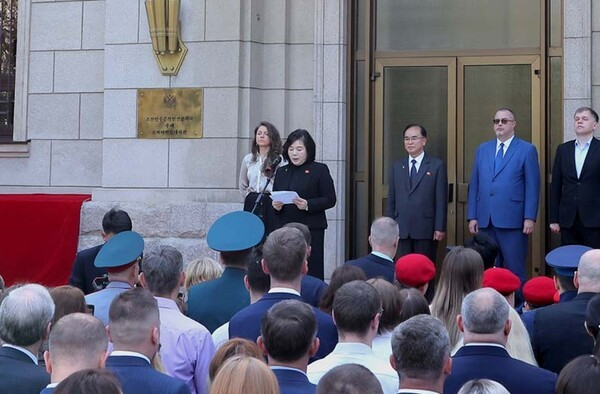
According to Russia’s state-run TASS news agency on May 31, North Korean Foreign Minister Choe Son-hui attended the unveiling ceremony of a memorial plaque for former Ambassador Matsegora held at the Russian Embassy in Pyongyang the previous day and stated, “The two countries share a common position on all strategic issues, which amounts to an alliance-level relationship.”
Foreign Minister Choe added, “By consistently safeguarding our core mutual interests, we are achieving comprehensive expansion and development of bilateral relations and tangible progress in improving the welfare of our peoples,” and emphasized, “It is our firm political stance to comprehensively expand and develop relations with Russia based on the comradeship and trust forged in blood during times of severe hardship.”
North Korea’s Rodong Sinmun also gave prominent coverage to the memorial event on page two of its edition that day. According to the newspaper, Choe paid tribute, stating that “Comrade Matsegora’s contributions to strengthening and developing North Korea–Russia friendship will remain permanently in the shared memory of both peoples.” Cho Yong-won, President of the Presidium of the Supreme People’s Assembly and North Korea’s second-highest-ranking official, also attended the event to offer condolences.
However, Rodong Sinmun did not include the phrase “alliance-level relationship” reported by TASS. This is interpreted as an effort to calibrate domestic messaging while still highlighting the elevation of bilateral ties in external communications.
Matsegora, who was appointed ambassador to North Korea in late 2014, was a central figure in managing North Korea–Russia relations for more than a decade while based in Pyongyang. He reportedly maintained such close ties with the North Korean leadership that Kim Jong-un personally visited his funeral home following his death last December.
Recently, North Korea–Russia cooperation appears to be expanding beyond the military domain into security and intelligence collaboration. North Korea dispatched a delegation from its State Security apparatus to the International Security Forum held in Moscow on the 28th. Rodong Sinmun reported that Ri Chang-dae, Director of the State Security Department, met with Sergei Shoigu, Secretary of the Russian Security Council, to discuss strengthening intelligence cooperation and addressing regional security challenges.
Since the deployment of North Korean troops to Russia, the two countries have steadily expanded cooperation across virtually all sectors, including trade, investment, energy, agriculture, education, and healthcare. Analysts assess that North Korea is seeking to mitigate international isolation while securing economic and technological support through its strategic alignment with Russia.
Against this backdrop, indications of possible preparations for a visit by Chinese President Xi Jinping to Pyongyang have also been observed.
NK News, a U.S.-based outlet specializing in North Korea reporting, recently stated that satellite imagery and on-the-ground visuals showed the installation of high fences, mobile cranes, and large temporary structures around Kim Il-sung Square in Pyongyang. The location corresponds to the site where a large ceremonial pavilion was erected during Russian President Vladimir Putin’s visit last year.
Additional signs of preparation for a high-level foreign visit have been observed at Pyongyang Sunan International Airport. Several Air Koryo aircraft were reportedly relocated from their usual parking positions between May 28 and 29, a pattern similar to preparations observed ahead of Vladimir Putin’s visit last year.
Furthermore, construction of new accommodation and residential facilities within the Paekhwawon State Guest House complex has fueled speculation that these developments may be intended to accommodate a large Chinese delegation.
However, assessments differ regarding the timing of a possible Xi visit. Chinese state media has reported that the President of Laos is scheduled to visit China from June 2 to 6, leading some analysts to suggest that a Xi visit during the first week of June is unlikely.
-
PREV [NK Focus]
-
NEXT [NK Inside]