

North Korea Inside
· Kim Jae-ryong’s Continued Presence at Public Events Sparks Speculation Over His New Role
· Kim Jong-un Accelerates Deployment of New Destroyer
· Kim Jong-un Makes Unscheduled Visit to Kumsusan Palace

Kim Myong-sung
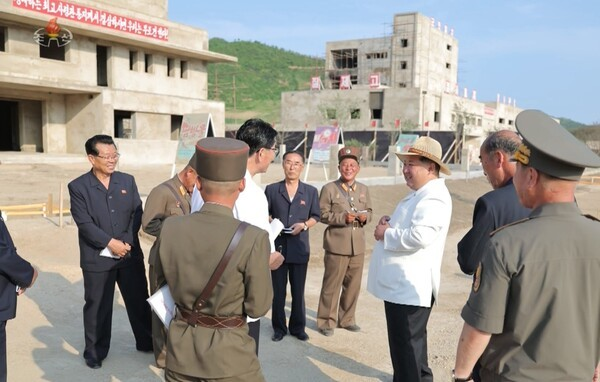
During Kim Jong-un’s recent on-site inspection of a local development project in Rakwon County, South Hamgyong Province, Kim Jae-ryong was observed accompanying the leader as a member of the inspection delegation. The visit focused on the implementation of the “Regional Development 20×10 Policy,” one of Kim Jong-un’s signature domestic initiatives, further fueling speculation that Kim Jae-ryong may have been assigned a role in overseeing regional development projects.
According to Korean Central Television (KCTV), Kim Jong-un inspected construction projects in Rakwon County on July 5. State media footage confirmed that Kim Jae-ryong accompanied the leader despite having been removed at last month’s Second Plenary Meeting of the Ninth Central Committee from several key posts, including membership in the Politburo Standing Committee, Secretary of the Party Central Committee, and Director of the Organization and Guidance Department.
His continued public appearances are notable given North Korea’s established practice of immediately removing purged officials from public view. Since his dismissal, Kim Jae-ryong has attended the commissioning ceremony of the new 5,000-ton destroyer Choehyon and participated in an expanded Politburo meeting, suggesting that he remains politically relevant despite the apparent reduction in his formal authority.
Evidence also suggests that, although he lost his seat on the Politburo Standing Committee, Kim Jae-ryong may have retained full membership in the Politburo itself. Official footage showed him participating alongside other Politburo members during the adoption of meeting resolutions. Nevertheless, his reduced political standing was reflected in his seating arrangement, as he was positioned in the rear rather than among the senior leadership.
The Rakwon County inspection is particularly significant because it focused on the Regional Development 20×10 Policy, one of Kim Jong-un’s highest domestic priorities. The initiative seeks to modernize 200 cities and counties over a ten-year period by constructing local industrial facilities while simultaneously expanding healthcare, education, cultural infrastructure, and grain management systems to reduce regional development disparities.
North Korea institutionalized the policy through the Law on the Implementation of the Regional Development 20×10 Policy, enacted in 2024. The legislation established an Ad Hoc Central Steering Committee responsible for coordinating nationwide implementation, including the oversight of industrial facilities, healthcare infrastructure, comprehensive service centers, and grain management projects through provincial-level implementation bodies.
Responsibility for the committee was initially reported to have rested with WPK Secretary Jo Yong-won. However, following Jo’s temporary reassignment as Chairman of the Presidium of the Supreme People’s Assembly before his return to the Party Secretariat, North Korean authorities have not publicly identified the committee’s current head. Against this backdrop, Kim Jae-ryong’s prominent participation in Kim Jong-un’s inspection has generated speculation that he may have assumed responsibility for overseeing implementation of the regional development initiative.
Since its announcement during Kim Jong-un’s 2024 policy address to the Supreme People’s Assembly, the Regional Development 20×10 Policy has become one of the regime’s flagship socioeconomic initiatives. Construction began with the first local industrial complex in Songchon County, South Pyongan Province, and the initiative is now entering its third year. At the Workers’ Party year-end plenary meeting, authorities further expanded the program to include advanced healthcare facilities, science, education, and cultural infrastructure, as well as grain management facilities, in addition to industrial development.
North Korean state media portray the initiative as “a uniquely socialist development model” designed to narrow disparities between urban and rural areas and between central and local governments while promoting balanced national development. Kim Jong-un has repeatedly demonstrated his personal commitment to the initiative through frequent on-site inspections of local development projects.
Kim Jae-ryong’s precise new responsibilities, however, remain unclear. At the recent plenary meeting, North Korean authorities described his removal only as a “change in duties” without announcing a subsequent appointment. While some observers initially linked the personnel reshuffle to investigations into military corruption, Kim’s continued participation in inspections of major policy initiatives increasingly suggests that he may have been reassigned rather than politically marginalized. Whether he will formally assume a leadership position within the central body overseeing regional development remains to be seen.
North Korean leader Kim Jong-un has moved to accelerate the operational deployment of the new 5,000-ton destroyer Kanggon despite the vessel’s widely publicized grounding during its launch ceremony earlier this year. By personally supervising tests of the ship’s principal weapons systems—including strategic cruise missiles, naval artillery, and electronic warfare capabilities—Kim underscored his determination to strengthen North Korea’s naval capabilities and advance its maritime nuclear deterrence posture.
According to the Korean Central News Agency (KCNA), the destroyer conducted test launches of strategic cruise missiles and evaluations of multiple onboard weapons systems on July 3 as part of a comprehensive assessment of its combat capabilities. The tests reportedly examined target detection, information processing, integrated fire-control capabilities, naval artillery, automatic weapons, and electronic warfare systems.
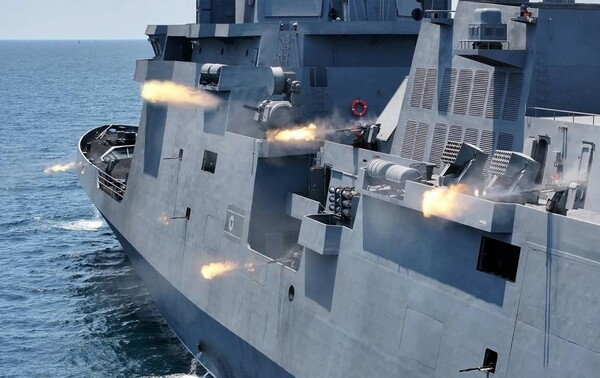
The strategic cruise missile launched during the exercise is widely assessed to belong to North Korea’s Hwasal family of land-attack cruise missiles. Analysts have long assessed that Pyongyang intends to deploy such systems aboard its new destroyers—including both the Choehyon and the Kanggon—as part of efforts to establish a sea-based nuclear strike capability.
Photographs released by state media showed the missiles painted blue, prompting speculation among military observers that the coloration may represent a camouflage measure intended to reduce visual detection.
South Korea’s Joint Chiefs of Staff confirmed that the military detected cruise missiles and other projectiles launched from the destroyer into the East Sea on July 3. South Korean and U.S. intelligence authorities are reportedly conducting a detailed assessment of the systems involved.
The exercise also highlighted the vessel’s close-in defensive capabilities, with KCTV footage showing multiple automatic weapons being fired from the ship during live-fire drills.
Following the exercise, Kim Jong-un stated that recent advances in domestic weapons development demonstrated the potential for significant improvements in North Korea’s indigenous naval combat systems. He emphasized the need to further strengthen maritime and underwater combat capabilities while maintaining what he described as a “credible war deterrent” and expanding the country’s war-fighting capabilities.
Kim also reaffirmed plans to expand naval bases and shipbuilding capacity nationwide and instructed the Navy to commission the Kanggon within two months. He additionally convened a high-level consultative meeting focused on the development of the country’s shipbuilding industry.
The destroyer suffered a highly unusual accident during its launch ceremony in May, when the vessel listed sharply and ran aground before entering service. Although North Korea successfully salvaged the ship within 22 days and subsequently held a second launch ceremony, outside analysts have continued to question its operational readiness.
If Kim’s timetable is met, the Kanggon will enter operational service roughly one year after the launch accident. North Korea commissioned its sister ship, the Choehyon, in late June for service with the West Sea Fleet.
Taken together, these developments suggest that Pyongyang intends to accelerate the deployment of a dual-coast surface fleet capable of supporting its evolving maritime nuclear strategy.
Kim Jong-un Makes Unscheduled Visit to Kumsusan Palace
Kim Jong-un paid tribute at the Kumsusan Palace of the Sun shortly after midnight on July 8 to mark the 32nd anniversary of Kim Il-sung’s death, despite the occasion not constituting a major commemorative event. The visit has been widely interpreted as an effort to reinforce elite cohesion following last month’s Second Plenary Meeting of the Ninth Central Committee while simultaneously reaffirming Kim’s own political authority through symbolic association with his predecessors.
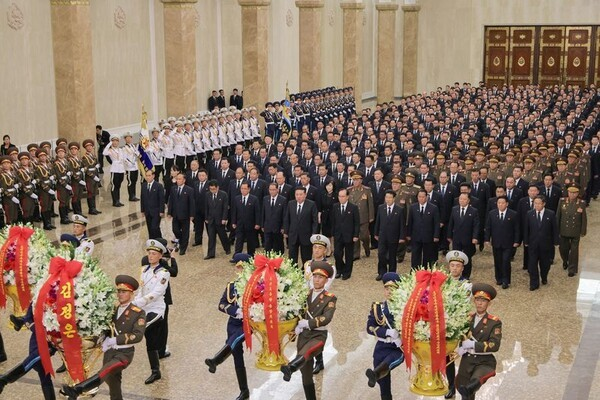
Particularly noteworthy was the timing of the state media coverage. Unlike the regime’s customary practice of reporting the leader’s activities a day after they occur, North Korean media publicized the visit on the same day, suggesting an effort to promptly project leadership unity to both domestic and international audiences following recent personnel adjustments.
The 32nd anniversary does not constitute one of North Korea’s traditional milestone commemorations, which typically occur at five- or ten-year intervals and are marked by large-scale state ceremonies. In contrast, this year’s observances were relatively modest, consisting primarily of ideological education activities targeting young people, workers, and farmers.
Kim’s personal appearance at the Kumsusan Palace nevertheless carries considerable political significance. The visit appears intended to reinforce party discipline and elite loyalty following recent personnel reshuffles while underscoring the continuity of the revolutionary leadership tradition.
State media described the anniversary as “the greatest day of mourning for the Party, the state, and the people”—a formulation that differs from previous references to “the nation’s greatest day of mourning.” The revised terminology has been used consistently since commemorations marking the anniversary of Kim Jong-il’s death in December and appears to place greater emphasis on the institutional authority of the Party and the state.
The linguistic adjustment is consistent with Pyongyang’s broader ideological emphasis on the concept of “two hostile states,” which increasingly highlights the sovereignty and institutional identity of the Democratic People’s Republic of Korea (DPRK).
In a front-page editorial published the same day, Rodong Sinmun further reinforced regime legitimacy by portraying Kim Jong-un as faithfully carrying forward Kim Il-sung’s political legacy. The newspaper asserted that Kim is implementing Kim Il-sung’s people-centered governing philosophy more fully than ever before and argued that North Korea would continue to prosper under his leadership.
-
PREV [Issue Analysis]
-
NEXT [NK Inside]