

NK Inside
· North Korea Also Hit by Extreme Heat as Temperatures Near 40°C; Water Parks and Wonsan Beach Attract Large Crowds
· North Korea Warns Cadres Against Sycophancy, Declaring Flattery “Anti-Party and Counterrevolutionary”
· North Korean Defense Minister Attends China’s PLA Anniversary Event in Pyongyang

Myongsung Kim
In areas under the high temperature warning, daytime highs are forecast to range from 35°C to 40°C, while regions under the heat wave warning are expected to experience relative humidity levels above 70 percent, with daytime temperatures ranging between 33°C and 35°C.
Pyongyang has experienced both extreme daytime heat and persistent tropical nights. On August 3, the city’s morning low reached 28°C, approximately 5°C above the seasonal average, while daytime temperatures were expected to rise to 35°C. The capital has recorded five consecutive tropical nights since July 27, with overnight temperatures remaining above 25°C.
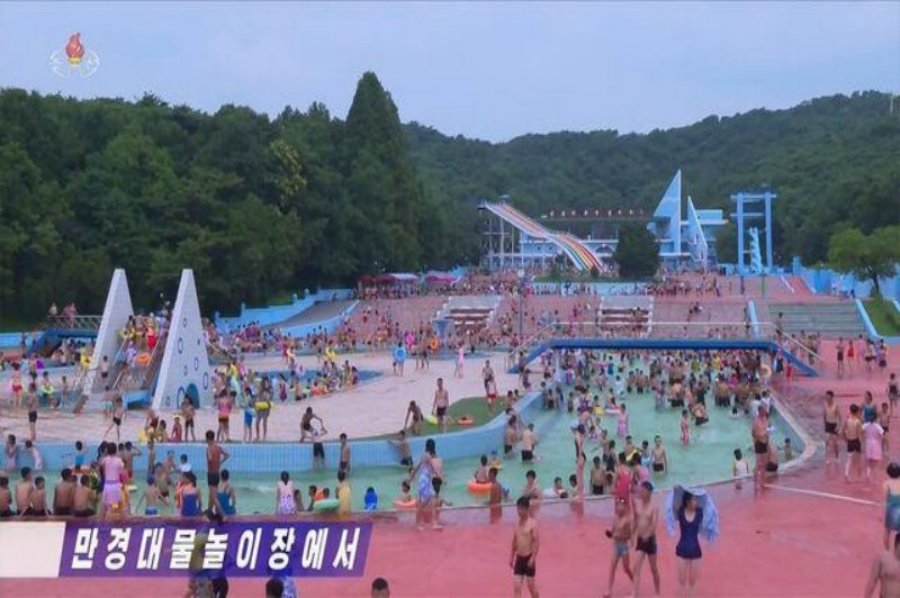
As the heat wave continues, North Korea’s principal summer recreation sites have reportedly seen a surge in visitors.
Korean Central Television (KCTV) reported that tens of thousands of visitors have traveled to the Wonsan-Kalma Coastal Tourist Zone in the month since its opening on July 1. The broadcaster described crowds extending along the famous Myongsasipri beach, highlighting official efforts to promote Wonsan-Kalma as North Korea’s premier coastal tourism destination.
KCTV also reported that the Mangyongdae and Munsu Water Parks in Pyongyang have been operating at full capacity, attracting workers, students, and families on a daily basis.
In an August 2 article titled “A Sea of People, A Sea of Laughter,” the Rodong Sinmun stated that Munsu Water Park has been filled to capacity every day during the peak summer season. The article also noted that visitors have arrived not only from Pyongyang but also from other provinces.
At the same time, North Korean authorities have intensified public messaging on heat-related health precautions in response to the prolonged period of extreme temperatures.
Citing physicians at Pyongyang General Hospital, the Rodong Sinmun advised individuals with cardiovascular disease, diabetes, and hyperthyroidism to exercise particular caution during the heat wave.
The newspaper also recommended consuming foods traditionally believed to help relieve heat stress—including watermelon, mung beans, and cucumbers—as well as nutrient-rich dishes such as dog meat soup, fish porridge, and red bean porridge. It further advised residents to avoid excessive outdoor physical activity during periods of high temperatures and humidity and instructed those experiencing symptoms of heat illness to immediately move to cooler environments, apply cooling measures, and seek medical treatment when necessary.
The sustained emphasis in North Korean state media on heat-related health guidance appears aimed at mitigating public health risks associated with the prolonged heat wave while minimizing potential social disruption. At the same time, extensive coverage of crowded tourist destinations and recreational facilities serves to showcase the regime’s investment in domestic tourism infrastructure and project an image of social normalcy despite extreme weather conditions.
As North Korea intensifies its recent campaign against corruption and lax discipline among Party officials, the regime has publicly identified flattery and sycophancy within the cadre corps as political threats. By portraying privilege and personal loyalty networks as sources of institutional corruption, Pyongyang appears to be seeking to curb both factionalism and abuses of authority while reinforcing centralized Party control.

In a commentary published on August 1 titled “Let Us Make the Party’s Ideology and Intentions Our Creed in Work and Life,” the Rodong Sinmun argued that “when officials abuse their authority through privilege or bureaucratic practices, flattery inevitably takes root,” urging cadres to adhere strictly to Party principles.
The newspaper further asserted that “idealizing individuals is itself contrary to Party principles” and declared that “there is no flattery divorced from personal gain or career advancement.” It characterized flattery as a process that “begins with ideological degeneration and ultimately leads to anti-Party and counterrevolutionary acts,” framing the issue as a systemic political threat rather than merely an individual ethical failing.
According to the commentary, officials who abandon Party principles inevitably begin evaluating others based on personal relationships and political influence rather than institutional standards, creating an environment in which influential figures become the objects of personal loyalty. The newspaper warned that such practices undermine the revolutionary discipline and collective cohesion of Party organizations.
The Rodong Sinmun also condemned officials’ sense of entitlement, arguing that the exercise of privilege reflects a belief that one is “a special being.” It emphasized that authority entrusted by the Party and the people must serve the public interest rather than personal power, privilege, or bureaucratic abuse.
The commentary repeatedly emphasized absolute adherence to Party principles, urging officials to remain “not even 0.001 millimeters” removed from the Party line and declaring that cadres should be prepared to defend Party principles “even at the cost of their lives.” It further warned that the Party would continue to act uncompromisingly against any official who deviates from Party discipline, regardless of rank or status.
The article is consistent with North Korea’s broader campaign to strengthen internal discipline among officials. In recent months, state media and Party meetings have repeatedly condemned abuses of power, bureaucratism, corruption, and privileged behavior while emphasizing ideological inspections and organizational discipline. One notable example was the recent prosecution of a deputy director of the Korean People’s Army General Political Bureau on corruption charges.
Kim Jong-un has likewise repeatedly stressed the need to reform officials’ attitudes toward the public, arguing that changes in their moral character and work style must precede improvements in administrative competence. Against this backdrop, the latest commentary appears intended to identify sycophancy surrounding powerful officials as a root cause of corruption while reinforcing the principle that loyalty should be directed toward the Party and its institutional line rather than toward individuals.
Taken together, North Korea’s public criticism of flattery appears to extend beyond efforts to improve organizational culture. Rather, it reflects an effort to curb corruption, factionalism, and excessive competition for political favor while strengthening centralized Party control over the cadre corps. By discouraging personal patronage networks, the regime seeks to reinforce a unified command structure centered on Kim Jong-un and the Party leadership.
North Korean Defense Minister Attends China’s PLA Anniversary Event in Pyongyang
North Korea and China reaffirmed their traditional friendship and growing military ties during a reception in Pyongyang commemorating the 99th anniversary of the founding of the People’s Liberation Army (PLA). North Korea’s decision to send Minister of National Defense No Kwang-chol—representing a higher level of participation than in previous years—underscored the continued improvement in bilateral relations following recent summit diplomacy between the two countries.
According to the Chinese Embassy in Pyongyang and the Rodong Sinmun, the reception was held on July 28 at the Chinese Embassy.
The event was attended by senior Chinese officials, including Ambassador Wang Yajun, Minister-Counselor Chi Han, and Defense Attaché Brigadier General Wang Yisheng, as well as approximately 150 participants, including North Korean Minister of National Defense No Kwang-chol, senior Party officials, military officers, government representatives, foreign diplomats, and military attachés stationed in Pyongyang.

Particular attention was drawn to North Korea’s decision to elevate the level of representation. Whereas last year’s ceremony was attended by Vice Minister of National Defense Kim Kang-il, this year’s delegation was led by Defense Minister No Kwang-chol, suggesting that bilateral military relations have continued to improve following the North Korea-China summit meetings held in September 2025 and June 2026. Beyond the higher-level representation, however, the overall composition and scale of the event remained largely unchanged.
During the reception, officials from both countries emphasized the continuation of military exchanges and cooperation based on agreements reached by their respective leaders.
Ambassador Wang Yajun stated that, under the strategic guidance of the top leadership of both countries, the armed forces should strengthen communication, deepen cooperation, and carry forward the traditional friendship forged through shared historical experiences. He further emphasized the importance of cooperation in advancing socialism, improving public welfare, and promoting regional peace and stability.
Defense Attaché Wang Yisheng similarly pledged to faithfully implement the outcomes of recent China-DPRK summit diplomacy and reaffirmed China’s commitment to expanding military exchanges in accordance with the guidance of the leaders of both countries.
Minister No Kwang-chol responded that the armed forces of North Korea and China have developed enduring comradely ties through a long history of shared struggle and continue to contribute jointly to regional peace, security, and international justice. He expressed confidence that implementing the agreements reached by the two leaders would further advance traditional bilateral friendship and socialist cooperation.
China commemorates August 1, 1927—the date of the Nanchang Uprising, which marked the founding of the Chinese Red Army—as PLA Day. North Korea has traditionally recognized the occasion through official editorials in the Rodong Sinmun or by participating in commemorative events hosted by the Chinese Embassy.
The Pyongyang reception had been suspended after the 2019 ceremony and resumed in 2025 following a six-year hiatus. The continued participation of senior officials and repeated public commitments to military cooperation suggest that North Korea and China are accelerating the restoration of bilateral cooperation not only in the political and diplomatic spheres but also in the defense and military domains.
-
PREV [NK Focus]
-
NEXT [NK Inside]