

Unveiling the Operations of North Korea's Diplomatic Missions: A Closer Look into Reality(2)

Ph.D. Kim Dong-soo in North Korean studies
Former North Korean diplomat
In the reports concerning the foreign activities of North Korean diplomatic missions since the 1980s, a temporary emphasis was placed on various issues such as nuclear weapons, missiles, chemical weapons, remains of U.S. soldiers, U.S.-North Korea Talks, Six-Party Talks, human rights, food assistance, United Nations and international organizations, relations with major countries, projects related to South Korean, unification issues, and the development of relationships with respective countries. These reports primarily focused on proposing foreign policies, strategies, and suggestions that needed immediate attention.
During this period, North Korean diplomacy experienced a downturn due to the collapse of the Soviet Union and the Eastern Bloc socialist countries, as well as China's comprehensive reforms and opening up. As a result, North Korea became increasingly fixated on the "cliff-edge diplomacy" of nuclear weapons development. As a result, North Korea experienced what is commonly known as the "Arduous March" in the late 1990s. During this period, the country resorted to a form of diplomacy characterized by seeking external assistance, which brought about significant hardships.
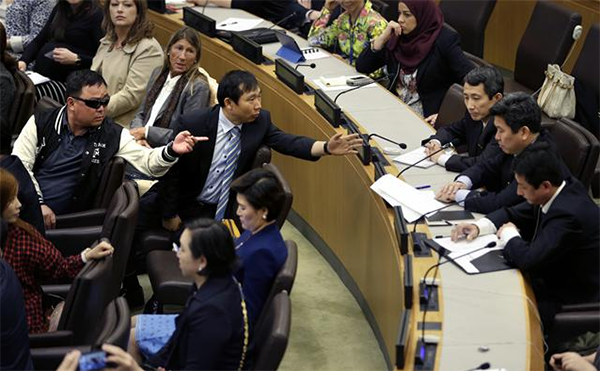
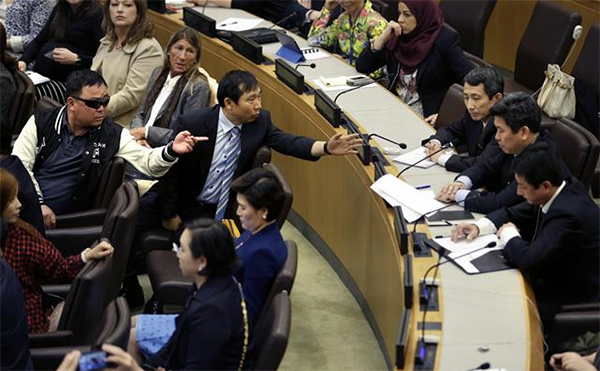
In April 2015, at a human rights event related to North Korea held at the United Nations (UN) headquarters in New York, North Korean defectors (left) protesting against the sudden actions of North Korean diplomats (right). / New York, AP
At the 6th Congress of the Workers' Party of Korea held in October 1980, Kim Jong-il was officially "designated" as the sole successor to Kim Il-sung, strengthening the "Ten Principles for the Establishment of the Party's Unique Ideology and Leadership System." Consequently, under the military dictatorship of Kim Jong-il's hereditary rule, North Korea focused its efforts on the "cliff-edge nuclear diplomacy" during a critical period when the people were facing severe issues related to their livelihoods. Considerable funds were invested in the idolization of Kim Jong-il and nuclear development. As a result of mobilizing all the funds and foreign currency sources of the Party, State, and Military toward Kim Jong-il's idolization and nuclear development during the era of Kim Il-sung and Kim Jong-il, North Korea's economy suffered significant setbacks. Furthermore, in the 1990s, the collapse of socialist countries, including the Soviet Union, and severe natural disasters pushed North Korea's economy into a comprehensive bankruptcy.
These circumstances directly impacted the operation of North Korea's overseas diplomatic missions and the selection and dispatch of diplomats, which required immediate attention. In the late 1980s, Kim Jong-il issued instructions to Kang Sok-ju, the Deputy Minister of Foreign Affairs, to withdraw more than half of the overseas diplomatic missions. Although the Office 39 of the Central Committee of the Workers' Party of Korea had ensured special operating expenses and maintenance costs for the Ministry of Foreign Affairs and its diplomatic missions annually, the Finance and Accounting Department reported to Kim Jong-il that they could no longer guarantee the special operating expenses and maintenance costs due to severe foreign currency shortages. After reviewing the report, Kim Jong-il issued an instruction to the effect of, "Retract all unnecessary diplomatic missions that are draining the country's valuable resources without yielding substantial benefits." As a result, the Ministry of Foreign Affairs decided to withdraw over 50 diplomatic missions from the total of 120 embassies and representative offices situated across the globe.
In the late 1990s, North Korea faced an unprecedented international sanctions led by the United Nations and the international community due to its nuclear weapons development. Additionally, the country experienced unprecedented natural disasters, leading to a dire situation with over 2 million deaths and the emergence of more than 300,000 defectors and refugees. The Kim Jong-il regime was on the brink of collapse. Kim Jong-il issued special instructions to the Party, Military, State Security Department, Ministry of Social Security, and Ministry of Foreign Affairs, stating:
"If our socialist system, like the Soviet Union and other Eastern Bloc socialist countries, collapses, comrades will be the first to be executed on the people's tribunal. The regime has its absolute authority in the General Political Bureau." Furthermore, Kim Jong-il instructed the Ministry of Foreign Affairs, "From now on, suspend all other foreign activities and concentrate all efforts on nuclear weapons development and obtaining international food assistance. All unnecessary diplomatic missions unable to engage in such external activities should be immediately withdrawn under the command of the Supreme Commander."
Following these special instructions, the Ministry of Foreign Affairs took immediate measures to withdraw around half of the overseas diplomatic missions, including more than 40 embassies and representative offices out of the existing 80. Since then, North Korea has been operating only around 35 to 40 diplomatic missions worldwide, including embassies and representative offices.
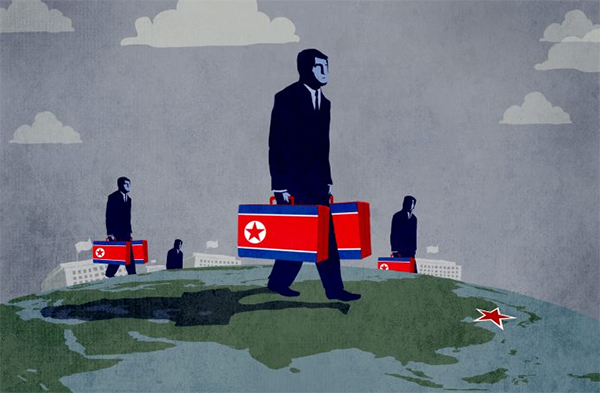
U.S. Department of State/D. Thompson
It is estimated that diplomats are dispatched to approximately 20 missions. The countries where North Korea maintains embassies and representative offices include Thailand, Indonesia, India, Pakistan, Australia, Tanzania, South Africa, Zimbabwe, Egypt, Iraq, Iran, Syria, Saudi Arabia, the United Kingdom, France, Italy, Germany, Spain, Switzerland, and Cuba. Diplomatic mission personnel carry out their organizational and daily activities in a combative manner, following a structured schedule: From Monday to Friday, the daily schedule consists of the following activities: from 8:00 AM to 9:00 AM, reading the Rodong Sinmun newspaper; from 9:00 AM to 10:00 AM, conducting briefings; from 10:00 AM to 6:00 PM, engaging in external activities; and from 8:00 PM to 10:00 PM, holding meetings and reporting on business matters. On Saturdays, the schedule includes a life review session from 9:00 AM to 10:00 AM, a lecture from 10:00 AM to 11:00 AM, cleaning activities from 11:00 AM to 12:00 PM, party policy studies from 2:00 PM to 4:00 PM, sports activities from 4:00 PM to 7:00 PM, and collectively organizing and watching party literature or artistic films from 8:00 PM to 10:00 PM.
Due to the foreign exchange constraints in their home country, diplomats often face delays and non-payment of living expenses for extended periods, ranging from six months to a year. As a result, some diplomats resort to engaging in illicit activities such as drug trafficking, counterfeiting currency, and involvement in the illegal trade of alcohol and tobacco. These activities are undertaken at great personal risk. In cases where a diplomatic mission experiences a delay of six months to a year in receiving funds, and the ambassador sends a special telegram requesting the funds, the response from Pyongyang is a clear directive to "withdraw the embassy!" Consequently, most diplomatic missions are unable to visit department stores regularly, and diplomat spouses collectively visit local grocery stores once a week to purchase canned food for pets or animal feed. They rely on discarded rice or corn with product defects for their sustenance.
Currently, the Ministry of Foreign Affairs has a total of approximately 1,500 personnel, out of which around 1,000 are diplomats. However, only a small fraction, approximately 100 diplomats, are repeatedly sent on diplomatic missions. This means that more than 80% of diplomats have not had the opportunity to go on overseas trips, including to countries like China and Russia. Among the preferred destinations for North Korean diplomats are the Middle East, despite the ongoing conflicts and unrest, and various African countries, where they can engage in lucrative illicit trade and accumulate foreign currency. Southeast Asia, China, Russia, and Europe are also ranked as preferred destinations. On the other hand, the United Nations in New York is the least preferred diplomatic mission for North Korean diplomats to be dispatched to.
North Korea currently finds itself at a critical juncture. On one hand, accepting support from various international financial and economic organizations, including the United States and the United Nations, would entail subjecting the country to extensive scrutiny of its internal affairs, which is unacceptable. On the other hand, without international assistance, the already bankrupt economy will struggle to recover, leading to severe internal class conflicts and a potential regime collapse. The evolving foreign policy of North Korea presents us with both challenges and opportunities. It holds the potential for peace, coexistence, and prosperity on the Korean Peninsula. However, if the ongoing phase of dialogue fails, it may result in renewed periods of tension and confrontation. Resolving the North Korean nuclear issue and achieving peace on the Korean Peninsula are tasks of utmost importance in our time, requiring collective wisdom and concerted efforts.