

Vladimir Putin's Pawn, Kim Jong-un's Visit to Russia: They Must Immediately Cease Weapons Trades that Violate International Order
North Korean leader Kim Jong-un is reportedly planning to visit Russia this month to hold a summit with President Vladimir Putin, according to The New York Times on the 4th. If Kim Jong-un's visit to Russia materializes, it will be the first in 4 years and 5 months since their last meeting in Vladivostok in April 2019. This rendezvous can be interpreted as an alignment of strategic interests between North Korea and Russia, both facing international sanctions and condemnations due to Ukraine's invasion and nuclear and missile developments. With the prolonged Ukraine conflict leading to a weapons shortage, Russia is in negotiations to receive artillery and weapons support from North Korea. The two leaders are expected to directly discuss this matter. Kim Jong-un is believed to be requesting Russia to provide nuclear development technology, including artificial satellites and nuclear-powered submarines, in exchange for supplying artillery to Russia.
According to The New York Times, the North Korea-Russia summit plans were solidified after a visit to Pyongyang by Russian Defense Minister Sergei Kuzhugetovich Shoigu in July. At the time, Kim Jong-un met with Shoigu and proposed measures to strengthen military cooperation and requested Putin's visit to North Korea. Kim had visited Russia in 2019, and now he has extended an invitation for Shoigu to visit North Korea. This return request might raise doubts about Kim potentially appearing as a mere diplomatic pawn for Putin during Shoigu's visit.
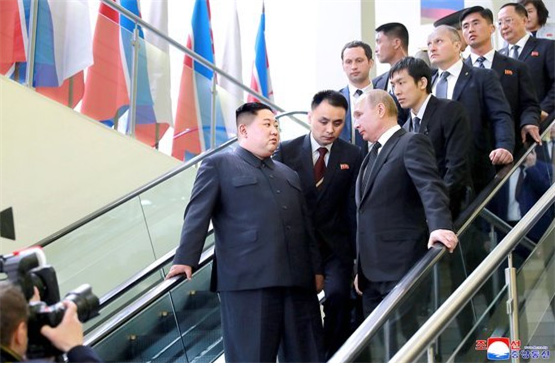
North Korean leader Kim Jong-un meeting with Russian President Vladimir Putin for a summit in Vladivostok, in April 2019 (Photo by Korean Central News Agency)
In 2019, Kim Jong-un returned from his first visit to Russia without any notable achievements. At that time, following the 'Hanoi No Deal', Kim Jong-un had hoped for a partial easing of sanctions on North Korea through Russia and support for a solution to denuclearization. However, Putin demanded 'complete denuclearization' from North Korea and announced he would share related matters with the U.S. and China. Contrary to Kim Jong-un's expectations, Russia made it clear that their stance on the denuclearization issue was the same as that of the U.S. Subsequently, Kim Jong-un canceled all his scheduled inspection plans for the next day and headed back home seven hours earlier than planned. This has led to evaluations describing Kim Jong-un's meeting with Putin as an 'empty-handed summit'.
Relations between North Korea and Russia began to tighten after Russia's invasion of Ukraine last February. North Korea has actively supported Russia regarding the Ukraine war, opposing the UN's resolution condemning Russia (22 Feb), recognizing the Donetsk People's Republic in the Russian-occupied territory (22 July), and expressing hope to participate in post-war recovery. Kim Yo-jong, Kim Jong-un's younger sister and Deputy Director of the Workers' Party of Korea, criticized the U.S. support of tanks to Ukraine in a statement (23 Jan). Especially in a party conference last December, Kim Jong-un assessed recent international relations trends as 'new cold war and multipolarization', indicating the intent to find new opportunities amid strengthening confrontations between South Korea-U.S.-Japan and North Korea-China-Russia. The visit of Russian Defense Minister Sergei Shoigu to North Korea last July marked the pinnacle of covert ties between North Korea and Russia.
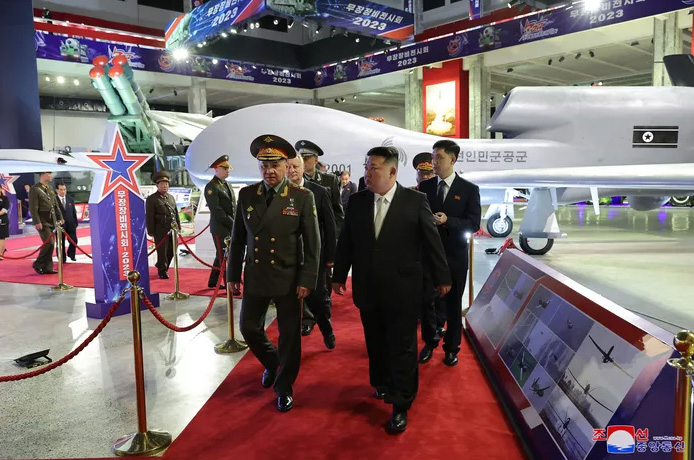
North Korean leader Kim Jong-un, visiting an arms exhibition with a Russian military delegation on the 70th anniversary of the 'Victory Day,' Korean War Armistice Agreement Anniversary, on the 26th (Photo by Korean Central News Agency)
If Kim Jong-un's visit to Russia materializes, the formalization of military cooperation between North Korea and Russia might lead to the potential collapse of the UN Security Council's North Korea sanctions regime. Russia might receive ammunition and weapons for deployment in the Ukraine war from North Korea, while North Korea might receive advanced technology for the enhancement of nuclear and missile capabilities as well as sanctioned goods such as food and oil from Russia. This undermines the Security Council's sanctions on North Korea, which prohibit the import/export, sale, and transfer of all conventional weapons and WMDs, especially when spearheaded by Russia, a permanent member. Currently, due to the opposition from Russia and China, both permanent members of the Security Council, new sanctions against North Korean provocations cannot be adopted. Furthermore, as Russia recently mentioned the possibility of the first-ever joint military exercise between North Korea, China, and Russia, security concerns in Northeast Asia are escalating.
The backdrop to Kim Jong-un's visit to Russia this time appears to reflect Putin's desperate situation, weakened by the prolonged Ukraine war, the shattered economy due to Western sanctions, diplomatic isolation, and armed rebellions by mercenaries. Even China, Russia's ally, seems to be distancing itself from Russia regarding the Ukraine war. In such a situation, North Korea might be the only country willing to brazenly disregard international criticism and sanctions to directly support Russia with ammunition and weapons.
Russia, a permanent member of the United Nations Security Council, should not grant absolution to North Korea, which blatantly violates UNSC resolutions and threatens international stability with its provocations. North Korea should also abandon the misguided notion that closely aligning with Russia, which is in a dire situation, is their only way out. They should adhere to the UNSC resolutions and engage in denuclearization negotiations. The potentially perilous arms trade between North Korea and Russia, with the potential to undermine the sanctions regime against North Korea and destabilize the region, requires an immediate and urgent cessation.
-
PREV [North Korea News]
-
NEXT [NK Focus]