

Potential North Korean Satellite Launch on Party Foundation Day: Russian Technical Assistance in the Spotlight
As North Korea signals its intent to launch a third military satellite, eyes turn towards the significance of Party Foundation Day, slated for the 10th. This year marks the 78th commemoration of the day, and while not a rounded milestone, its political weight could make it the chosen date. Such a successful launch would be a monumental accolade for Kim Jong-un, demonstrating both military prowess and further consolidating the regime's power. Yet, the ongoing Asian Games in Hangzhou, China might cause a delay, pushing the launch to mid-October. The potential involvement of Russia, providing technical aid, is generating buzz among international observers.
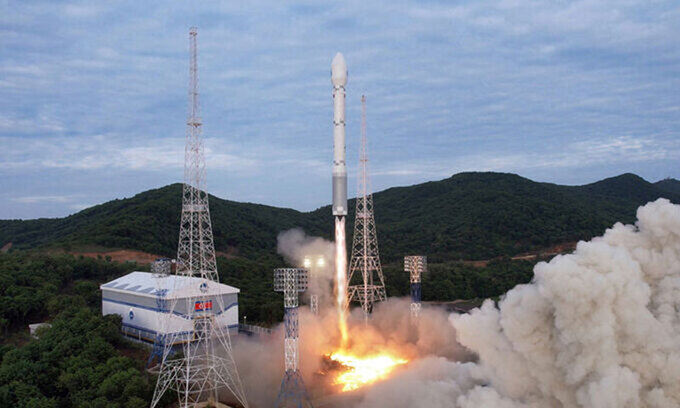
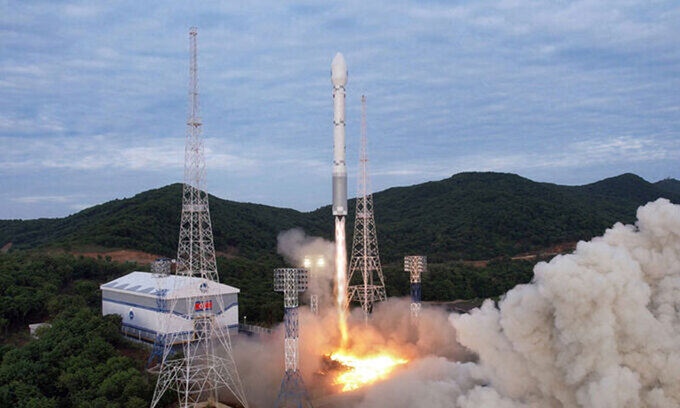
The rocket, 'Military Reconnaissance Satellite' Manlyeong 1st model launches from Sohae Satellite Station, North Phyongan, North Korea, on May 31st / Photo by Korean Central News Agency
Reports from the Korean Central News Agency on the 3rd relay that North Korea has admitted to the unsuccessful second attempt at launching a military reconnaissance satellite on August 24th. The statement suggested a thorough investigation into the failure, pledging a third attempt in October. Their first try on May 31st also didn't pan out. A mere 85 days later, a second attempt was made, which unfortunately culminated in another crash.
The North Korean regime attributed the failure of the initial launch to issues encountered post-separation of the first stage, specifically abnormalities during the ignition of the second-stage engine. The subsequent launch seemed promising as they managed to rectify the second-stage engine glitch, only to encounter problems with the 'flight termination system' during the satellite's third stage. However, they seem optimistic about a re-launch, hinting that some software tweaks might solve the issue.
Speculations are rife about the timing of the next launch. With the 78th Party Foundation Day on the horizon, many anticipate a launch around this significant date. Yet, the festivities of the Asian Games in Hangzhou, China, might nudge the timeline to mid-October. If collaborations between Russia and North Korea materialize for this satellite initiative, it would demand some preparatory time, possibly earmarking the latter half of the month for the launch.
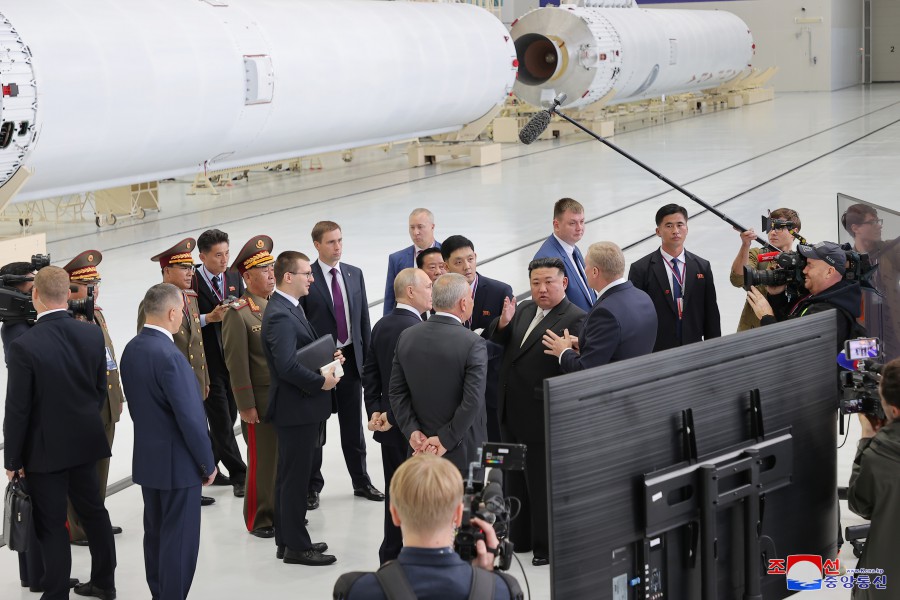
Chairman Kim Jong-un of North Korea alongside Russian President Vladimir Putin at Vostochny Cosmodrome, September 13th / Photo by Korean Central News Agency
Speculation surrounds Russia's potential technical support for North Korea's upcoming satellite launch. Last September, Kim Jong-un met Putin at Russia's Vostochny Cosmodrome, closely inspecting its facilities. When queried about assisting North Korea's satellite project during the summit, Putin hinted at collaboration, stating, "That's why we are here at the cosmodrome."
Russia, renowned for its advanced rocket technology, could aid North Korea's third satellite launch and boost their rocket and ICBM capabilities. Potential North Korea-Russia satellite collaborations might encompass Russian spacecraft provision, development support for North Korea's 'Chollima-1' rockets, main satellite body assistance, advanced testing equipment supply, and shared reconnaissance satellite use.
Chairman Kim Jong-un's keen interest in reconnaissance satellite development became evident after he assumed power and prioritized space development. In April 2012, a year into his leadership, North Korea's artificial satellite launch failed. However, they achieved success with the 'Kwangmyongsong-3' unit 2 launch in December. By April 2013, they founded NADA (National Aerospace Technology General Bureau of the DPRK) and later, in 2016, launched 'Kwangmyongsong-4'. Despite its orbit placement, the satellite's operational status remains uncertain as no images or videos have been shared.
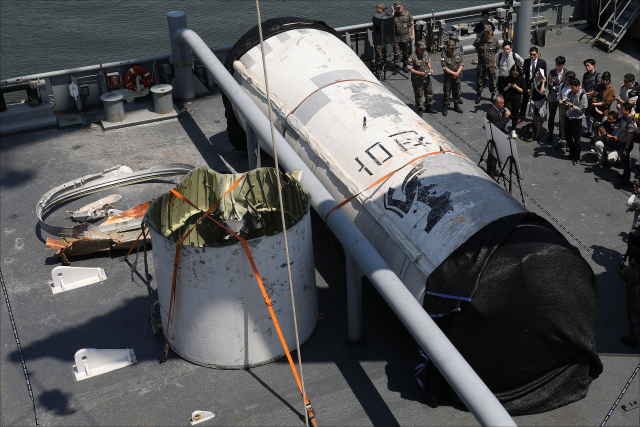
South Korea's navy displays remnants of the North Korean Chollima-1 rocket salvaged from the western sea, showcased at the Second Fleet Command, Pyeongtaek City, on June 15th / Photo by Joint Press Corps
During the 8th Congress of the Workers' Party of Korea in January 2021, Kim Jong-un emphasized the development of a military reconnaissance satellite as a top defense priority. Given North Korea's accelerated efforts in developing ICBMs aimed at the U.S. and tactical nuclear-armed short-range missiles for South Korea, the push for enhanced 'surveillance and reconnaissance assets' became imperative for their evolving arsenal.
Russia's willingness to provide North Korea with advanced military technology remains uncertain. Historically, countries at the forefront of military innovation have been hesitant to share critical advancements, such as rockets or nuclear technologies. Given this, Russia may be reluctant to divulge its state-of-the-art military secrets.
From Russia's viewpoint, while there's an immediate demand for ammunition from North Korea, the dynamics might shift if tensions in Ukraine simmer down or a ceasefire emerges. If so, North Korea's primary value to Russia could be supplying labor for reconstruction in regions like Donetsk, under Russian control. Consequently, some analysts believe that Russia might prioritize aid in the form of traditional weaponry over sharing advanced technologies. This could involve Russia offering essential supplies like food, fertilizers, and energy to North Korea, as well as parts for weapons such as the 'MiG-29', which North Korea finds challenging to procure.
Moreover, given Russia's agreement to the sanctions imposed on North Korea, including the United Nations Security Council Resolution 2397 from December 2017, any technology transfer, especially satellite technology, might subject Russia to further international penalties. Should North Korea, potentially with Russian assistance, fail in another satellite launch attempt in October, any debris landing near the Korean peninsula could reveal the depth of cooperation between Russia and North Korea.