

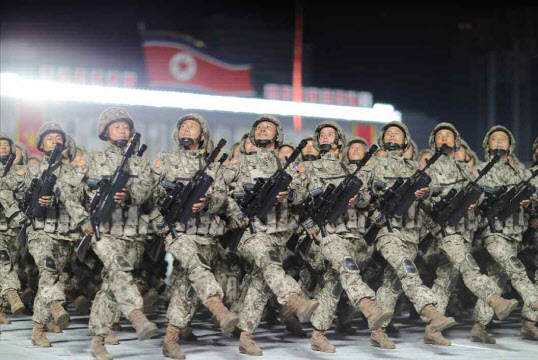
Revealing the Challenging Realities of North Korean Military Life Behind the Grand Parades
North Korea has flexed its military might with three grand military parades this year. However, beneath the spectacle lies a stark reality: North Korean soldiers struggle to secure three full meals a day due to severe food shortages. Amidst ongoing economic hardships, disturbing reports of corruption within the North Korean military, involving bribery and embezzlement of food supplies, have surfaced. Additionally, incidents of physical assaults and accidents within military units persist, as does the longstanding issue of sexual violence against female soldiers. The younger generation of soldiers, often referred to as the "Jangmadang generation," is reportedly showing significantly diminished loyalty. Recently, South Korea's Ministry of National Defense voiced concerns that North Korea might resort to various strategic and tactical provocations, including a seventh nuclear test, in response to internal dissatisfaction stemming from food shortages and failed economic policies.
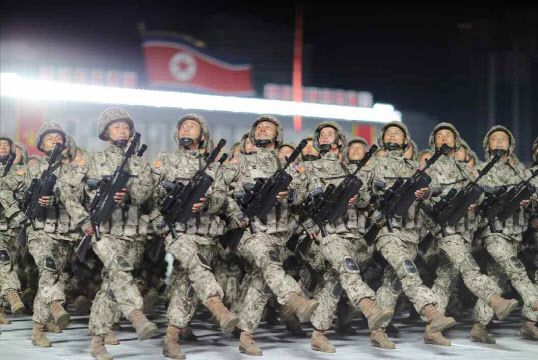
Soldiers mark Korean People's Army Foundation Day with a grand military parade on February 8, 2023. / Rodong Sinmun
In 2013, North Korea initiated the 'Byungjin policy (parallel development),' which aimed to simultaneously develop nuclear weapons and the economy. Part of the policy involved a promise that, once nuclear capabilities were achieved, some funds would be redirected to improve soldiers' rations and enhance civilian living standards. However, by November 2017, when North Korea declared the completion of its nuclear capabilities, heavy international sanctions had eroded the regime's ability to fulfill this promise. Instead of bolstering civilian welfare, military rations had to be managed on a unit-by-unit basis through 'Self-reliance.' Despite North Korea's status as one of the world's poorest nations, with 24% of its GDP allocated to the military, most of these resources were channeled into nuclear and missile development, leaving soldiers with inadequate rations.
Consequently, North Korean soldiers typically consume meals primarily composed of corn rice, with rice mixed with corn reserved for special occasions. According to North Korean defectors who served in the military, the official ration per soldier should be 200g per meal. In practice, this often falls significantly short due to embezzlement by commanding officers.
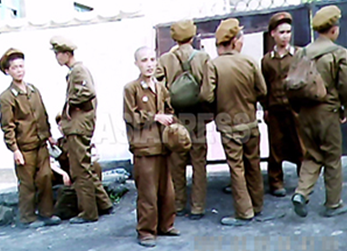
In 2011, North Korean soldiers, malnourished due to chronic starvation, await a train. / ASIAPRESS INTERNATIONAL
According to the 2018 report 'Prisoners in Military Uniform' by the Database Center for North Korean Human Rights (NKDB), North Korean soldiers experience insufficient rations due to corruption and embezzlement by senior officers during food distribution.
Mr. No Cheol-min, who defected from North Korea via the Korean Demilitarized Zone (DMZ) in 2017, disclosed that a North Korean military officer's monthly salary could purchase only 1 kilogram of rice in the Jangmadang (North Korea's local market). In contrast, a soldier's monthly salary equated to the price of a pack of cigarettes. Mr. Lim Kang-jin, another North Korean defector and a former battalion commander with 27 years of service, received a meager retirement payment of approximately 10,000 North Korean won (about $1.20 USD). During his military tenure, his monthly salary was just 3,500 North Korean won (approximately $0.35 USD).
In stark contrast, the salary for South Korean military personnel this year, based on a corporal rank, stands at 1,000,000 won (approximately $737 USD) per month. It is slated to increase to 1,250,000 won (about $922 USD) in 2024 and 1,500,000 won (around $1,100 USD) in 2025, making it more than 736 times higher than the salary of a high-ranking North Korean military officer.
Mr. No Cheol-min also shared his experience of standing guard for 13 hours a day during winters with temperatures plummeting to -40°C in the DMZ. He endured these harsh conditions while wearing clothing with minimal insulation. Considering that DMZ units are comparatively better supplied than other North Korean military units, the conditions elsewhere are likely even more challenging.
In this harsh environment, many North Korean soldiers are diverted from military training to engage in various side jobs, including farming, goat raising, and fishing, simply to survive. To combat hunger and malnutrition, soldiers sometimes resort to theft in civilian areas, raiding food storage on farms and pilfering dogs, pigs, chickens, and even cabbage and radishes meant for kimchi preparation.
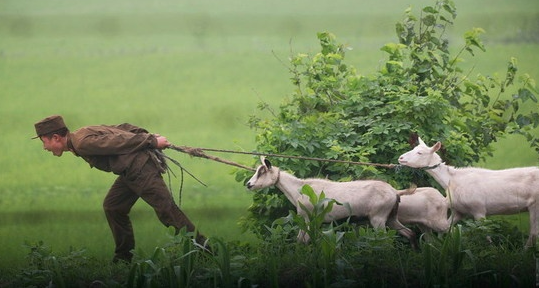
A North Korean soldier guiding a goat along the North Korea-China border in the mid-2000s. / Free North Korea Radio
One of the major issues in the North Korean military is the widespread culture of "bribes." Much like Newton's Third Law of Physics states that 'for every action, there is an equal and opposite reaction,' in the realm of human behavior in North Korea, they say that when you offer someone money or a bribe, their actions tend to reflect the incentive given. Soldiers often have to offer bribes to superiors and administrators to obtain permissions such as "joining the army," "going out," "visits," and even "early discharge." The long, grueling 10-year military service period, which takes a toll on the physical and mental health of North Korean youth, has also been a subject of criticism. Persistent problems, such as sexual violence against female soldiers, continue unabated.
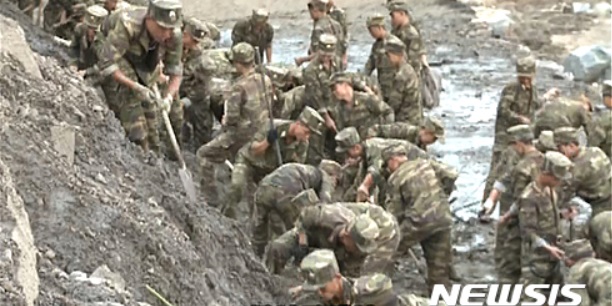
North Korean soldiers, armed with shovels and tools, mobilize for embankment construction. / Newsis
Especially during Kim Jong-un's leadership, another grave issue has emerged—the increased deployment of military personnel across various sectors of society. This has resulted in labor exploitation, posing safety threats due to inadequate safety equipment and sleep durations of less than 2 hours. Despite Kim Jong-un's initial policies aimed at eradicating corruption and ending physical abuse and cruelty within the military, the impact of these measures has proven to be short-lived.
The challenging living conditions and poor treatment of soldiers have become widely known in North Korean society, leading to a negative perception of "military enlistment" among North Korean youth. The dwindling number of male enlistment applicants indicates a diminishing status for "military enlistment" as a pathway for social advancement. Observations suggest that the introduction of "mandatory female military service" in April 2015 in North Korea was a response to the decline in male enlistment applicants. This sobering reality lies hidden behind the grand military parades of North Korea.