


Kim Myungsung
SAND's Secretary
General Editor for the SAND Newsletter
⦁ Daring Journey to Freedom: Four North Koreans Execute ‘Long-Term Plan Escaping’ on a Wooden Boat
⦁ North Korea Masks Food Crisis with Grand Harvest Claims
⦁ North Korea Retracts Global Footprint: Embassies Close in Uganda, Spain, and Hong Kong Amidst Currency Woes
Daring Journey to Freedom: Four North Koreans Execute ‘Long-Term Plan Escaping’ on a Wooden Boat
In the early morning of October 24th, four North Korean residents navigated a small wooden boat across the Northern Limit Line, setting course for a new life in South Korea. During their debriefing, they spoke of their admiration for South Korean society—a view shaped by various sources depicting its better living conditions. Their defection, they revealed, was the culmination of a carefully thought-out, long-term plan.
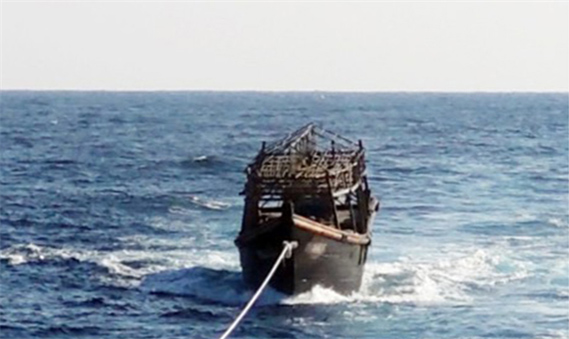
Transferring a wooden boat back to North Korea, used by its residents in 2019 / Ministry of Unification
Back in May, two families embarked on a daring journey, navigating a fishing boat across the NLL to find sanctuary in South Korea. They had covertly accessed South Korean TV broadcasts and received flash drives filled with information from defector organizations inside North Korea, spreading awareness through balloon propaganda.
Facing severe food shortages and oppressive rule in North Korea, they meticulously planned their escape, addressing every detail with care.
Taking advantage of reduced North Korean surveillance, four family members made their escape on a modest wooden boat. Now secure in South Korea, the group—comprising three women, one in her 60s, and a man—are all in stable health.
This recent maritime defection, echoing incidents from May, indicates a possible surge despite the ongoing closure of the North Korean-Chinese border.
Third-quarter data from this year shows that 40 North Korean defectors have arrived in South Korea, totaling 139 individuals up to September— a notable increase from the 42 documented in the same timeframe last year. Prior to the COVID-19 pandemic, yearly defections regularly exceeded 1,000.
Officials from the Ministry of Unification explained the recent increase in defections, attributing it to "the partial reopening of borders and eased travel restrictions within China. However, accurately projecting future numbers is complicated due to numerous factors, and it’s uncertain if defections will ever reach pre-COVID-19 figures again."
North Korea Masks Food Crisis with Grand Harvest Claims
On October 25th, Rodong Sinmun, North Korea's main state newspaper, boasted of a supposed record harvest in South Hwanghae Province, describing an unprecedented bounty with claims of paddies yielding over double their usual output.
Some suspect that this narrative is a strategic move to enhance Kim Jong-un's image as he tackles the nation's food shortage crisis.
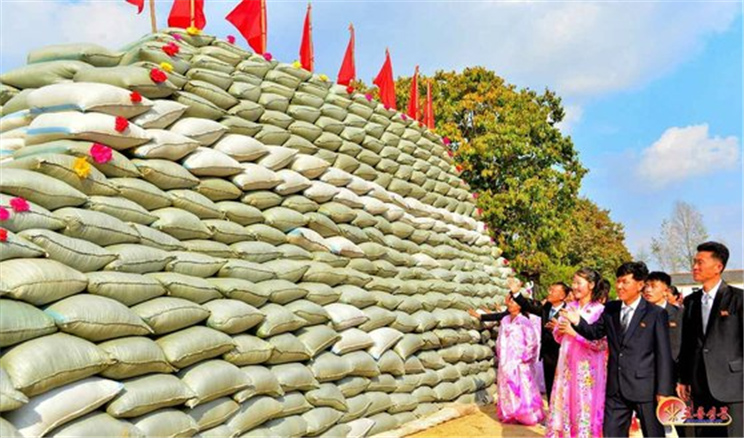
It highlights the successful distribution of rice from the fertile fields of South Hwanghae Province. / Rodong Sinmun
On the ground, there has been a notable drop in grain prices within North Korea. AsiaPress International, a Japanese media outlet specializing in North Korean affairs, reported that the price of corn hit its lowest for the year at 2,550 North Korean won per kilogram as of October 20th. Even rice, which had surged to 6,800 won per kilogram in September, saw a decrease to 5,700 won.
This year’s harvest has seen a turn for the better compared to the last, where poor weather conditions severely affected crop yields. However, despite these improvements and the current favorable weather conditions, experts are unanimous in their opinion that it falls short of resolving the longstanding issue of food shortages.
Kwon Tae-jin, Director of the GS&J Institute and an agricultural expert, shared his insights, stating, "This year’s favorable weather and external factors such as grain imports have indeed played a part in boosting North Korea’s grain harvest compared to previous years. However, these partial improvements are far from sufficient in addressing the chronic food shortages." The root of the issue lies in the limitations of the socialist collective farming system employed in North Korea, and experts agree that without a substantial overhaul through reform and opening up, solving the food crisis remains a distant dream.
In a report titled "Conflict between Distribution and Markets," published on October 12th, researcher Lim Su-ho from the Institute for National Security Strategy (INSS) highlighted a stark reality: From 2020 to 2022, North Korea’s per capita grain supply nosedived to 182 kilograms, even lower than the 201 kilograms average during the Arduous March period from 1994 to 1999.
Lim Su-ho attributes this severe supply crisis to the government’s shift from a "distribution-market parallel system" to a "grain monopoly system" under the "grain preemption system," which centralizes grain distribution control in the hands of the state. He suggests that the food situation in North Korea is likely far worse than official reports indicate, with low-income groups bearing the brunt of the impact.
Alarmingly, if North Korea persists in sidelining marketplaces (“Jangmadang”) and maintains its direct control over grain production and distribution under the “new grain policy” (which mandates that grains produced in each region’s farms be sold according to a planned schedule, leaving no surplus), there is a looming threat of another food shortage crisis as early as next spring.
North Korea Retracts Global Footprint: Embassies Close in Uganda, Spain, and Hong Kong Amidst Currency Woes
North Korea has been confirmed to be withdrawing its diplomatic mission in Spain, following a series of embassy closures across Africa. It is reported that around ten foreign missions are being shut down, including the consulate in Hong Kong, China, due to the increased international sanctions on North Korea making it financially challenging to maintain these diplomatic posts.
In addition, after more than 50 years, North Korea has withdrawn its embassy from Uganda, a key diplomatic hub in East Africa. On October 25th, Ugandan media outlets including The Independent reported that the North Korean Ambassador to Uganda, Jeong Dong-hak, explained during a visit to Ugandan President Yoweri Kaguta Tibuhaburwa Museveni, "To enhance the efficiency of our foreign institutions, North Korea is adopting a strategy of reducing the number of embassies in Africa, and Uganda is included in this plan."
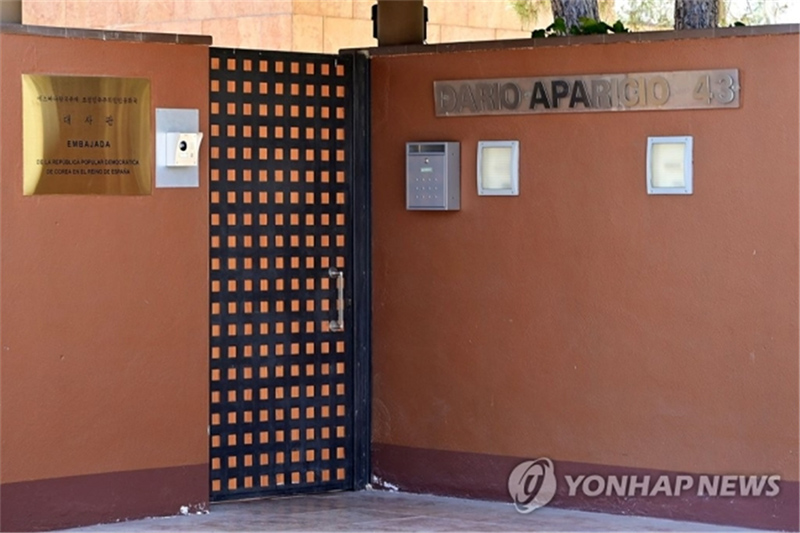
The main gateway to the North Korean Embassy in Spain / Yonhap News Agency
Amidst these developments, North Korea has also withdrawn its embassy in Spain. According to a diplomatic document titled "Draft" published on November 1st by the Communist Party of the People of Spain (Partido Comunista de los Pueblos de España (PCPE)), the acting charge d'affaires of the North Korean embassy in Spain, Seo Yun-seok, announced the withdrawal of the North Korean diplomatic mission on October 26th, and stated that the Italian embassy in Spain would handle related matters in the future.
Recently, North Korea has shown a trend of downsizing its foreign embassies. News of the closure of diplomatic missions in Uganda and Angola in Africa around October 25th was reported through North Korean media, and there were reports in foreign media that the North Korean Consulate General in Hong Kong had informed China of its plan to close.
Ryu Hyeon-woo, a former North Korean deputy ambassador to Kuwait who defected in 2019, stated that the closure of North Korean overseas missions had been decided before the spread of COVID-19.
He added, "Due to the exacerbation of North Korea's overall financial situation, which was influenced by the effects of sanctions following the 2019 missile launch, North Korea reached a point where it could not guarantee foreign currency."
He believed that the process of closing North Korean embassies had been temporarily halted due to the spread of COVID-19, but it had resumed recently following measures to ease the pandemic and reopen borders.
The United Nations Security Council imposed successive sanctions against North Korea in 2016 after North Korea's fourth and fifth nuclear tests, and these sanctions have been strengthened. African countries, including Angola and Uganda, also participated in these sanctions and expelled North Korean construction workers, laborers, and military advisors in 2017.
Ryu said, "There may be further closures of embassies," and he considered Senegal, Guinea, Nepal, Libya, and Algeria to be likely candidates.
Until the closure of embassies in the African region, North Korea operated embassies (47 embassies, 3 consulates general, 3 representative offices) in 53 countries worldwide. Thae Yong-ho, a former North Korean diplomat who defected and is now a member of South Korea's People Power Party, stated in a Facebook post on October 31st regarding North Korea's recent series of embassy closures, "North Korea's simultaneous withdrawal of numerous overseas embassies is the first time in over 20 years since the 'Arduous March' crisis of the late 1990s."
-
PREV [Issue Brief]
-
NEXT [Issue Brief]