

U.S.-North Korea Relations During Donald Trump's Second Term:
Assessment and Prospects

Hwang Jihwan
Professor, University of Seoul
The Return of the ‘America First’ Policy Toward North Korea
Donald Trump has returned. As the Joe Biden administration took a passive approach to North Korea, some hold high hopes for a fresh policy under Trump. However, to state it plainly, such optimism may amount to nothing more than wishful thinking.
Biden largely adhered to Barack Obama’s “Strategic Patience” policy, which maintained that the U.S. would only engage actively if North Korea altered its behavior. While Biden characterized his policy as “calibrated and practical,” he offered no clear roadmap or actionable plan.
The rapidly shifting international landscape, including Russia’s invasion of Ukraine in February 2022 and Hamas’ attack on Israel in October 2023, further diminished Biden’s ability to prioritize North Korea. Even if Trump’s return ushers in shifts in Ukraine or the Middle East, it is uncertain whether U.S.-North Korea relations will see any meaningful breakthroughs.
During Trump’s first term, his approach to North Korea differed significantly, driven by his “America First” foreign policy. Trump framed U.S. interests in transactional terms, focusing on costs and benefits over democracy or normative values.

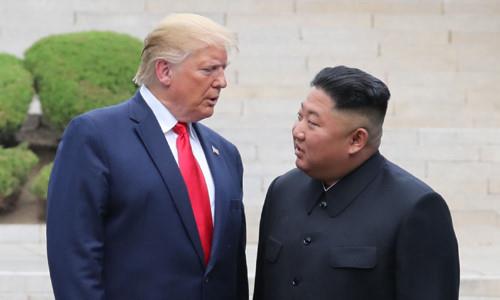
Trump and Kim Jong Un Meet at Panmunjom in June 2019
In his 2018 speech at the UN General Assembly, Trump stressed “principled realism,” declaring that the U.S. would not be bound by “old dogmas” or “discredited ideologies.” This signaled that Trump was open to improving relations with North Korea if it aligned with his interpretation of U.S. interests. His remarks at the 2018 North Korea–United States Singapore Summit further underscored this approach: “The past does not have to define the future. Yesterday’s conflict does not have to be tomorrow’s war. And as history has proven, adversaries can indeed become friends.”
Despite these ambitions, Trump’s efforts with North Korea yielded no tangible results. Meetings with Kim Jong-un in Singapore and Hanoi failed to produce substantive outcomes, as North Korea fell short of meeting the expectations tied to Trump’s vision of U.S. interests. As Trump re-enters the White House, he is likely to focus first on domestic issues like the economy and immigration.
In foreign affairs, his initial priority will probably be ending the conflicts in Ukraine and Gaza to reshape the global order. Only after progress in these areas might he consider a summit with Kim Jong-un. Even then, it remains uncertain whether Kim would engage with Trump in the same manner as before. Thus, the hope for improved U.S.-North Korea relations during Trump’s second term appears to be more wishful thinking than a realistic expectation.
Kim Jong-un Is Not Ready to Talk with Trump, Yet
The obstacles to progress in U.S.-North Korea relations during Trump’s second term are not limited to the American side; North Korea also plays a key role. Trump has repeatedly expressed willingness to hold another summit with Kim Jong-un, even appointing Alex Wong—who worked on Trump-Kim summits during his first term—as Deputy National Security Advisor. Yet, Kim firmly rejected these overtures, criticizing the U.S.’s hostile stance and asserting, “We have exhausted all avenues for negotiation with the U.S.”
Kim’s stance remains rooted in the aftermath of the failed Hanoi summit in February 2019. After conducting a sixth nuclear test and launching the Hwasong-15 ICBM, Kim declared North Korea’s nuclear deterrence capability complete in November 2017. This appears to have been a move to negotiate with Trump in hopes of securing strategic concessions.
However, the collapse of the Hanoi talks led Kim to abandon hopes of diplomatic engagement, opting instead for a “head-on breakthrough” strategy. At the 8th Congress of the Workers’ Party of Korea in January 2021, Kim committed to advancing North Korea’s nuclear capabilities—a pursuit that continues aggressively. Without renewed confidence in its nuclear and missile programs, Kim is unlikely to reopen negotiations with Trump.
Kim’s perception of the global order has also changed drastically since 2018. With the intensification of U.S.-China rivalry and Russia’s invasion of Ukraine, North Korea views the world as entering a new cold war and shifting toward a multipolar system.
Kim believes this evolving dynamic will enhance North Korea’s security environment. To this end, he has actively supported Russia in the Ukraine war, signing a “Treaty on Comprehensive Strategic Partnership” with Russia in June, which includes provisions for military aid, and even deploying troops to assist Russia. Given this context, North Korea is expected to prioritize strengthening its alliances with Russia and China over pursuing improved ties with the U.S.
Conclusion
Managing North Korea issues in Trump’s second term will be a significant challenge. While his approach might shift, any changes—similar to the unexpected Trump-Kim summits—are likely to be unpredictable, leaving meaningful progress uncertain.