

North Korea’s Key Activities in April–May
- Stability and International Leverage via the Russia–Ukraine War -

Lee Seung-hyun
Ph.D in Public Administration (Research Fellow at the SAND Institute)
From April to May 2025, North Korea took notable steps to bolster its military and reshape foreign policy, signaling a shift in both regional and global security dynamics. During this time, Pyongyang deepened military ties with Russia, highlighted its self-reliant defense capabilities, and reinforced domestic unity.
On May 9, Kim Jong-un, joined by his daughter Kim Ju-ae, visited the Russian Embassy in Pyongyang to mark the 80th anniversary of World War II’s Victory Day. He reaffirmed North Korea’s alliance with Russia and stressed continued strategic cooperation.
On April 6, North Korea revived the Pyongyang International Marathon after a six-year pause due to the pandemic—likely an effort to boost internal morale and promote a stable national image abroad. Just two days later, on April 8, North Korean troops briefly crossed into the southern side of the eastern DMZ before retreating after warning shots from South Korean forces—an incident that heightened cross-border tensions.
The provocation suggests Pyongyang may be prepared to raise the stakes in future encounters to legitimize potential military actions.
Further highlighting its military ambitions, North Korea launched the 5,000-ton Choe Hyon-class destroyer on April 25. Equipped with a Vertical Launching System and Phased Array Radar, the warship supports Kim Jong-un’s goal of enhancing long-range naval power. It appears to be part of a broader strategy to assert dominance in regional maritime competition.
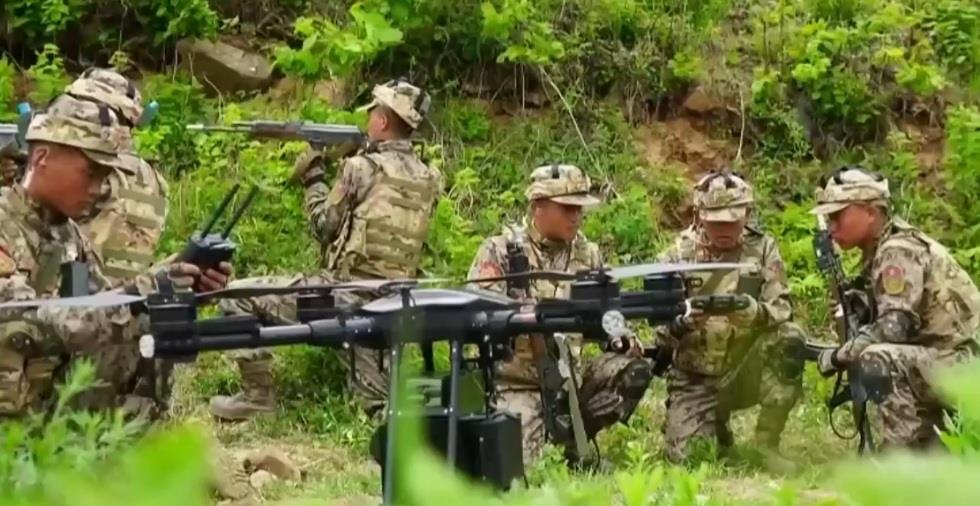
"The Korean Central News Agency (KCNA) reported on the 14th that North Korean troops were engaged
in drone training exercises."
Toward the end of April, test launches from the vessel included cruise missiles, surface-to-air missiles, and a 127mm naval gun—concrete steps toward improving the country's maritime strike power.
In another notable move, North Korea officially confirmed the deployment of about 15,000 troops to Russia’s Kursk region in late April. Kim Jong-un framed the action as “defending a brother nation” and praised the soldiers as national heroes. This marks a clear shift from North Korea’s traditional isolationism toward active involvement in global conflicts.
Reports also indicate that Russia has been providing North Korea with satellite, drone, and missile technologies—evidence of deepening strategic ties that are helping advance Pyongyang’s military capabilities.
Further reinforcing its military alliance with Russia, North Korea has been ramping up its arms production. In early May, Kim Jong-un inspected the Cheonma-2 tank manufacturing facility, highlighting the regime’s push for modernized armored forces.
The Cheonma-2 reportedly blends technology from the U.S. M1A2 Abrams and Russia’s T-14 Armata, featuring advanced defensive systems such as explosive reactive armor and active protection. These innovations represent a major upgrade for North Korea’s tank corps.
Kim also visited ammunition factories, praised the doubling of artillery shell production, and called for further increases—moves likely tied to ongoing arms support for Russia and aimed at strengthening North Korea’s defense industry.
On May 8, Pyongyang test-launched a short-range ballistic missile from Wonsan into the East Sea, potentially to demonstrate the capabilities of weapons intended for export and to send a pointed message to the international community.
Taken together, North Korea’s actions in April and May 2025 reveal a regime pursuing military buildup, diplomatic assertiveness, and internal solidarity in tandem, aiming to solidify its grip on power and expand its global influence.
A localized provocation at the eastern DMZ in mid-April escalated tensions with the South, suggesting an effort to normalize military confrontation on the peninsula. This was soon followed by the disclosure of troop deployment to Russia, justified under the banner of fraternal defense, which signals Pyongyang’s readiness to engage in broader geopolitical conflicts.
Meanwhile, the unveiling of the Choe Hyon-class destroyer, cruise missile tests, and other demonstrations reflect tangible progress in enhancing North Korea’s naval and precision strike capabilities.
In early May, Kim Jong-un reaffirmed his commitment to modernizing ground forces during a visit to the Cheonma-2 tank plant. Simultaneously, expanded munitions production appears aimed at both enhancing wartime readiness and positioning North Korea as a potential arms exporter.
The short-range ballistic missile test on May 8 was likely intended to publicly validate the effectiveness of its weapons. The next day, Kim’s visit with his daughter to the Russian Embassy for Victory Day celebrations offered a symbolic gesture of the strengthening strategic alliance with Moscow.
Taken together, these actions suggest North Korea is pursuing three parallel goals: advancing military technology, strengthening ties with Russia, and ramping up domestic propaganda. This signals a clear break from past isolationism and the emergence of a more active, multi-pronged survival strategy.