

North Korea–Russia Military Ties and Kim Jong-un’s Mention of South Korea
- Strategic Messaging and the Risk of Provocation -

Lee Seung-hyun
Ph.D in Public Administration (Research Fellow at the SAND Institute)
In recent months, deepening North Korea–Russia ties have brought their military cooperation into sharper and more public focus. Notably, Kim Jong-un spoke of sending troops to support Russia, linking the move to instability on the Korean Peninsula. Given its political and military implications, the statement warrants close examination of the strategic context and potential consequences.
Kim Jong-un’s mention of “South Korea” appears to be a calculated move to strengthen solidarity with Russia by framing a common adversary. As Russia contends with Western-backed forces in Ukraine, North Korea finds itself increasingly isolated under growing pressure from the U.S., South Korea, and Japan. By framing Korean Peninsula instability as a reason for military support to Russia, Kim is signaling more than internal propaganda—he is positioning North Korea as a committed and dependable ally to Moscow in a broader strategic alignment.
Put simply, Kim Jong-un’s direct reference to South Korea alongside talk of deploying troops underscores a shift in strategy that cannot be dismissed as symbolic posturing. It reflects North Korea’s attempt to recalibrate its role within a newly forming bloc reminiscent of Cold War divisions, with military cooperation between Pyongyang and Moscow becoming a critical axis of that effort.
Kim’s reference to South Korea reflects layered motives, chiefly to counter the strengthening security ties among South Korea, the U.S., and Japan. As these alliances bolster their deterrence posture, Pyongyang aims to highlight its partnership with Moscow. Framing South Korea as a hostile threat allows North Korea to justify its alliance with Russia as a defensive move, lending it political and diplomatic legitimacy.
North Korea’s follow-up actions have reinforced the seriousness of its rhetoric. The country has reportedly been delivering artillery and missile supplies to Russia, receiving advanced military technologies in return. This exchange seems to be accelerating North Korea’s development of high-end systems such as satellite launch platforms and hypersonic missiles.
North Korea has reportedly resumed solid-fuel ICBM testing and is preparing another reconnaissance satellite launch. These moves showcase both the results of its cooperation with Russia and a broader display of military strength. In effect, ongoing arms transfers to Russia appear to be reciprocated with advanced technologies—such as satellite systems, solid-fuel propulsion, and hypersonic missile tech—now evident in North Korea’s latest weapons and test launches.
A pressing concern is that these developments may soon manifest as real-world provocations. Kim’s statement could provide the rationale for future weapons tests or targeted military actions. Whether it’s launching another reconnaissance satellite, testing more solid-fuel ICBMs, or instigating skirmishes near the DMZ or maritime boundaries, each of these scenarios fits into a broader strategy to enhance and legitimize North Korea’s strategic arsenal.
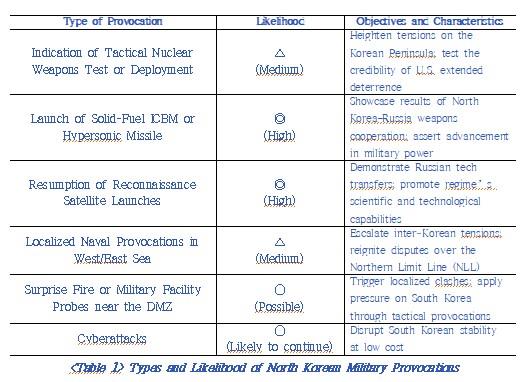
North Korea’s agenda is becoming increasingly transparent. By invoking external threats, it aims to legitimize its aggressive military path, deepen its alliance with Russia, and leverage its standoff with the South Korea–U.S.–Japan partnership. Whether through immediate provocations or more sustained military demonstrations, rising tensions on the Peninsula appear inevitable. As joint drills and international sanctions continue, North Korea’s provocations are expected to grow in both scale and frequency. The table below outlines the potential forms and likelihood of such actions.
In summary, Kim Jong-un’s mention of South Korea in connection with sending troops to Russia is a calculated move driven by strategic, political, and psychological motives. It signals both a response to the South Korea–U.S.–Japan alliance and an effort to deepen military ties with Russia. As this alignment strengthens, North Korea is likely to accelerate its weapons development and provoke more frequently, heightening regional tensions. In response, South Korea must strengthen its defense and cyber posture, and enhance deterrence coordination with allies to ensure credible extended deterrence.