


Kim Myongsung’s Inside North Korea
· North Korea Sees First-Ever Major Data Breach, Exposing 4.7 Million Mobile Users
· Iran’s Saturation Assault Overwhelms Iron Dome — A Strategy North Korea Has Long Embraced
· Officials Linked to Destroyer Incident Vanish from North Korean Coverage — First Instance Since Jang Song-thaek Purge

Kim Myong-sung

A source with insight into North Korean affairs disclosed that complete subscriber databases from Kangsong Net and Koryolink—North Korea’s two major telecoms—have been leaked. These files are reportedly selling for tens of millions of won (roughly $14,000 – $36,000), as mobile subscriptions in North Korea involve real-name and biometric data registration.
The breach is believed to have been orchestrated by a senior insider with access to internal telecom systems, rather than an external hacker. North Korean authorities were reportedly unaware until after the leak occurred, and have since launched full-scale audits and emergency measures.
North Korea has experienced serious internal data leaks before, including the exposure of a registry of 2.5 million Pyongyang residents and classified files from the military’s 3rd Corps. All cases involved insiders, underscoring weaknesses in the regime’s information control.
Whereas earlier breaches focused on military or regional data, this incident is unprecedented—impacting private citizens across the entire nation and amplifying the potential fallout.
For years, North Korea’s telecom network has functioned as a core tool of government surveillance and control. Yet repeated leaks of its real-name user data are revealing serious cracks in that system.
Signing up for mobile service in North Korea requires submission of full personal details—name, ID number, occupation, address, and photo. This information allows security agencies to monitor calls, messages, and user locations in real time.
Observers suggest this isn’t a failure of technology, but a breach stemming from deliberate internal theft—highlighting a human vulnerability in North Korea’s surveillance state.
One cybersecurity expert pointed out, “With 4.7 million affected users, this leak likely encompasses the vast majority of North Korea’s mobile phone users. If such data ends up with foreign or anti-regime groups, it would effectively expose the inner workings of North Korean society to the outside world.”
Iran’s recent multi-pronged missile and drone attack on Israel has once again showcased the power of saturation warfare. Analysts warn that similar tactics could soon be used on the Korean Peninsula, as North Korea has long been developing this approach with its growing and diversified missile arsenal targeting the South.
Reports indicate that Iran’s three-day retaliation exposed major flaws in Israel’s air defense. While the Iron Dome could intercept rockets, it faltered against the mix of medium-range ballistic missiles and drones fired en masse. At least 24 lives were lost and nearly 592 were injured in the attack.

Military insiders in South Korea see Iran’s attack as a real-world preview of the threat posed by North Korea’s evolving saturation tactics. Since 2022, Pyongyang has deployed hundreds of maneuverable short-range ballistic missiles like the KN-23, KN-24, and KN-25, alongside massive 600mm rocket launchers. One official said, “North Korea is operating large numbers of launchers capable of firing various missile types from land or sea.”
North Korea has tested this tactic in real-world drills. In January 2022 alone, it launched missiles on seven separate occasions—the highest monthly tally under Kim Jong-un—changing altitude, range, and launch sites to probe the limits of South Korea’s interception systems.
At the January 2021 8th Party Congress, North Korea unveiled a five-year defense blueprint that includes hypersonic missiles, solid-fuel ICBMs, and submarine-launched variants. Since then, it has conducted multiple hypersonic tests, launched KN-23s from trains, and boosted its cruise missile range to 1,800 km—putting both U.S. bases in South Korea and Japan within potential strike range.
On May 8, North Korea fired several short-range ballistic missiles into the East Sea over the span of an hour. Authorities believe the launch used a variety of platforms, including KN-23s and massive rocket artillery. Ranges varied from 200 to 800 kilometers. A defense official remarked, “It’s evident North Korea aimed to avoid early detection and throw off our air defense systems.”
Although South Korea asserts that its Korea Air and Missile Defense (KAMD) system can withstand such threats, Iran’s recent attack has raised doubts. If North Korea were to launch a similar large-scale strike, concerns are growing that the defense system could become overwhelmed. Some experts believe North Korea will likely fine-tune this tactic using lessons drawn from Iran’s operation.
Officials Linked to Destroyer Incident Vanish from North Korean Coverage — First Instance Since Jang Song-thaek Purge
After the recent grounding of North Korea’s new destroyer, the Kang Kon, key officials held responsible have abruptly vanished from state media coverage. It’s the first such disappearance since the 2013 execution of Jang Song-thaek. Analysts believe the penalties may be far harsher than what has been publicly disclosed, possibly including prison terms or even executions.
On June 14, NK News reported that Korean Central Television (KCTV) had edited out scenes from a recent re-launch broadcast of the Kang Kon destroyer. Missing from the updated footage were Navy Commander Kim Myong-sik and Chongjin Shipyard Director Hong Kil-ho, both of whom had accompanied Kim Jong-un during a March inspection.
Kim Myong-sik and Hong Kil-ho are believed to have borne primary responsibility for the destroyer’s failed launch. Hong was reportedly the first to be questioned after the incident. Though the regime has not confirmed any punishment, the replacement of Kim by Pak Kwang-sop as navy commander at the re-launch strongly suggests disciplinary action. Neither man appeared at the ceremony.
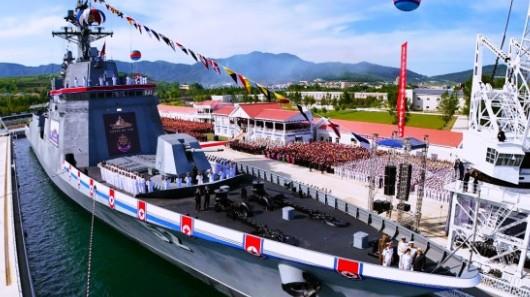
The deliberate omission of both men from broadcast footage is widely seen as a sign of severe internal punishment—possibly a purge. NK News noted that this is the first such media erasure since the Jang Song-thaek execution, suggesting the individuals may have been permanently stripped of their positions, imprisoned, or even executed.
Interestingly, Kim Myong-sik was seen as recently as May 30, wearing a general’s insignia at a Central Military Commission meeting. However, speculation is growing that he may have been disciplined at or shortly after that event.
Although the regime has officially confirmed only five arrests related to the destroyer mishap, many believe the scope of punishment extends further. Notably absent from the latest ceremony was Pak Jong-chon, Director of Military Affairs, who had been front and center at the Choe Hyon destroyer launch in April.
Earlier announcements from North Korea included the arrests of four additional figures: Chief Engineer Kang Jong-chol, Hull Assembly Supervisor Han Kyong-hak, and Administrator Kim Yong-hak, along with Hong Kil-ho. However, details on their punishment remain undisclosed.
With the regime now systematically removing those linked to the destroyer failure from public view, growing concerns point to a resurgence of Kim Jong-un’s signature fear-driven politics and intensifying purges.
-
PREV [News&Issue]
-
NEXT [News&Issue]