

North Korea Inside
· North Korea’s Arrogance, Backed by China and Russia: Daily Rhetoric Targeting the United States
· North Korea Urges Internal Unity: Focus on Completing the Five-Year Plan Ahead of the 9th Party Congress
· Kim Jong Un’s Motives in Raising the Issue of “Acts Undermining Authority” Despite His Firmly Established One-Man Rule
· Kim Jong Un Warns: “South Korean Territory Can Never Be a Safe Zone” — Assigns “Special Assets” to Key Targets
Kim Myong-sung
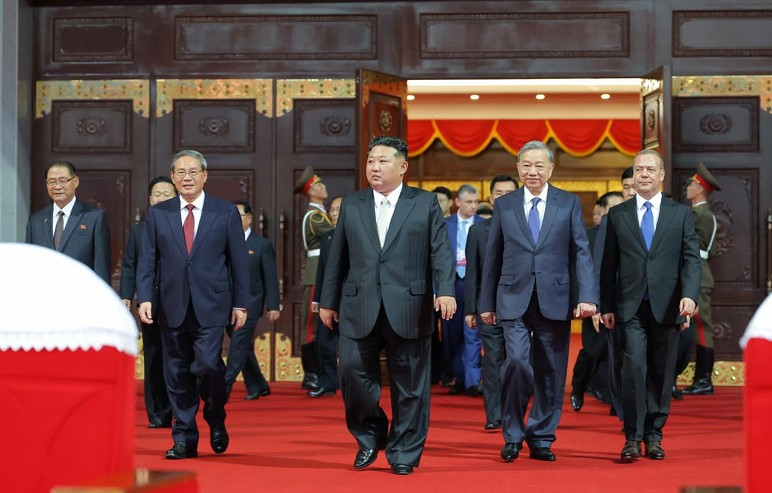
The Rodong Sinmun, the official newspaper of the Workers’ Party of Korea, published an article on October 16 asserting that “calls are growing to relocate the UN headquarters from New York to another country,” attributing such sentiment to what it termed “America’s arrogant and coercive behavior.”
The paper accused Washington of subordinating international treaties and institutions to its own interests, halting funding, and even withdrawing from organizations such as the World Health Organization and UNESCO. It claimed such actions have “paralyzed the functions of the United Nations.”
The article cited as evidence the recent U.S. decision to revoke the visa of the Colombian president during the 80th UN General Assembly session, describing it as a blatant violation of the 1947 UN–U.S. headquarters agreement and an affront to diplomatic immunity.
The Rodong Sinmun argued that the decision demonstrated “America’s disregard for international law” after the Colombian leader criticized Israel’s military actions in Gaza. It also highlighted remarks from a senior UN spokesperson noting that discussions were underway regarding potential relocation of UN offices, allegedly due to “U.S. financial pressure and political interference.”
According to North Korean media, multiple countries — including Türkiye, Qatar, Rwanda, Kenya, and Serbia — have expressed interest in hosting UN institutions. The paper framed this as “a global movement to resist U.S. domination,” claiming that Washington expects all entities to serve its interests and discards international mechanisms when they do not.
Other North Korean outlets, including Minju Joson, echoed these criticisms, citing Venezuela’s defense minister, who denounced U.S. military deployments in the Caribbean as a “relic of colonialism.” The following day, China’s Permanent Representative to the United Nations also condemned U.S. actions in the Caribbean at a Security Council meeting, characterizing them as violations of sovereignty and international law — a stance that aligns with North Korea’s broader effort to support Beijing’s position in global affairs, including the tariff dispute with Washington.
Regarding the Israel-Palestine issue, North Korean media made no mention of the Trump administration’s mediation or the signing of peace accords, instead devoting extensive coverage over October 15–16 to the destruction in Gaza caused by Israeli airstrikes. North Korea also referenced a mass shooting in South Carolina as further evidence of “America’s internal disorder.”
Observers view these statements as part of Pyongyang’s broader strategy to consolidate its standing within a China-Russia axis and to frame itself as the “vanguard” of global anti-American sentiment. “North Korea’s sustained criticism of the United States is aimed at signaling its alignment with Beijing and Moscow,” said one diplomatic source. “By doing so, it seeks to reinforce its status as a nuclear power, emphasize its defiance of Washington, and strengthen domestic cohesion.”
In the aftermath of celebrations marking the 80th anniversary of the Workers’ Party of Korea (WPK), North Korea has directed its citizens to concentrate national efforts on completing the current Five-Year Economic Development Plan and preparing for the 9th Party Congress, expected to convene in early 2026.
In a front-page editorial on October 15 titled “Let Us March More Vigorously Toward the Glorious Party Congress with the Momentum of the 80th Anniversary Celebration,” the Rodong Sinmun emphasized that “the period for implementing the five-year plan presented at the 8th Party Congress is now drawing to a close.” The paper acknowledged that “challenges and difficulties obstructing our advance remain severe” and called on officials to “ensure that all undertakings yield excellent results.”
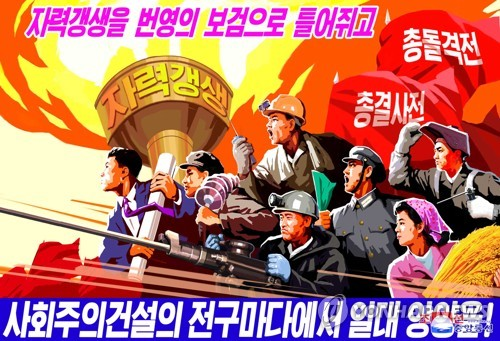
The editorial urged cadres to recognize “the weight of their positions and roles in today’s all-out advance toward the Party Congress,” and to identify and correct “any shortcomings or perfunctory approaches” in executing Party directives.
This year marks the final stage of the Five-Year Economic Development Plan announced by Kim Jong Un at the 8th Party Congress in 2021. Following high-profile displays of military strength—including parades and large-scale exhibitions in recent months—Pyongyang appears to be intensifying its internal review of “economic achievements” and “policy outcomes” ahead of the upcoming Congress.
The 9th Party Congress is expected to conduct a comprehensive review of the regime’s economic, military, and social performance over the past five years, while setting the strategic direction for the next planning cycle. During a recent inspection of the Academy of National Defense Science, Kim Jong Un stated that “the policy of simultaneously advancing nuclear and conventional forces will be clearly presented at the 9th Party Congress.”
At a separate ceremony marking the completion of the Pyongyang General Hospital earlier this month, Kim also pledged to unveil “a concrete plan for modernizing the healthcare system, including the establishment of a second Pyongyang hospital,” at next year’s Party Congress. These remarks suggest that the Congress may introduce a new five-year policy blueprint encompassing national defense, the economy, and social welfare.
Analysts interpret the Rodong Sinmun editorial as part of Pyongyang’s effort to consolidate internal unity and mobilize public enthusiasm ahead of the 9th Party Congress. Following the extensive loyalty campaigns surrounding the WPK’s 80th anniversary, the regime now appears focused on linking ideological cohesion to measurable economic and policy outcomes.
Kim Jong Un’s Motives in Raising the Issue of “Acts Undermining Authority” Despite His Firmly Established One-Man Rule
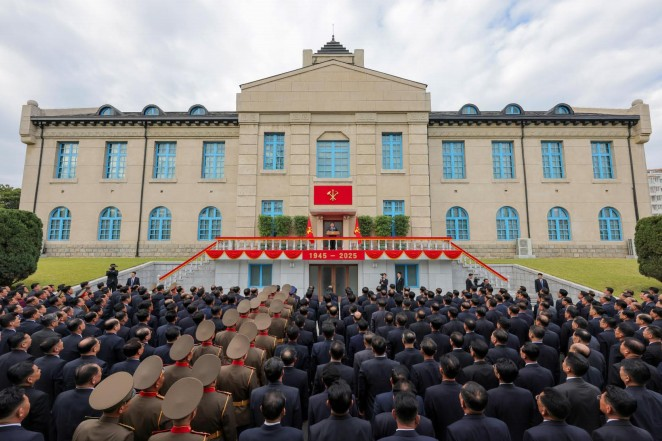
In advance of the 80th anniversary of the founding of the Workers’ Party of Korea (October 10), Chairman Kim Jong Un has reportedly directed a comprehensive campaign to identify and eliminate “acts undermining Party authority.” This directive, issued alongside his declaration of a “Second Era of National Founding,” reflects a dual effort to consolidate political discipline and redefine national strategy for the coming decade.
According to the Korean Central News Agency (KCNA), Kim delivered instructions during a visit to the Party Founding Memorial Hall in Pyongyang, ordering officials to “prioritize the identification and elimination of all elements and acts that undermine the Party’s leading authority.” He further called for “firmly establishing strict discipline and a sound culture of order within the Party.”
Analysts note that this renewed emphasis on Party authority—despite Kim’s already entrenched one-man rule—suggests concern over potential internal instability. It likely serves as a preemptive measure to neutralize dissent and maintain regime cohesion during what many view as the preparatory phase for fourth-generation succession involving Kim’s daughter, Kim Ju-ae.
This directive follows a June Rodong Sinmun editorial that underscored the “unique leadership of the Party Central Committee” and the “irresistible authority” of the Party and state. The repetition of such rhetoric, experts argue, signals internal anxiety rather than confidence.
One North Korea specialist observed, “As regimes stabilize, political discourse usually becomes simpler; the reintroduction of complex ideological symbols indicates heightened tension and an ongoing effort to manage elite alignment ahead of succession.”
In the same speech, Kim described the present period as the “Second Era of Nation-Building,” asserting that “all sectors and regions must undergo comprehensive transformation within ten years.” Observers interpret this slogan as an attempt to construct an ideological and institutional foundation for hereditary continuity, positioning Kim Ju-ae as the future leader of the regime.
Recent developments appear consistent with this trajectory. South Korea’s National Intelligence Service (NIS) reported to the National Assembly’s Intelligence Committee last month that Kim Ju-ae’s participation in her father’s visit to China was part of a broader effort to embed her within the “revolutionary narrative” of the Kim dynasty.
Moreover, Rodong Sinmun has increasingly emphasized themes of “Baekdu bloodline” legitimacy and the “completion of revolutionary succession.” A September 3 editorial asserted that “the question of carrying forward the revolutionary cause has been elevated to an issue of eternal national significance, now resolved both theoretically and practically.”
Taken together, these developments suggest that Kim Jong Un’s latest call for internal discipline represents not merely routine political maintenance, but a calculated effort to secure the Party’s absolute loyalty as North Korea transitions into a new phase of dynastic entrenchment.
Kim Jong Un Warns: “South Korean Territory Can Never Be a Safe Zone” — Assigns “Special Assets” to Key Targets
North Korea has escalated its threats against South Korea and the United States, unveiling a full array of strategic weapons—including intercontinental ballistic missiles (ICBMs) and hypersonic systems—at its latest military exhibition in Pyongyang.
During the event, Kim Jong Un declared that “special assets have been assigned to key targets,” a statement widely interpreted as signaling North Korea’s intent and capability to strike U.S. bases in South Korea and critical South Korean infrastructure.
According to the Korean Central News Agency (KCNA), the “Defense Development-2025” exhibition opened on October 4 in Pyongyang. In his keynote address, Kim accused Washington and Seoul of intensifying nuclear cooperation and military training “based on nuclear operational guidelines,” adding that the U.S. has been “increasing its military presence in South Korea and surrounding regions.”
He warned, “We have taken decisive measures to deploy special assets against key targets… South Korean territory can never be a safe zone.”
The exhibition featured a comprehensive display of North Korea’s modernized missile inventory, including the Hwasong-11 short-range ballistic missile (SRBM) fitted with a hypersonic warhead, supersonic cruise missiles, anti-submarine missiles, and the Hwasong-18 and Hwasong-19 ICBMs. The event effectively showcased Pyongyang’s full strike spectrum—from tactical weapons aimed at U.S. forces on the Korean Peninsula to strategic systems capable of reaching the U.S. mainland.
Kim warned that if the United States “continues to disregard regional security concerns and pursue a unilateral military buildup,” North Korea would be “left with no choice but to accelerate military and technological measures to preserve the balance of power.”
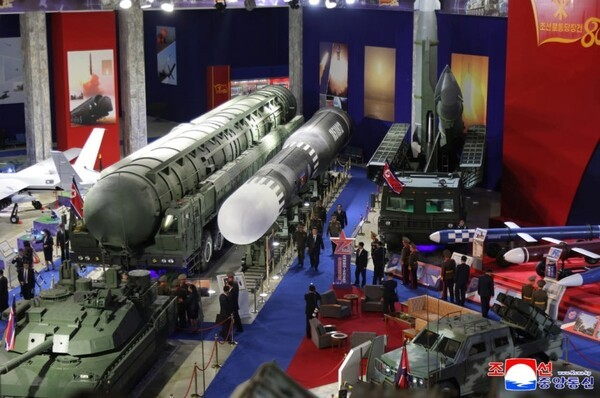
The Rodong Sinmun, the official party newspaper, described the exhibition as a “resounding success,” publishing extensive photographs of advanced weapons systems.
Since 2023, North Korea has institutionalized annual arms exhibitions under the “National Defense Development” brand, following the “Self-Defense-2021” show. Analysts view these events as intended not only to counter the expanding U.S. military posture in the region but also to enhance Pyongyang’s bargaining leverage in future negotiations with Washington.
As part of the exhibition schedule, Kim Jong Un also inspected the new 5,000-ton destroyer “Choe Hyon Ho,” calling it a “super-powerful warship” that demonstrates the “justice and vitality” of North Korea’s self-reliant defense line. The destroyer, launched in April 2025, has been described as North Korea’s version of an Aegis-class vessel.
During the inspection, Kim stressed the importance of ideological discipline within the navy, remarking, “The strongest power of a guardian lies not in weapons or equipment, but in ideological commitment, inherited from the spirit of revolutionary forebears.” He added that the navy must ensure “the eternal tranquility of our homeland’s seas” through robust maritime power.
The destroyer features a photo and statue of anti-Japanese guerrilla Choe Hyon, Kim’s grandfather and a symbol of revolutionary lineage. Kim explained that the installation is designed to instill “an indomitable fighting spirit” in the new generation of sailors.
Photographs released by state media revealed interior images of the ship’s bridge and combat control room, including electronic charts displaying the Northern Limit Line (NLL) in the West Sea.
Rep. Yoo Yong-won, a member of the National Assembly Defense Committee (People Power Party), assessed this as “a deliberate disclosure intended to signal operational readiness for ship-based attacks in the NLL area.” He also noted potential prospects for maritime cooperation with China and Russia.
Since August, North Korea has been conducting performance tests on the ship's vertical launch system(VLS), sensors, and combat integration systems. Rep. Yoo projected that “trial operations and performance verification could begin as early as October.”
North Korea has reportedly committed to constructing additional destroyers of the same class by October 10, 2026—following the Choe Hyon Ho and Kang Gon Ho. Analysts interpret this as part of Kim Jong Un’s broader initiative to modernize naval capabilities and achieve what Pyongyang describes as “world-class maritime power.”
-
PREV [NK Focus]
-
NEXT [Current Affairs Analysis]