

Analysis and Outlook of Trade between North Korea and China: January–September 2025

Choi, Jangho
Korea Institute for International Economic Policy
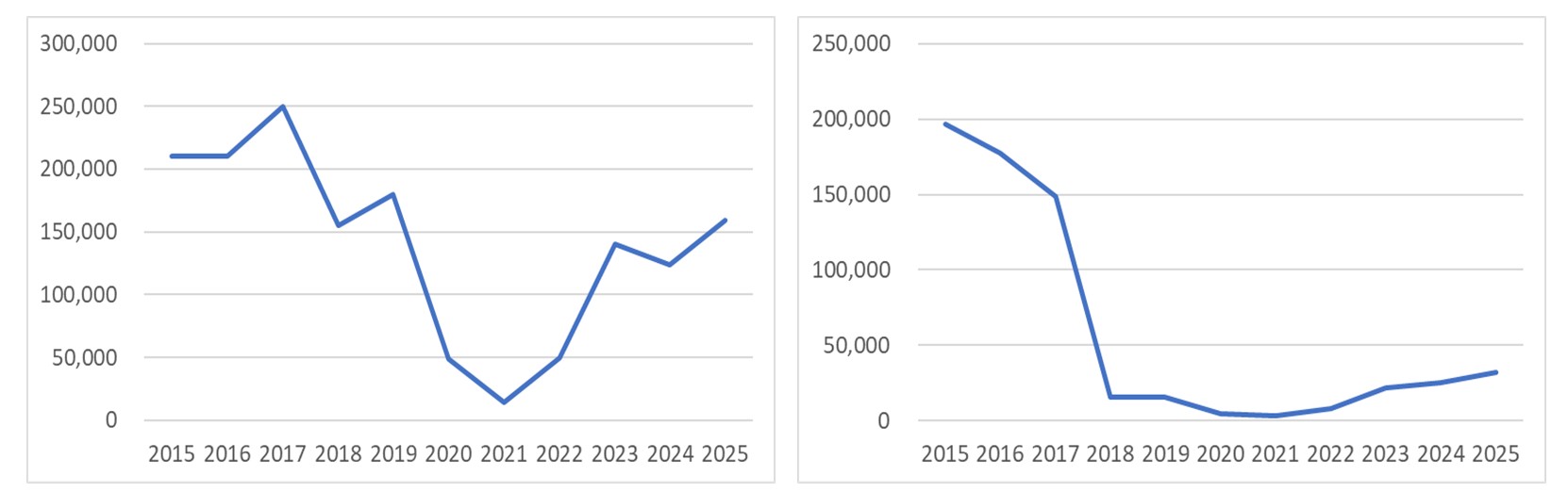
North Korea’s trade with China continued to expand during the first three quarters of 2025, signaling a near-complete recovery to pre-pandemic levels. From January to September 2025, imports from China rose 29.1% year-on-year to USD 1.60 billion, while exports increased 26.6% to USD 322 million. In terms of scale, North Korea’s trade volume has now surpassed 2018–2019 levels, underscoring a normalization of economic activity following years of contraction under COVID-19 restrictions and UN sanctions.
1. Import Trends
North Korea’s imports from China reached USD 1.60 billion, almost matching the 2018 level (USD 1.56 billion) but still below the 2019 peak (USD 1.79 billion). Growth was broad-based across major categories, reflecting its improved domestic economic conditions, strengthened North Korea–China relations, and reduced logistics costs due to the restoration of overland and maritime routes.
Top five import categories:
. Human hair (HS 6703) – USD 166.9 million (10.5%)
. Soybean oil (HS 1507) – USD 83.9 million (5.3%)
. Synthetic filament fabrics (HS 5407) – USD 77.6 million
. Knitted fabrics (HS 6006) – USD 38.5 million
. Furniture and parts (HS 9403) – USD 36.5 million
Significant structural changes were also observed. Fertilizer imports declined sharply, while imports of coke and construction materials increased. The reduction in fertilizer imports likely reflects the progress in North Korea’s coal gasification projects for nitrogen fertilizer production. Imports of coke, a key input in steelmaking, rose to USD 34.4 million, suggesting intensified industrial activity, possibly linked to arms production and exports to Russia. Construction material imports reached USD 123.7 million, up from USD 99.8 million a year earlier, indicating continued investment in housing and regional development under the “20×10 Regional Development Policy.”
Figure 1. Annual imports (left) and exports (right) with China, 2015–2024 (January–September of each year) (Unit: 10,000 USD)
Source: Author’s compilation.
2. Export Trends
Exports to China totaled USD 322 million, up 26.6% year-on-year, nearly double pre-pandemic levels.
Top five export categories:
. Wigs, beards, and eyelashes (HS 6704) – USD 157.0 million (48.7%)
. Tungsten ore (HS 2611) – USD 20.5 million (6.4%)
. Electric energy (HS 2716) – USD 20.1 million (6.2%)
. Ferroalloys (HS 7202) – USD 20.0 million (6.2%)
. Watch movements (HS 9108) – USD 16.7 million (5.2%)
The surge in hair-related exports reflects China’s approval of North Korean wig and eyelash shipments since April 2023, along with Pyongyang’s adaptation to prolonged sanctions by prioritizing low-tech, labor-intensive industries.
3. Trade Balance and Financing Capacity
The January–September trade deficit stood at USD 1.27 billion, which, if annualized, implies a USD 1.7 billion deficit for 2025, comparable to 2019 levels. Despite the widening deficit, North Korea appears capable of sustaining it, drawing on foreign currency reserves accumulated during the COVID-19 border closures, domestic foreign exchange absorption measures since 2021, and external revenue streams such as cyber operations and arms exports to Russia.
4. Policy and Strategic Implications
Looking ahead, trade dynamics in 2026 will be shaped by both domestic policy milestones and external strategic alignments.
Domestic: The 9th Party Congress in January 2026 is expected to declare the success of the 2021–2025 Five-Year Economic Development Plan and announce a new plan emphasizing localization and import substitution, influencing trade priorities.
Bilateral: Following the September 2025 summit marking China’s Victory Day, North Korea–China relations have entered a phase of institutionalized economic cooperation, which is likely to expand further in 2026.
Geo-strategic: North Korea continues to pursue a dual-track alignment, “security with Russia, economy with China.” This framework enables Pyongyang to exploit the partial enforcement of UN sanctions by both countries, reopening borders and revitalizing external trade networks.
5. Limitations and Outlook
Despite the recovery in trade volume, North Korea’s economy remains structurally constrained by sanctions, high logistics costs, and limited access to global markets. The current trade pattern reflects stabilization rather than expansion.
Moving forward, the sustainability of North Korea’s economic recovery will depend on:
. The durability of its partnership with China and Russia,
. Its ability to finance trade deficits without eroding domestic liquidity, and
. The degree of UN sanctions enforcement by Beijing and Moscow.
Overall, North Korea’s trade normalization with China in 2025 represents a tactical adaptation rather than a strategic breakthrough. The coming year will test whether this recovery can evolve into sustainable growth within the constraints of the ongoing sanctions regime.
-
PREV [North Korea Inside]
-
NEXT [North Korea Inside]