

North Korea Inside
· China’s Strategic Concessions to Pyongyang: Sugar Aid, Symbolic Diplomacy, and Implications for Regional Order
· Strategic Signaling Through Weapons Imagery: The Hwasong-20 and Calendar Diplomacy
· Kim Jong-un Rebukes Cadres at Party Plenum, Signals Possible Party Charter Revision at 9th Congress
· Kim Jong-un Attends Completion Ceremony of Food Processing Facility with Wife and Daughter
Kim Myong-sung

According to the South Korean National Diplomatic Academy’s 2026 International Situation Outlook, published on December 16, Chairman Kim secured 19,000 tons of granulated sugar through a bilateral summit with Chinese President Xi Jinping held in conjunction with the anniversary events. The report characterizes the aid as a measure aimed at stabilizing citizens’ livelihoods amid prolonged economic hardship.
The institute further assessed the move as indicative of Kim’s intent to address internal economic pressures through expanded external diplomacy, projecting that similar efforts are likely to accelerate in the coming year. This assessment suggests a pattern in which Pyongyang seeks material compensation through strategic alignment—first with Russia via troop deployments and now with China through symbolic political engagement.
Internal North Korean sources indicate that the sugar shipment entered the country around October 10, coinciding with the anniversary of the founding of the Workers’ Party of Korea. Sugar is a commodity entirely dependent on imports, and border closures during the COVID-19 period severed supply lines, leading to dramatic price inflation. Because sugar is not subject to international sanctions, the shipment is reportedly reflected in Chinese customs statistics.
Within North Korea, sugar holds greater value than staple grains such as rice and is widely regarded as a luxury item accessible primarily to elites and officials. The prolonged shortage has produced broad socio-economic effects, including the suspension of operations at food-processing facilities, reduced availability of children’s snacks, and declining nutritional conditions among soldiers.
Cuba, historically North Korea’s principal sugar supplier, has reduced shipments significantly following the normalization of diplomatic relations with South Korea last year, further exacerbating supply constraints. As a result, sugar prices have surpassed those of rice in domestic markets, placing the commodity beyond the reach of most citizens.
Food-processing facilities have been particularly affected. Production of basic items such as candy, bread, snacks, and jam has either ceased or sharply contracted, disrupting supply chains for children’s institutions and military units. Reductions in snack allocations to daycare centers, kindergartens, and frontline units have raised growing concerns over nutritional imbalances.
Historically, sugar played a symbolic role in regime legitimacy, distributed during major political holidays—such as the birthdays of Kim Il-sung and Kim Jong-il—as a tangible demonstration of state benevolence. The inability to sustain such distributions has therefore carried political as well as economic consequences, weakening propaganda narratives centered on paternalistic governance.
In response, North Korean authorities have sought substitutes, including a stevia-like plant known domestically as “August grass,” which reportedly provides sweetness hundreds of times stronger than sugar but offers negligible caloric value. While artificial sweeteners such as saccharin are also in limited use, these alternatives remain inadequate for large-scale industrial food production.
Sugar has also been identified as a potential medium for inter-Korean economic engagement. In 2020, a South Korean private organization explored a barter arrangement involving sugar shipments in exchange for Kaesong-produced ginseng liquor, reportedly eliciting significant interest from Pyongyang.
Meanwhile, South Korea’s Institute for Foreign Affairs and National Security (IFANS) assesses that China is likely to incrementally deepen cooperation with North Korea to counter U.S. pressure and limit Russian influence on the Korean Peninsula. IFANS further anticipates renewed efforts by Pyongyang to restore traditional ties with Beijing, while noting the possibility of a renewed U.S.–North Korea summit in the coming year—a development that could further motivate Chinese diplomatic engagement.
North Korea’s 2026 external-propaganda calendar prominently features images of advanced strategic weapon systems, including the Hwasong-20 intercontinental ballistic missile (ICBM), often described by Pyongyang as its most powerful nuclear delivery system. The missile appears on both the cover and December page, depicted with a blunt-nosed MIRV configuration and mounted on an 11-axle transporter-erector-launcher similar to that used for the Hwasong-19.
Experts assess that the warhead configuration is designed to accommodate multiple reentry vehicles—potentially five or more—intended to overwhelm U.S. missile defense systems.
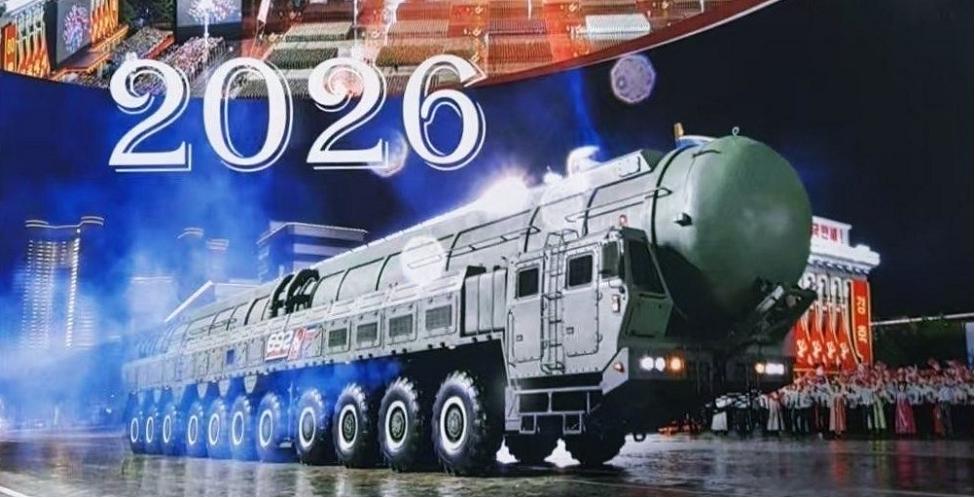
While military authorities believe the Hwasong-20 remains under development and has not yet undergone a test launch, recent activity at the West Sea Satellite Launching Station in Dongchang-ri suggests preparations for future testing.
Satellite imagery analyzed by NK News indicates that the solid-fuel engine test facility has undergone significant upgrades, including the replacement of a fixed protective cover with a multi-stage folding structure that allows crane-assisted installation of large engines.
Activity has also been detected at adjacent vertical test stands, suggesting the capacity for parallel testing of engines with varying thrust levels. Chairman Kim personally observed testing of a new carbon-fiber composite solid-fuel engine last September, a material critical for reducing missile weight while preserving structural integrity.
North Korea’s most recent ICBM test occurred on October 31 of the previous year with the Hwasong-19. Intelligence assessments indicate a high likelihood of additional tests coinciding with the upcoming 9th Workers’ Party Congress. Some analysts interpret the inclusion of the Hwasong-20 in Chinese-language calendars, printed locally in China and distributed through diplomatic channels, as an effort to secure Beijing’s tacit approval or acquiescence.
Beyond strategic weaponry, the calendar also depicts hypersonic missiles, suicide drone launchers, and large-caliber multiple rocket systems. Notably, January 8, widely believed by intelligence agencies to be Kim Jong-un’s birthday, remains unmarked as a public holiday, reinforcing assessments that the regime continues to manage internal symbolism cautiously amid succession sensitivities.
Kim Jong-un Rebukes Cadres at Party Plenum, Signals Possible Party Charter Revision at 9th Congress
North Korean leader Kim Jong-un sharply criticized the work discipline and ideological posture of senior officials at the conclusion of a three-day plenary meeting of the Central Committee of the Workers’ Party of Korea (WPK). Rodong Sinmun, the party’s official newspaper, reported on December 12 that in his closing remarks Kim identified “artificial obstacles to revolutionary development,” attributing them to “erroneous ideological perspectives and passive, irresponsible work attitudes” among certain leading officials and responsible cadres.
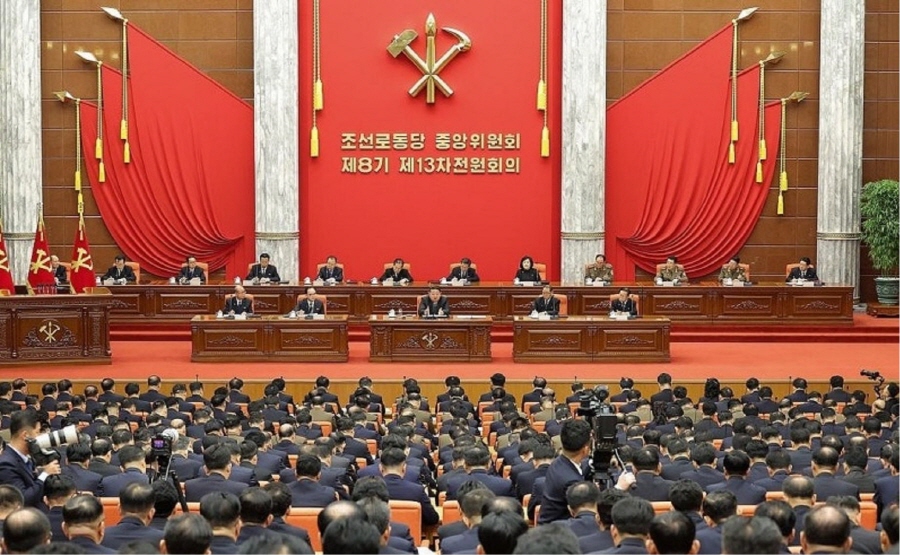
The language used in the report suggests that shortcomings in the implementation of Kim’s flagship “Local Development 20×10 Policy” were implicitly attributed to bureaucratic failure rather than to structural or resource constraints. Kim reportedly characterized these problems as “defects and malpractices that must be rectified,” reinforcing a familiar pattern in which policy underperformance is framed as a function of cadre discipline rather than systemic limitations.
In this context, Rodong Sinmun disclosed that organizational (personnel) issues constituted the fifth agenda item of the plenary meeting, noting that one Central Committee member and five alternate members were recalled. Although no names were released, the scope of the personnel action suggests that those removed were directly linked to Kim’s criticisms.
A report issued by the Party Central Inspection Commission further highlighted deficiencies and bias in the enforcement of party discipline, raising the likelihood of a broader cadre reshuffle ahead of the 9th Party Congress scheduled for next year.
Despite the critical tone directed at officials, Kim framed the current year as “a year of transformation through accelerated advance and doubled self-reliance,” asserting that notable achievements had been made across industry, agriculture, construction, and regional development.
State media claimed that industrial production targets were exceeded through intensified efficiency campaigns, while grain output reportedly surpassed last year’s levels. Major construction projects tied to the local development policy were presented as tangible indicators of expanding “people’s welfare,” with the regime asserting that the modernization of the national economy and its technological foundations has entered a “consolidation phase.”
Kim indicated that next year’s economic policy will largely extend existing priorities, identifying the restructuring of agriculture and rural areas as the foremost national task. He personally issued directives to expand wheat cultivation, increase processing capacity, reform the distribution system, and modernize tidal-flat farms along the west coast.
For 2026, the regime finalized 20 cities and counties as targets for local development projects, citing examples such as the construction of six power plants in Gangwon Province and the modernization of the Unsan Paper Mill in South Pyeongan Province. Improving living conditions in coal-mining regions was designated a major national priority, alongside initiatives in education, trade, finance, and environmental management.
The plenary meeting was attended not only by Central Committee members and alternates but also by provincial, municipal, and county officials, enterprise managers, and senior military commanders. The Politburo formally entrusted Kim with presiding over the meeting. Notably, unlike previous plenums, the session made no reference to external strategy toward the United States or South Korea, focusing instead on internal discipline, economic restructuring, and agricultural reform.
Particular attention has been drawn to the announcement that the Party Charter will be amended at the forthcoming 9th Party Congress. While no details were provided, some analysts speculate that revisions could include provisions related to institutional reforms or frameworks that further entrench hereditary succession into a fourth generation.
Kim Jong-un Attends Completion Ceremony of Food Processing Facility with Wife and Daughter
North Korean leader Kim Jong-un attended the completion ceremony of a local factory and comprehensive service center in Gangdong County, near Pyongyang, accompanied by his wife, Ri Sol-ju, and daughter, Kim Ju-ae.
The Korean Central News Agency (KCNA) reported on December 16 that the event marked Ri Sol-ju’s first public appearance in approximately six months. The facility forms part of the regime’s broader local development initiative aimed at expanding regional food-processing capacity and service infrastructure.
State media images showed Ri Sol-ju tasting soy sauce produced at the facility alongside Kim. She was depicted carrying a luxury handbag believed to be a product of the French brand Gucci, similar to one previously observed at the Wonsan-Kalma Coastal Tourist Zone completion ceremony.
Such items are prohibited from export to North Korea under UN Security Council Resolution 1718; nevertheless, luxury goods are widely believed to enter the country through diplomatic channels for elite consumption. Observers note that these images underscore the contrast between elite privilege and the material burdens imposed on local officials and residents tasked with meeting construction quotas.
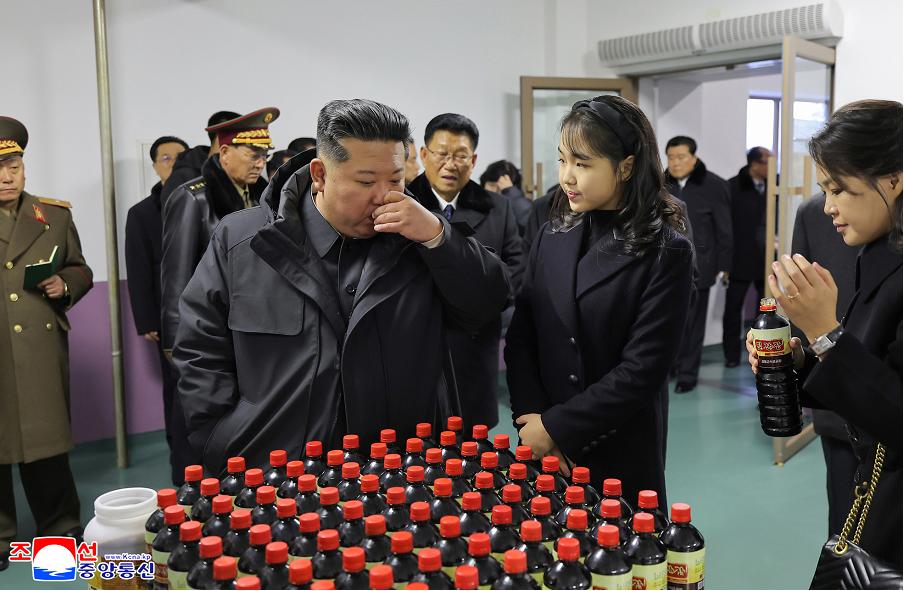
KCNA released 53 photographs of the event, many of which prominently featured Kim Ju-ae. In several images, she appeared positioned ahead of Kim Jong-un during site inspections or seated alongside him during briefings, while Ri Sol-ju was typically framed in the background or at the margins. The visual emphasis on Kim’s daughter has reinforced assessments that the regime continues to cultivate her public profile as part of longer-term succession signaling.
During the visit, Kim reiterated that advancing provincial development and delivering “prosperity and civilization” to local populations constitutes a “sacred undertaking” of the Workers’ Party. He emphasized that the intended beneficiaries of the local development policy are ordinary residents and called for sustained momentum in expanding what he described as an unprecedented era of innovation and transformation.
The 13th Plenary Meeting of the 8th Central Committee, held from December 9 to 11, ultimately confirmed the list of 20 cities and counties slated for development projects next year under the Local Development 20×10 Policy, further institutionalizing the regime’s emphasis on regional economic performance as both a governance priority and a source of political legitimacy.
-
PREV [NK Focus]
-
NEXT [North Korea Inside]