

North Korea Inside
· South Korean Ministry of Unification Submits the Fifth Basic Plan for Developing Inter-Korean Relations
· Kim Jong-un Observes Destroyer Missile Launches Three Times in April, Possibly Linked to Middle East Developments
· “I Will Be the Next Hero”: North Korea Organizes Student Visits to Families of Fallen Soldiers from Russia Deployment

Kim Myong-sung
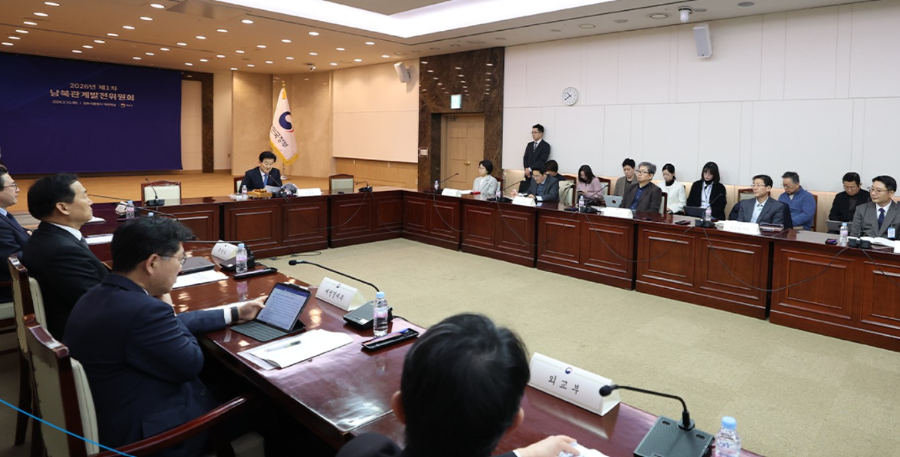
In the report, the Ministry stated that, based on the ROK–U.S. alliance and with the goal of achieving a “nuclear-free Korean Peninsula,” it would seek to halt North Korea’s production and development of nuclear weapons and intercontinental ballistic missiles (ICBMs).
Under the key policy priority of “resolving the North Korean nuclear issue and advancing toward a peace regime on the Korean Peninsula,” the government outlined the following objectives: creating conditions conducive to dialogue aimed at a Korean Peninsula free of war and nuclear weapons; achieving substantive progress on the North Korean nuclear issue through a phased and pragmatic approach; and, in parallel, advancing the establishment of a peace regime on the Korean Peninsula.
Specifically, the policy framework includes formulating and implementing a phased resolution strategy based on a “suspension–reduction–elimination” sequence; seeking an immediate halt to North Korea’s nuclear development as an initial step toward a “nuclear-free Korean Peninsula”; promoting the implementation of agreements through phased commitments and reciprocal actions; and strengthening international coordination.
The government also indicated that it will pursue the establishment of a peace regime on the Korean Peninsula in parallel. It plans to explore all feasible pathways for transitioning to such a regime and to further develop the contours of a prospective peace agreement. It also intends to pursue the conclusion of such an agreement among relevant parties when conditions permit. In addition, it plans to promote the operation of a four- or six-party cooperative framework to advance peace and stability on the Korean Peninsula and in Northeast Asia.
To promote mutually beneficial inter-Korean exchange and cooperation that resonates with the public, the government stated that it will pursue consistent humanitarian cooperation irrespective of political or military considerations and plans to revise relevant legal and institutional frameworks. To alleviate the humanitarian consequences of division, the government intends to strengthen cooperation aimed at materially improving the human rights conditions of North Korean residents. The plan envisions phased implementation, beginning with groups such as persons with disabilities, women, and children, for whom North Korea is assessed to be relatively more receptive.
The Basic Plan for the Development of Inter-Korean Relations is a mid- to long-term comprehensive framework that sets out the direction and objectives for advancing inter-Korean relations in pursuit of shared prosperity and peaceful unification. In accordance with the “Act on the Development of Inter-Korean Relations” and its implementing decree, the government formulates a basic plan every five years following consultations with relevant central government agencies.
The Plan was newly formulated to reflect the Lee Jae-myung administration’s North Korea policy, following the early termination of the Fourth Plan—adopted under the Yoon Suk-yeol administration—after three years of implementation.
In July 2024, based on amendments to the Inter-Korean Relations Development Act, the government conducted an evaluation of the previous Basic Plan. With respect to the Fourth Basic Plan formulated under the Yoon Suk-yeol administration, the current government assessed that the “Bold Plan”—introduced in August 2022 as a denuclearization roadmap—did not produce meaningful progress toward North Korea’s denuclearization and, in some respects, contributed to heightened security instability on the Korean Peninsula.
In particular, the government assessed that the emphasis on “peace through strength” and the prioritization of sanctions coordination constrained efforts to address core security challenges through dialogue and cooperation. It further assessed that evolving external dynamics—such as the strengthening of North Korea–Russia relations following the Russia–Ukraine conflict—have accelerated the development of North Korea’s nuclear and missile capabilities. Additionally, the government concluded that the strict application of “reciprocity” during a period of strained inter-Korean relations contributed to a prolonged stalemate.
While efforts were made to raise international awareness of North Korean human rights issues, the report noted that an excessive emphasis on internationalizing these issues may have reduced opportunities for inter-Korean cooperation in this area.
Meanwhile, with respect to trends in North Korea, the Ministry of Unification assessed that the North Korean economy has moved beyond a contraction phase and entered a period of gradual recovery. It further assessed that North Korea has established and sustained what may be characterized as an “alliance-level” cooperative relationship with Russia, including the transfer of advanced weapons systems and technology, while leveraging U.S.–China strategic competition to expand its strategic autonomy and bargaining leverage.
North Korean State Affairs Commission Chairman Kim Jong-un observed an additional missile test launch from the destroyer Choe Hyon-ho on April 12, marking his third such observation following visits on April 4 and April 10.
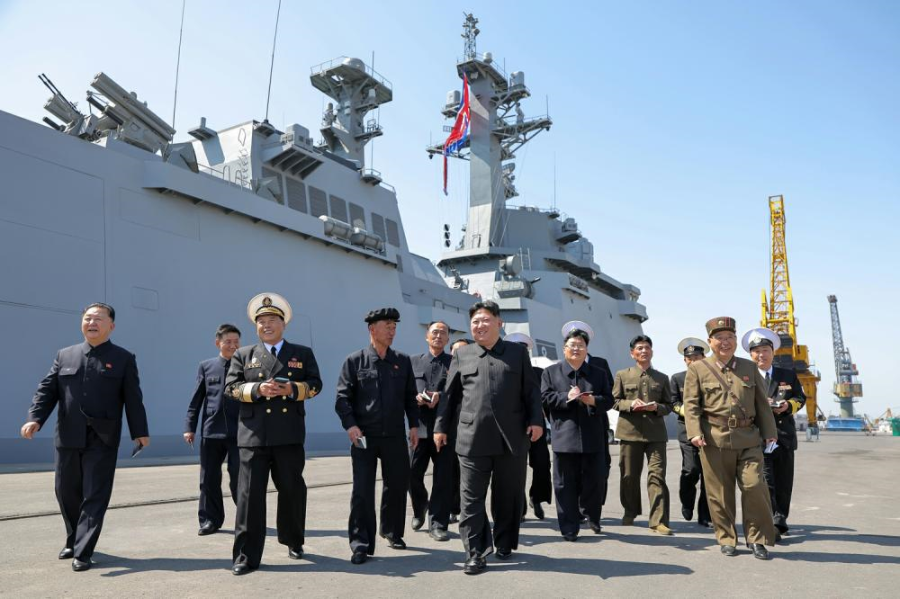
In addition to strategic cruise missiles, three ship-to-ship (anti-ship) missiles were fired from the destroyer at a simulated naval target.
This is reportedly the first instance in which North Korea has conducted ship-to-ship missile launches from the Choe Hyon-ho.
This activity appears to reflect final-stage inspections of onboard weapons systems in line with plans to deploy the vessel—launched in April last year—to the East Sea Fleet within the current year.
A South Korean Ministry of Unification official assessed that “this activity is part of the implementation of the defense plan outlined at the 9th Party Congress” and characterized it as “a final systems validation process prior to the vessel’s operational deployment.”
At the same time, these developments appear to be influenced by the ongoing conflict between the United States and Iran.
Chairman Kim has observed three missile test launches from the Choe Hyon-ho within a 40-day period that coincides with the timeline of the U.S.–Iran confrontation, which began on February 28.
This pattern also suggests sensitivity to the recent escalation of the conflict into a maritime standoff involving blockade and counter-blockade dynamics in the Strait of Hormuz.
Chairman Kim referenced nuclear capabilities during each of these inspections. During his April 4 visit, he stated that “the naval nuclear armament program is progressing satisfactorily,” and on April 10, he declared that “the national nuclear force has entered a multi-domain operational phase.”
During the most recent visit, he further emphasized that “the continuous and unlimited expansion of nuclear war deterrence constitutes the Party’s consistent defense line and its most critical task,” adding that “strategic and tactical offensive capabilities underpinning nuclear deterrence must be further strengthened.”
The strategic and tactical offensive capabilities referenced by Chairman Kim are assessed to be directed not only at South Korea but also at the United States.
In this context, some analysts assess that North Korea is accelerating efforts to enhance its naval capabilities in response to shifts in the regional military balance, including the reported degradation of Iranian air and naval forces by the United States. It is also reported that North Korea has conducted test launches simulating strikes against U.S. aircraft carriers and forward-deployed military bases in a contingency scenario on the Korean Peninsula.
“I Will Be the Next Hero”: North Korea Organizes Student Visits to Families of Fallen Soldiers from Russia Deployment
North Korea has organized group visits by graduating secondary school students preparing for military enlistment to Saebyeol-dong, a residential area housing the families of soldiers killed during deployment to Russia, in an apparent effort to reinforce loyalty and ideological commitment. This initiative is widely interpreted as an attempt to highlight the achievements of North Korea’s military deployment, console bereaved families, and instill patriotism and a spirit of sacrifice among younger generations.
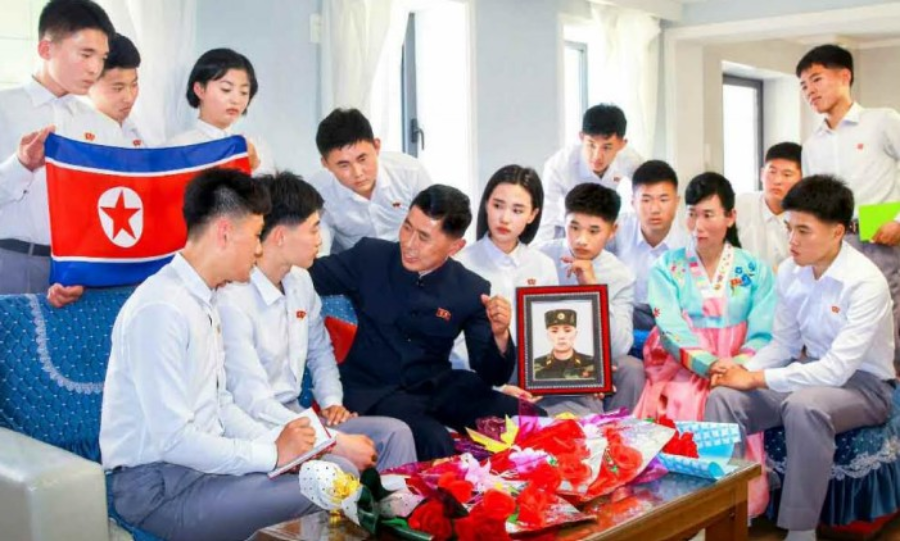
In a front-page article published on April 13 titled “Upper Secondary School Graduates Who Volunteered for Enlistment in the People’s Army Continue to Visit Saebyeol-dong,” Rodong Sinmun reported that students from multiple schools in Pyongyang visited the families of fallen soldiers and pledged that “we will become a source of pride for our country, our families, and our schools, just as our predecessors who sacrificed their lives for the motherland.” The newspaper further reported that in some schools, all graduates volunteered for frontline assignments.
The newspaper cited Chairman Kim Jong-un as stating that “Saebyeol-gil has become a symbol etched in the hearts of the people, representing the lives of those who fought for the motherland on distant battlefields.”
While viewing medals and photographs of fallen soldiers, the students reportedly expressed their determination, stating that “we will become sons who can stand proudly before our parents and the motherland” and that “we will be the next heroes.”
Students also reportedly participated in activities such as singing with bereaved families, delivering letters, and listening to accounts of the soldiers’ lives. A commemorative tree-planting event was held at Saebyeol-gil Park to reaffirm their “commitment to patriotism.”
The North Korean media highlighted what it described as voluntary participation among youth, stating that “pledges to inherit the noble spirit of the fallen and become shining pillars of the nation continue to emerge.” Reports also indicated that some students sent letters to bereaved families expressing their loyalty.
These developments are consistent with North Korea’s broader effort to leverage its military deployment in the Russia–Ukraine conflict for domestic propaganda purposes. After reportedly deploying approximately 12,000 troops in October 2024, North Korea did not publicly acknowledge the deployment until April 2025, when it launched a large-scale campaign following Russia’s declaration of a “Kursk victory.”
Following imagery of Chairman Kim personally receiving the remains of fallen soldiers in June last year, he awarded state honors to participating troops in August and directed the construction of a residential complex for bereaved families in Pyongyang. More recently, he emphasized that a planned memorial hall for deployed troops would serve as a “center for patriotic education” and announced a mid-April completion ceremony.
Analysts assess that these initiatives carry political objectives closely linked to regime stability, extending beyond symbolic commemoration. Specifically, they appear designed to mitigate potential domestic discontent stemming from casualties while framing military cooperation with Russia as a strategic achievement of the Kim Jong-un era.
In particular, the emphasis on “experiential, on-site loyalty education” targeting youth is notable. Analysts suggest this reflects an effort to integrate younger generations—often assessed as having relatively weaker ideological cohesion—into a state-sponsored “heroic narrative,” thereby reinforcing their role as a foundational pillar of regime support. Some observers further interpret this trend as connected to the consolidation of the “Kim Jong-un-centered leadership system” emphasized after the Ninth Party Congress and, over the longer term, to the preparation of conditions conducive to a fourth-generation succession.
It has been further observed that Saebyeol-dong functions as a “political education and propaganda complex,” extending beyond its residential function to transform the narrative of military sacrifice into a source of regime legitimacy and embed it within the consciousness of younger generations.
-
PREV [NK Focus]
-
NEXT [North Korea Inside]