

North Korea Inside
· North Korea Inaugurates Memorial to Deployed Troops; Kim Jong-un Calls for Strengthening DPRK–Russia Relations as a “Powerful Bulwark”
· Kim Jong-un Marks “Partisan Founding Day” with Mortar Firing Competition, Emphasizing Ideological Consolidation and Combat Readiness
· Visit by Russian Interior Ministry Delegation to USS Pueblo in Pyongyang Highlights Anti-U.S. Strategic Alignment

Kim Myong-sung
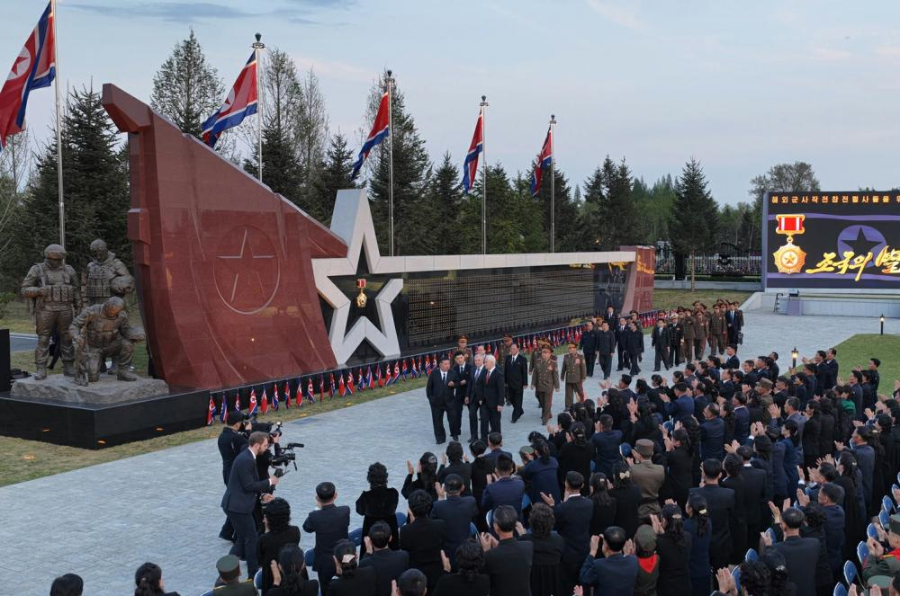
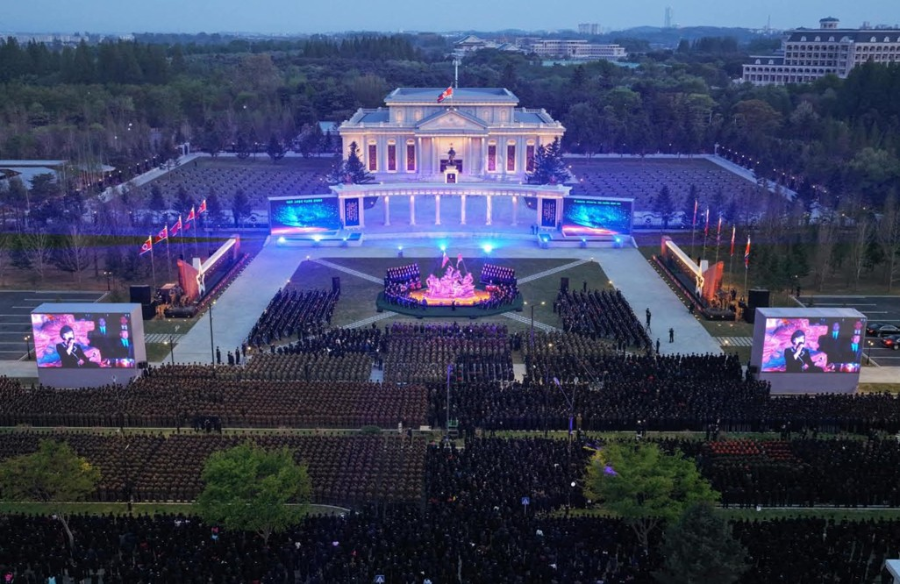
The Korean Central News Agency (KCNA) reported on April 27 that the inauguration ceremony for the Memorial Hall for Combat Merits in Overseas Military Operations had been held the previous day. The event was attended by Chairman Kim Jong-un, Vyacheslav Volodin, Speaker of the Russian State Duma, and Andrei Belousov, Minister of Defense of the Russian Federation.
In his address, Chairman Kim stated, “We have inscribed in this memorial hall a new history of North Korea–Russia friendship written in blood, and a new history of justice won through blood.” He further emphasized that the peoples of both countries share this aspiration, declaring, “No matter how the rules of war may change, or whenever and wherever a crisis may arise, we must be strengthened into a sincere, dedicated, and powerful bulwark that always responds with united strength.” He added, “Standing before this memorial hall, our resolve for the future becomes even stronger.”
Kim’s assertion that North Korea and Russia must become a “stronghold that responds with united strength” to any crisis is widely interpreted as a renewed signal of both countries’ commitment to implementing the military provisions of the Treaty on Comprehensive Strategic Partnership, signed at the June 2024 Pyongyang summit.
Kim also stated that the two countries “fought shoulder to shoulder on the same front for peace and sovereignty, achieving a victory of pivotal significance in preventing the resurgence of fascism and crushing the war ambitions of hegemonic forces.” He added that the “strategic significance” of the Kursk Liberation Operation was immense. He further emphasized that “there is no contribution more sacred than the sacrifice of one’s life,” and asserted that “the hegemonic ambitions and military adventurism pursued by the United States and the West were thwarted by the valiant struggle of the Korean People’s Army.”
In particular, the commemorative messaging framed the conflict as a confrontation between “justice and injustice,” emphasizing its ideological legitimacy. Kim reiterated that “the (North) Korean and Russian armies, faithful to the ideology of justice, fought side by side for peace and sovereignty,” adding that “we achieved a victory of crucial significance in preventing the resurgence of fascism and crushing the war ambitions of hegemonic forces.”
Notably, Chairman Kim highlighted the sacrifices of North Korean forces by directly referencing instances of self-immolation on the battlefield. He described these sacrifices in concrete terms, stating that “they did not seek any reward for their sacrifice even as the explosions of their self-immolation echoed,” and referring to “heroes who chose self-immolation and suicide to defend their honor.” This is interpreted as the first instance in which the North Korean leader has publicly acknowledged the actual combat conditions faced by deployed troops, which had previously been understood only indirectly.
Kim also asserted that North Korea’s participation “thwarted the hegemonic ambitions and military adventurism of the United States and the West,” underscoring the strategic effectiveness of support for Russia. He assessed the Kursk operation by stating, “Although it was a military operation that lasted only a few months, its strategic significance is immense.” He further claimed that North Korean forces “annihilated and eradicated the Ukrainian armed invaders who had encroached upon Russia’s sovereignty and security, contributing to the liberation of the Kursk region,” and that they “secured victory through unparalleled bravery, collective heroism, and an indomitable fighting spirit.”
Observers note that by emphasizing the significance of North Korea’s contributions despite the relatively short duration of the operation, Pyongyang may be signaling expectations of reciprocal compensation from Moscow. The commemorative messaging appears intended to underscore that DPRK–Russia military cooperation has evolved beyond symbolic or diplomatic alignment into a relationship characterized by shared combat experience and sacrifice, while simultaneously framing this cooperation as a form of “solidarity of justice” within the international system.
Meanwhile, Speaker Volodin delivered a personal letter from Russian President Vladimir Putin. In the letter, President Putin commended the performance of North Korean troops, stating that “their heroic deeds will remain forever in the hearts of the Russian people,” and expressed his intention to further strengthen strategic cooperation between the two countries. The event is thus widely viewed as a symbolic demonstration that bilateral military cooperation has moved beyond diplomatic solidarity to a stage characterized by de facto joint operational engagement and shared sacrifice.
In the letter read by Volodin, Putin emphasized that “the fearless feats of the North Korean military will remain forever in the hearts of all Russian citizens,” adding, “I am confident that we will continue to strengthen our comprehensive strategic partnership through joint efforts.” He also noted that, toward the end of World War II, the Soviet Army, together with Korean patriots, liberated the Korean Peninsula from Japanese colonial rule, and that in the 1950s it “provided assistance in defending the independence of the Democratic People’s Republic of Korea in its struggle against foreign aggressors.”
Since North Korea’s deployment of troops to Kursk, there has been an observable increase in bilateral messaging emphasizing historical ties, including references to the Soviet Union’s role in ending Japanese colonial rule and to the participation of Soviet forces in the Korean War—topics that had not previously been highlighted in this manner in official discourse.
Kursk, located in southwestern Russia along the border with Ukraine, was partially occupied by Ukrainian forces in August 2024. North Korea claims that its troop deployment played a decisive role in Russia’s recapture of the region, which Russia officially declared complete on April 26 of the following year.
In October of last year, Chairman Kim broke ground on a memorial hall in Pyongyang’s Hwasong District, a newly developed urban area, to commemorate the sacrifices and heroic deeds of deployed troops. He subsequently visited the construction site on multiple occasions, accompanied by his daughter Ju-ae and other officials, to oversee progress.
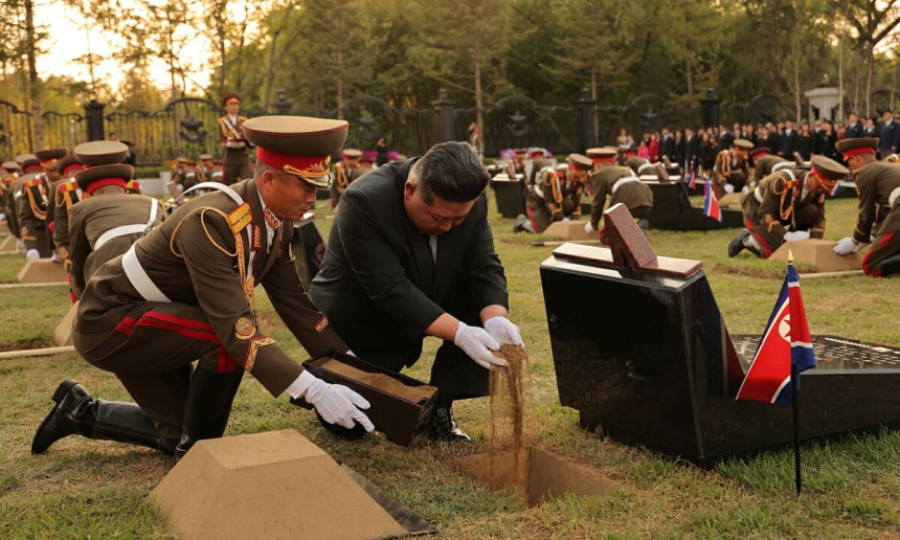
The remains of fallen soldiers have been interred at the site. KCNA reported that Chairman Kim personally placed soil on the remains of one fallen soldier and laid flowers at the interment chamber. The interior of the memorial hall is elaborately decorated with sculptures and paintings depicting combat scenes. Kim also left a handwritten message in the guestbook, stating, “Even if life is buried in the soil they fought to defend, the spirits of the martyrs will live on forever alongside the great honor they safeguarded.”
Chairman Kim further toured an exhibition hall displaying captured weapons alongside Russian officials. Images released by the Russian Embassy in North Korea via Telegram, as well as by North Korean state media, showed German-made tanks, various firearms, and drones on display.
North Korean attendees included Jo Yong-won, Chairman of the Presidium of the Supreme People’s Assembly; Jo Chun-ryong, Party Secretary; and No Kwang-chol, Minister of National Defense, along with other senior Party, government, and military officials, commanders of large combined units of the Korean People’s Army, and soldiers and bereaved families from combat and engineering units deployed to Russia.
State media images also confirmed that Ri Chang-ho, Deputy Chief of the General Staff and Director of the Reconnaissance General Bureau, has been promoted to First Deputy Chief of the General Staff, replacing Jung Myong-do. The position had previously operated under a dual leadership structure shared by Jung Myong-do and Lieutenant General Kim Yong-bok.
North Korea’s decision to construct a large-scale memorial and hold commemorative events marking the first anniversary of the Kursk operation appears intended to underscore the extent to which its sacrifices contributed to Russia’s efforts to counter U.S. influence, while also seeking to secure continued material and strategic benefits.
For its part, Russia demonstrated goodwill by dispatching both Speaker Volodin and Defense Minister Belousov to the event—an unusual move that reflects the importance Moscow places on the bilateral relationship.
Chairman Kim Jong-un also held separate meetings with Speaker Volodin and Minister Belousov in Pyongyang, reaffirming the military alignment between the two countries. According to the Russian Embassy in North Korea’s Telegram channel and the state-run TASS news agency, Kim met Volodin on April 26. During the meeting, Volodin conveyed greetings from President Putin and delivered a message congratulating Kim on his reappointment as Chairman of the State Affairs Commission.
Volodin expressed particular gratitude for North Korea’s troop deployment, stating, “The North Korean military fought side by side with our soldiers to liberate Russian territory from Ukrainian Nazis.” He added, “The Russian people will never forget the dedication of the North Korean military, who sacrificed their lives for the freedom of the motherland,” emphasizing that “this is the true spirit of comrades-in-arms.” He further assessed that the close relationship between Kim and Putin “has become the decisive key to building the future in the most difficult times.”
Volodin arrived in North Korea on April 25 to attend the inauguration ceremony, reportedly at the direction of President Putin. Defense Minister Belousov also arrived the same day for a working visit, with North Korean Defense Minister No Kwang-chol personally receiving him at the airport.
Kim subsequently held talks with Minister Belousov to discuss ways to strengthen military cooperation. Belousov stated that Russia is prepared to conclude a mutual military cooperation plan with North Korea covering the period 2027–2031. This is interpreted as an indication that both sides intend to formalize medium- to long-term military cooperation on a five-year basis, moving beyond short-term wartime coordination such as troop deployments.
Taken together, the inauguration ceremony appears to mark a starting point for a new phase in DPRK–Russia relations, with both sides using high-level exchanges to highlight and institutionalize the outcomes of their expanding military cooperation for both domestic and international audiences.
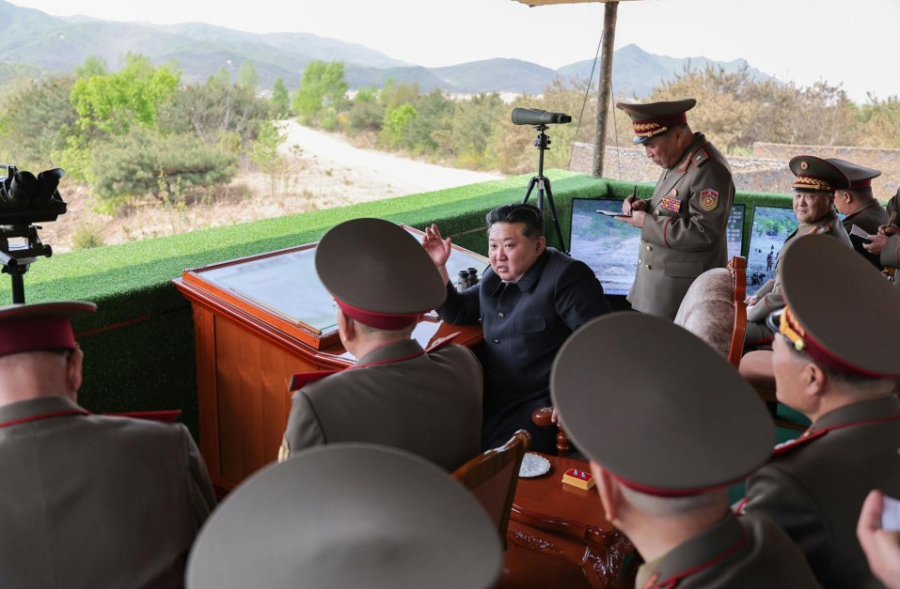
North Korean State Affairs Commission Chairman Kim Jong-un observed a mortar firing competition and emphasized the need to strengthen ideological resolve among troops on April 25, marking the anniversary of the founding of the Korean People’s Revolutionary Army (KPRA), the anti-Japanese partisan force regarded as the historical foundation of the Korean People’s Army (KPA).
According to the Korean Central News Agency (KCNA), Kim visited a combined unit subordinate to the Western District Mechanized Infantry Division of the KPA on the same day to commemorate the 94th anniversary of the KPRA’s founding and to encourage frontline personnel.
During the visit, Kim laid a bouquet at a monument commemorating on-site guidance by President Kim Il-sung, observed a moment of silence, and toured the unit’s Revolutionary History Museum. His remarks focused heavily on ideological discipline as a core determinant of military effectiveness.
He stated, “The ideological elite status of soldiers is the invincible sword of our Party’s unchanging ideology for building a strong army and our view of war,” adding that “only an ideologically strong army that remains constantly aware of its lineage and roots can resolutely subdue and crush any enemy.”
Kim further outlined operational expectations, emphasizing that combined units must “serve as a model for the entire army in political and ideological work with soldiers and in the completion of combat readiness,” in line with their organizational status and mission profile.
As part of the visit, Chairman Kim observed a live-fire competition involving light infantry and mortar units drawn from large combined formations across multiple command levels. He was accompanied by senior military and political officials, including Minister of National Defense No Kwang-chol, Chief of the General Staff Ri Yong-gil, and Director of the General Political Bureau Kim Song-gi.
KCNA reported that the exercise evaluated combat tactics under simulated operational constraints, with units required to “swiftly overcome natural and artificial obstacles, maneuver into firing positions, eliminate multiple targets within a specified time, and withdraw under cover.”
Expressing satisfaction with the exercise outcomes, Kim stated that “combat training must be organized and conducted with a focus on fully implementing the military strategic ideology of our Party and the requirements of Juche-based tactics, while strengthening combat capabilities in every possible way to completely annihilate the enemy.” He directed that such training competitions be expanded in scale and intensity across all unit levels and specialized formations within the Korean People’s Army.
In the marksmanship component of the competition, the Park Kyung Artillery Unit, subordinate to the 11th Army Corps, reportedly achieved first place. Chairman Kim subsequently posed for a commemorative photograph with all officers and soldiers of the brigade and observed athletic events together with unit personnel.
The KPRA, referenced in the commemoration, was the guerrilla force organized by Kim Il-sung during the anti-Japanese struggle in Manchuria. Since 1978, North Korea has designated April 25, 1932—the date it attributes to the KPRA’s founding—as the official anniversary of its armed forces and has marked the occasion with annual commemorations.
Parallel commemorative activities were conducted nationwide. Jo Yong-won, Chairman of the Presidium of the Supreme People’s Assembly, along with senior Party and government officials including Kim Song-nam, An Kum-chol, and Kim Jong-gwan, visited the Museum of the Korean Revolution. Prime Minister Pak Thae-song and other officials laid wreaths at the Daesongsan Revolutionary Martyrs’ Cemetery, where anti-Japanese partisans and independence activists are interred.
In Pyongyang, KPA personnel, workers, and youth placed floral tributes at the statues of Kim Il-sung and Kim Jong-il on Mansu Hill. University students from South Hamgyong Province visited the Revolutionary Historic Site in Ryonggang County to pledge loyalty to the leadership.
Cultural events were also organized as part of the commemoration. The Ministry of National Defense Symphony Orchestra staged a combined music and dance performance at the Bonghwa Art Theater, while students in Pyongyang participated in a public dance event in front of the Pyongyang Acrobatics Theater, performing songs praising the Kim family leadership.
Visit by Russian Interior Ministry Delegation to USS Pueblo in Pyongyang Highlights Anti-U.S. Strategic Alignment
Separately, a delegation from the Russian Ministry of Internal Affairs visited the USS Pueblo during a trip to Pyongyang, drawing attention as a symbolic gesture underscoring perceived “anti-U.S. solidarity” between North Korea and Russia.
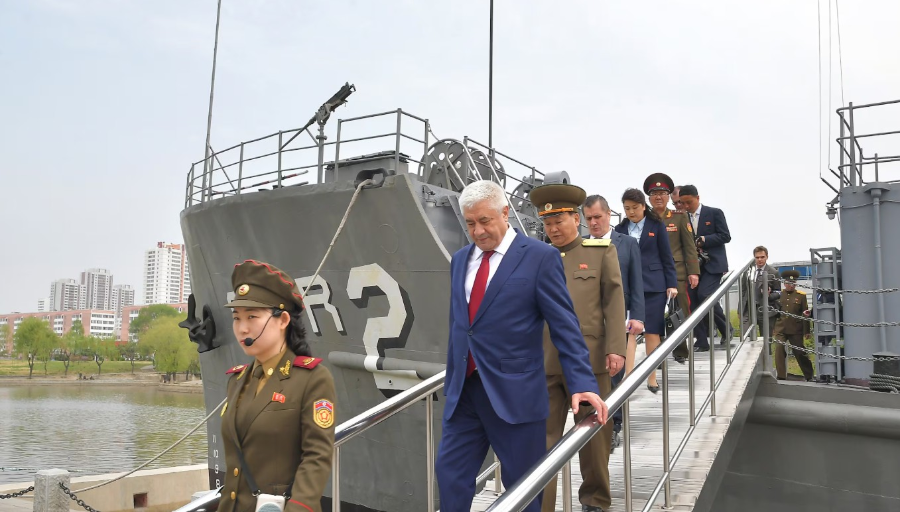
KCNA reported on April 24 that the Russian delegation, led by Interior Minister Vladimir Kolokoltsev, also visited the Museum of the Victory in the War of Liberation of the Fatherland, North Korea’s principal Korean War museum.
The USS Pueblo is a U.S. Navy intelligence-gathering vessel seized by North Korea in 1968 in international waters off Wonsan during the administration of President Lyndon B. Johnson. The incident is widely regarded as a significant escalation in tensions on the Korean Peninsula amid Cold War confrontation between the United States and the Soviet Union.
Originally commissioned as a U.S. Army cargo vessel in 1944 and later converted into a reconnaissance ship in 1966, the USS Pueblo measures approximately 54 meters in length and 10 meters in width, with a displacement of 906 tons. It was captured by the North Korean Navy while conducting signals intelligence operations after departing from Japan.
During the seizure, one crew member was killed and 13 were injured, while the remaining 82 crew members were detained by North Korea for approximately 11 months. The incident marked the first time in over a century that a U.S. naval vessel had been seized on the high seas. In response, the United States deployed the aircraft carrier USS Enterprise and accompanying destroyers to waters near Wonsan, significantly escalating tensions.
The crew was repatriated via Panmunjom in December 1968, but the episode generated controversy in the United States due to what was perceived as a “humiliating negotiation,” as Washington—then heavily engaged in the Vietnam War—accepted substantial North Korean demands to secure their release. North Korea ultimately refused to return the vessel.
Since then, North Korea has designated the USS Pueblo as “war booty seized from the United States” and has used it extensively for propaganda purposes. Originally moored in Wonsan, the vessel was relocated in 1999 under orders from Kim Jong-il to the Victorious Fatherland Liberation War Museum along the Potong River in Pyongyang, where it remains on public display as a prominent anti-U.S. symbol.
The museum itself serves as a key ideological institution, presenting the Korean War as a North Korean victory and reinforcing regime legitimacy through anti-American narratives. Within this framework, the USS Pueblo functions as a central exhibit.
The Russian delegation’s visit to the site is interpreted as a symbolic reaffirmation of the deepening strategic alignment between Pyongyang and Moscow. Notably, the United States has never formally decommissioned the USS Pueblo and continues to list it as a commissioned vessel, effectively treating it as a detained U.S. naval asset.
As a result, analysts have long suggested that, in the event of renewed U.S.–North Korea negotiations, the potential return of the USS Pueblo could serve as a bargaining chip for Pyongyang.
-
PREV [North Korea Inside]
-
NEXT [NK Focus]