

North Korea Inside
· Xi Jinping and Kim Jong-un Meet in Pyongyang, Pledge Stronger North Korea–China Cooperation
· Kim Jong-un Attends Sea Trials of the Kanggun-ho with Ju Ae, Urges Prompt Naval Commissioning
· Kim Yo-jong: “Nuclear-Weapon State Status Is an Absolute, Uncrossable Line”

Kim Myong-sung
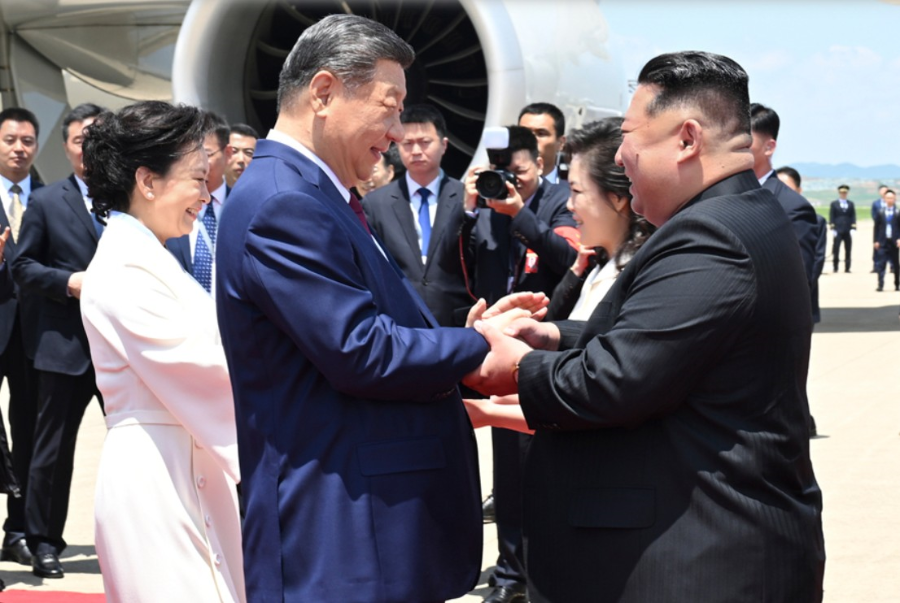
The summit also included an exchange of views on the recent international situation. The Korean Central News Agency reported that the two leaders “reached a satisfactory consensus” on “strengthening strategic coordination and cooperation between the two parties and two countries amid the complex and multifaceted global political situation, firmly safeguarding the sovereignty, security, and development interests of both nations, and jointly safeguarding regional and global peace and development.”
Kim particularly emphasized the strategic importance of North Korea–China relations. He stated, “We will continue to regard North Korea–China friendship as our most important and primary strategic task,” adding, “We will spare no effort to strengthen and develop the relationship between our two countries into a special, sincere, and solid strategic relationship that serves as a model for relations among socialist countries.”
He also reaffirmed his support for China on the Taiwan issue, stating, “No matter how the situation changes, our Party and government will fully support and endorse the policies and positions of the Chinese Party and government aimed at safeguarding their core interests based on the One-China principle.”
North Korea described the summit as “a historic occasion that demonstrated the immutability of DPRK–China friendship and set a new milestone in the development of the strategic cooperative relationship between the two parties and two countries.”
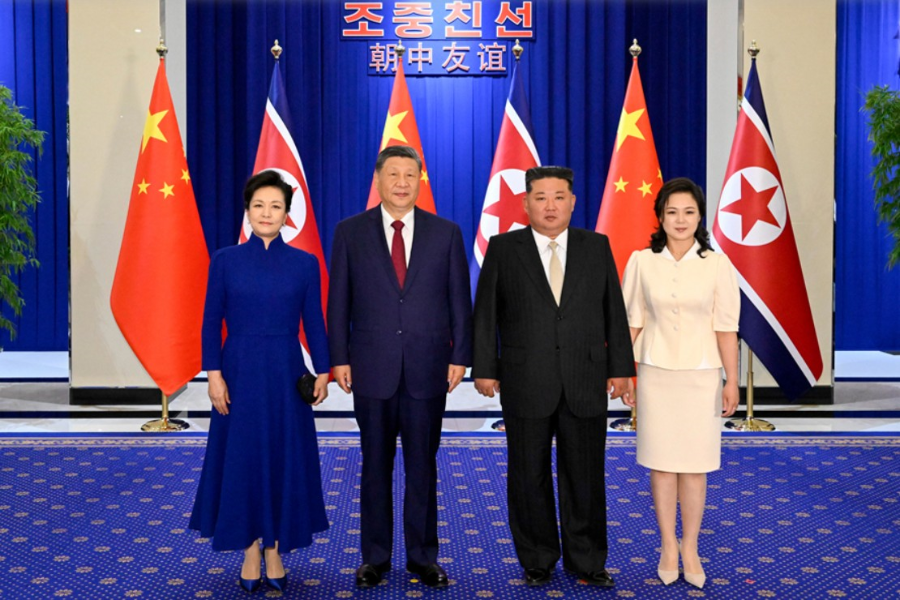
However, some discrepancies emerged between the content released by the Chinese side and reports in North Korean media. While Chinese state-run media prominently reported President Xi’s remarks the previous day on strengthening exchanges with North Korea in areas such as diplomacy, law enforcement, and the military, North Korea’s Korean Central News Agency (KCNA) did not mention these remarks. Some observers interpret this as an instance of coordinated message management between North Korea and China with regard to the expansion of military cooperation.
The results of the summit released by Xinhua News Agency did not include any mention of North Korea’s denuclearization or the resolution of the Korean Peninsula issue. Instead, the two leaders repeatedly emphasized the protection of sovereignty, security, and development interests, as well as the strengthening of strategic cooperation.
Some interpret this as an indication that, with North Korea having declared itself a nuclear-armed state, China’s diplomatic focus is shifting away from denuclearization of the Korean Peninsula and toward the strengthening of strategic cooperation with North Korea.
While the United States stated in materials released following last month’s U.S.–China summit that the two countries had reaffirmed their shared goal of North Korean denuclearization, China emphasized its opposition to sanctions against North Korea in a recent joint statement with Russia, without reference to the denuclearization issue.
Some observers suggest that, during the process of coordinating President Xi’s visit to North Korea, China may have tacitly accepted—or at the very least not objected to—North Korea’s position that the denuclearization agenda was unacceptable.
Prior to his visit, President Xi also published an op-ed in Rodong Sinmun in which he did not once use the term “Korean Peninsula”—a phrase he had referenced six times in 2019—instead emphasizing opposition to hegemony and the strengthening of strategic cooperation.
Xi Jinping Returns to China, Sends Thank-You Message to Kim Jong-un
In a thank-you message sent to North Korean State Affairs Commission Chairman Kim Jong-un upon his return from a state visit to China, Chinese President Xi Jinping stated that “China–North Korea relations have already embarked on a new historical journey,” reiterating the close ties between the two countries. North Korea also mobilized all state-run media to extensively publicize the outcomes of President Xi’s visit and to highlight friendly relations between the two nations.
According to the Korean Central News Agency on June 10, in a message of thanks sent to Chairman Kim on May 9—the day of his return—President Xi stated, “I am satisfied with the results of this visit,” adding that “China–North Korea relations have already embarked on a new historical journey.” He expressed gratitude to Chairman Kim and First Lady Ri Sol-ju for the successful conclusion of his visit, noting that “this fully demonstrates the deep friendship between the two parties and two countries.”

President Xi particularly emphasized that during the summit, he and Chairman Kim “exchanged in-depth views on issues of mutual concern and reached a series of important common understandings,” adding that “this has added new, epoch-making content to China–DPRK relations.” He further stated, “We have demonstrated our firm resolve to uphold traditional friendship, jointly promote development and prosperity, and safeguard regional and global peace and stability.”
He also proposed to Chairman Kim, “Let us jointly seize the trend of the times and safeguard and develop China–DPRK relations based on the fundamental and long-term interests of both countries.” At the end of the message, he added, “I look forward to meeting Chairman Kim again,” and expressed his wish that “China–DPRK friendship be passed down from generation to generation and remain evergreen.”
North Korea intensively publicized the achievements of Xi’s visit to its domestic audience, highlighting the strategic value of North Korea–China relations. Rodong Sinmun, the official newspaper of the Workers’ Party, devoted four of its six pages that day to articles related to Xi’s visit. At the top of the front page, the national emblems and flags of both countries were displayed, accompanied by the red slogan: “The history and tradition of North Korea–China friendship will be eternal and immortal.”
The newspaper provided detailed coverage of Xi’s wreath-laying ceremony at the Tower of Friendship, his visit to the Workers’ Party Central School of Cadres, his luncheon with Kim and his wife, and the large-scale farewell event held by Pyongyang citizens. The Tower of Friendship is a symbolic site honoring Chinese People’s Volunteer Forces soldiers who died during the Korean War, and the image of Xi and Kim laying wreaths together is interpreted as symbolizing the two countries’ “blood alliance.”
In particular, Rodong Sinmun published 52 related photos on that day alone. Pages 3 and 4, which covered Xi’s departure from Pyongyang, featured 22 photos from the farewell ceremony, including images of Xi and Kim shaking hands, as well as First Lady Peng Liyuan and First Lady Ri Sol-ju embracing. The previous day’s coverage of the first day of the visit also reached an unprecedented level, with the usual six-page spread expanded to ten pages and a total of 80 photos included.
Korean Central Broadcasting and Korean Central Television also focused their programming on President Xi’s visit as a major news story. That morning, Korean Central Television featured anchor Ri Chun-hee as the lead presenter in its regular broadcast, providing a detailed account of the second day of the visit. The Korean Central News Agency also released a series of related articles accompanied by a large number of photos.
Experts view this visit and the subsequent propaganda campaign as an attempt by both North Korea and China to showcase their recently strengthened strategic cooperative relationship, both domestically and internationally, while simultaneously demonstrating solidarity to the international community, including the United States. In particular, President Xi’s reference to a “new historic journey” is interpreted as reflecting his intention to elevate North Korea–China relations beyond traditional friendship toward a long-term strategic cooperative partnership.
North Korean State Affairs Commission Chairman Kim Jong-un personally observed the sea trials of the new 5,000-ton destroyer Kanggun-ho—which ran aground during its launch ceremony last year—and emphasized the need to strengthen naval capabilities to secure nuclear deterrence. This is interpreted as a demonstration that the vessel, which suffered a loss of face due to the failed launch, has now entered a normal sea trial phase, while also revealing the regime’s intent to extend its nuclear- and missile-centered strategic capabilities to the naval domain.
North Korea’s state-run Korean Central News Agency (KCNA) reported on June 6 that Chairman Kim visited the destroyer Kanggun-ho, which began operational capability assessment trials on June 4, to observe its sea trials. Photos released by North Korea showed his daughter Ju-ae accompanying him.
Kim boarded the destroyer, toured combat stations including the integrated command post, and received briefings on the test schedule for the ship’s weapons systems and the trial voyage plan. He assessed that “the ship’s cruising and high-speed maneuvering capabilities are excellent, ensuring that its mobility meets operational requirements.”
He went on to emphasize the need to strengthen naval capabilities, stating, “We can deter war and safeguard peace only by possessing a substantial and powerful military force capable of responsibly exercising military sovereignty in any space—on land, at sea, or in the air.”
In particular, Kim directly linked the role of the Navy to nuclear capabilities. He stated, “The issue of rapidly strengthening the Navy into a force capable of reliably fulfilling its role as part of our nuclear deterrent—a force capable of delivering a fatal blow to the enemy at any time, both underwater and on the surface—is the most crucial core task in our Party’s new five-year national defense development policy.”
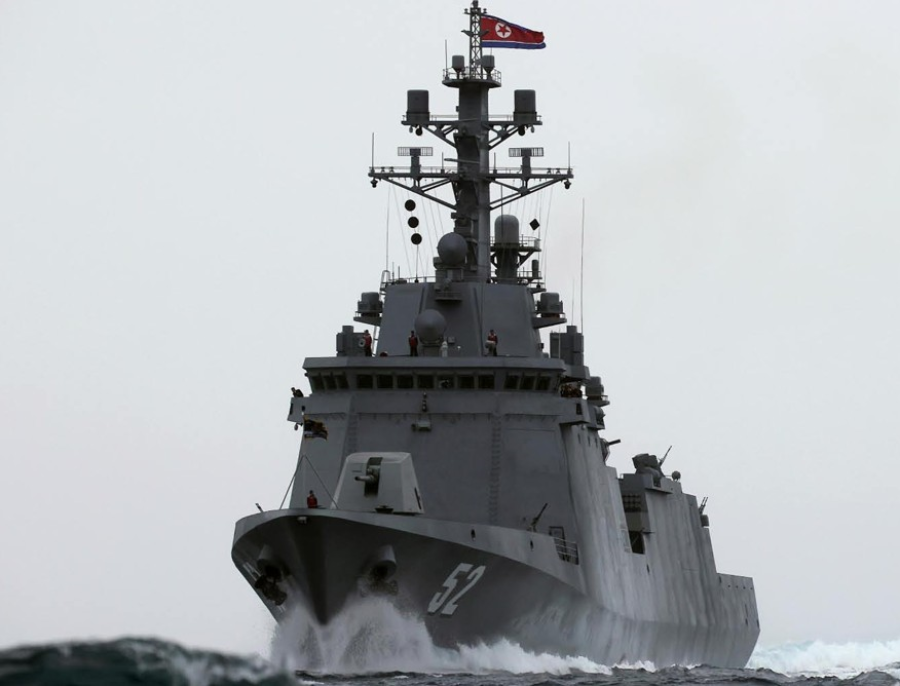
This statement is interpreted as lending weight to North Korea’s recent plans to expand its nuclear-armed surface fleet and submarine forces. Since last year, North Korea has emphasized the expansion of the Navy’s strategic role by successively unveiling plans for new destroyers, strategic cruise missiles, and nuclear-powered submarines.
On that day, Kim instructed officials from shipbuilding and weapons system research institutes, as well as scientists and technicians, saying, “I hope the Choehyun-ho and Kanggun-ho destroyers will be commissioned into the Navy as soon as possible.”
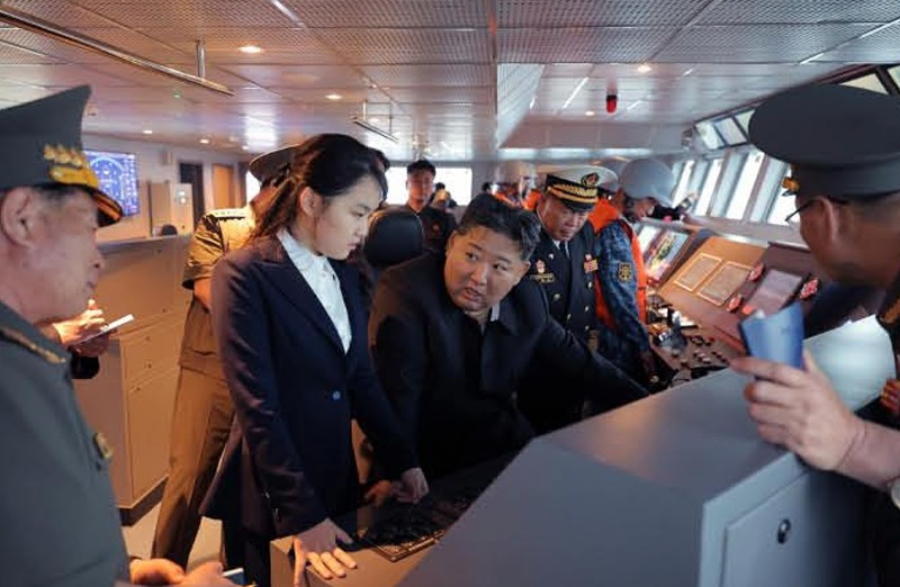
The Kanggun-ho ran aground last May during its launch ceremony after the hull tilted to one side and capsized. Chairman Kim, who witnessed the scene at the time, strongly reprimanded the incident as a “serious and grave accident and a criminal act” and ordered disciplinary action against those responsible.
North Korea subsequently refurbished the vessel following restoration work, and by publicly revealing this sea trial, it appears to be signaling both domestically and internationally that it has overcome the aftermath of the accident and that operational deployment is imminent. In particular, bringing Kim Ju-ae along is interpreted as an effort to highlight the naval modernization project as a key achievement of the Kim Jong-un era while emphasizing its symbolic connection to the succession structure.
Kim Yo-jong: “Nuclear-Weapon State Status Is an Absolute, Uncrossable Line”
Ahead of Chinese President Xi Jinping’s visit to North Korea, Pyongyang has repeatedly flaunted its nuclear capabilities, asserting that “nuclear-weapon state status is a reality.” Analysts suggest that this move is intended to preempt any discussion of denuclearization during the North Korea–China summit while seeking de facto recognition of its nuclear-weapon state status from China.
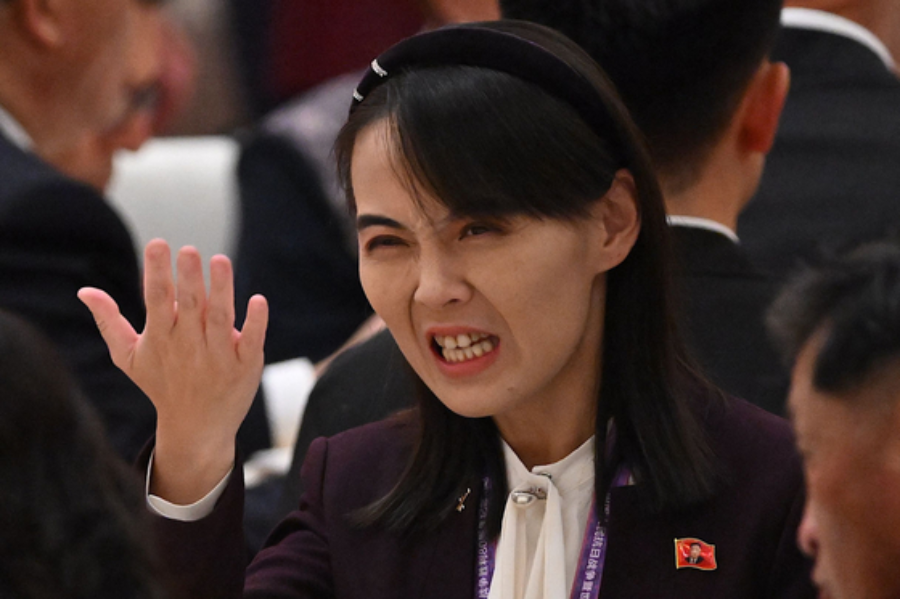
On June 7, the Korean Central News Agency reported on a statement released the previous day by Kim Yo-jong, Director of the General Affairs Department of the Workers’ Party of Korea. Director Kim stated that “the status of a nuclear-armed state is an absolute, unyielding red line,” completely rejecting the “confirmation of the common goal of North Korea’s denuclearization” announced by the U.S. side last month following the U.S.–China summit. She claimed, “It is complete fabrication and baseless false information,” adding, “We possess the most accurate information regarding the existence of such facts.”
This statement, released one day before President Xi’s visit to North Korea on May 8 and 9, is interpreted as a reiteration that North Korea has no intention of bringing the denuclearization issue to the negotiating table. North Korea recently made public footage of Chairman Kim Jong-un inspecting a new uranium enrichment facility, openly demonstrating its determination to advance its nuclear capabilities.
North Korea experts analyze that this message is strongly intended to exclude denuclearization discussions from Xi’s agenda during his visit. They suggest that, by defining its status as a nuclear-armed state—as enshrined in its constitution—as an irreversible national policy rather than a subject for negotiation, North Korea has sent a coercive signal to China to recognize this stance.
Attention is focused on what message Xi will deliver in Pyongyang. While China officially maintains the principle of denuclearization on the Korean Peninsula, it has recently refrained from making related remarks. There is speculation that even if China does not publicly acknowledge North Korea’s nuclear status, it may adopt language that partially reflects North Korea’s position.
Expanding economic cooperation is also cited as a key agenda item for this summit. Amid prolonged international sanctions, North Korea is hoping for economic recovery through increased Chinese tourism and the normalization of trade, while China is also considering its strategic interests in developing its northeastern region.
In particular, attention is focused on whether progress will be made on the issue of Tumen River access to the sea, which China has long pursued. China has been advancing plans to gain access to the East Sea via the lower reaches of the Tumen River in order to strengthen the maritime logistics competitiveness of its three northeastern provinces. At last month’s China–Russia summit, the two countries announced that they would continue trilateral consultations with North Korea on the Tumen River access issue.
If an agreement is reached, the economic cooperation network connecting North Korea’s Rason (Rajin–Sonbong) region with China’s three northeastern provinces and Russia’s Primorsky Krai is expected to be further strengthened. Some observers suggest that such economic cooperation could serve as a foundation for expanded strategic cooperation among North Korea, China, and Russia in the long term.
However, the prevailing view is that the likelihood of China establishing a cooperative framework with North Korea and Russia at the level of a military alliance is limited. This is because, even amid strategic competition with the United States, China does not want the situation on the Korean Peninsula to deteriorate in an uncontrollable direction. Instead, it is expected that China will seek to deter North Korea’s military provocations and to manage, to a certain extent, the military rapprochement between North Korea and Russia.
Diplomatic circles are also paying close attention to the possibility that President Xi will attempt to serve as a bridge for the resumption of North Korea–U.S. dialogue by conveying the U.S. position, as confirmed at last month’s U.S.–China summit, to Chairman Kim. There is speculation that the outcome of President Xi’s visit to North Korea will be a crucial turning point in determining the future of the North Korean nuclear issue and the situation on the Korean Peninsula.
-
PREV [North Korea Inside]
-
NEXT [NK Inside]