

North Korea Inside
· Kim Jong-un Signals Deeper Consolidation of North Korea–China Ties
· North Korea Highlights “100-Day Economic Achievements” Ahead of Party Plenary Meeting, Emphasizing Local Development Efforts
· North Korea Rejects Denuclearization Calls, Says “Disarmament of a Combatant Is an Illusion”

Kim Myong-sung
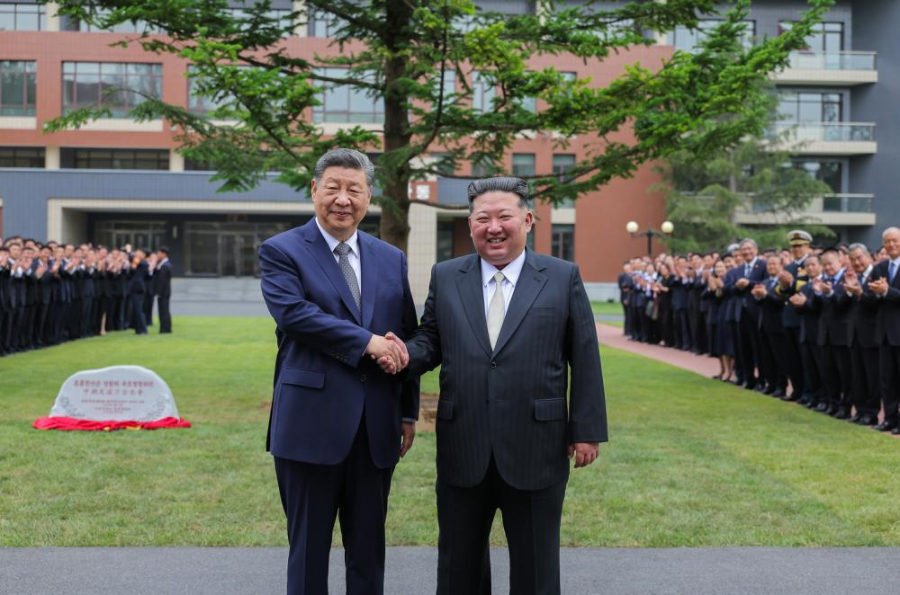
KCNA also reported that the ribbon attached to the congratulatory flower basket sent by Kim bore the message: “Warm congratulations to Comrade General Secretary Xi Jinping on his birthday.”
The message and flower basket were delivered to an official of the International Liaison Department of the Communist Party of China Central Committee via the North Korean ambassador to China.
This marks the first time since President Xi’s 70th birthday in 2023 that North Korea has publicly issued a birthday congratulatory message in the name of its top leader. The gesture is particularly notable as it came just one week after Xi completed a two-day state visit to Pyongyang on June 8, during which he held a summit with Kim Jong-un.
During the summit, the two leaders reportedly discussed measures to expand cooperation in political, economic, and security-related areas and reaffirmed their commitment to elevating North Korea–China relations into a “strategic cooperative partnership for a new era.”
Analysts assess that the public release of Kim’s congratulatory message goes beyond a routine diplomatic gesture and reflects an effort to demonstrate the restoration and strengthening of North Korea–China strategic ties, both domestically and internationally.
Against the backdrop of intensifying strategic competition between the United States and China, North Korea's strategic calculations appear to be converging more closely with Beijing's efforts to expand its influence on the Korean Peninsula. Pyongyang is widely assessed as viewing closer ties with China as a means of expanding diplomatic space and improving economic resilience under conditions of sustained sanctions and international isolation.
At the same time, North Korea's deepening military cooperation with Russia, alongside its efforts to restore and stabilize relations with China, has led some analysts to argue that a loose North Korea–China–Russia alignment may be gradually taking shape.
Ahead of the Second Plenary Meeting of the Ninth Central Committee of the Workers’ Party of Korea scheduled for later this month, North Korea has launched an extensive propaganda campaign highlighting economic achievements across various sectors during the 100 days since the Ninth Party Congress.
The campaign is widely interpreted as an effort to strengthen ideological unity among workers and reinforce momentum toward implementing the economic objectives established by the Party.

In an article published on the 15th titled “Miracles and Innovations Created on the Front Lines of the New Five-Year Plan Following the Supreme Leader’s Guidance,” KCNA reported that “overall industrial production has increased by 105 percent during the 100 days since the Party Congress.”
The report stated that workers and officials across the country had mobilized their “mental strength and scientific and technological capabilities” to continuously establish new production records and advance toward higher targets.
KCNA highlighted the Sangwon Cement Complex, which Chairman Kim Jong Un visited immediately after the Ninth Party Congress in February, as a key example. According to the report, the facility shortened the period of intensive equipment maintenance and launched a campaign aimed at achieving significant production increases, recording an average daily production rate of 107 percent in March and subsequently meeting production targets for April and May.
The agency also reported that the February 8 Jikdong Youth Coal Mine launched various mass campaigns, including “one extra shift,” “supporting the next shift,” and “one additional coal cart,” resulting in coal production exceeding planned targets by more than 1,000 metric tons.
KCNA further claimed that enterprises across major sectors—including construction materials, coal mining, metallurgy, chemicals, electricity, machinery, and light industry—achieved substantial production growth through technological innovation and ideological mobilization.
The report emphasized the importance of ideological preparation, stating that recent achievements demonstrate that there are no insurmountable obstacles when the country first identifies internal reserves and strengthens scientific and technological capabilities.
It also reiterated North Korea’s commitment to achieving the economic objectives established at the Ninth Party Congress, stating that the country would continue setting new standards and breaking new records.
Rodong Sinmun, the official newspaper of the Workers’ Party of Korea, also reported on its front page that construction of 20 comprehensive service facilities nationwide under the “Local Development 20×10 Policy” had been completed with the participation of military construction units.
The newspaper added that military personnel were continuing roofing and exterior finishing work in preparation for the Party plenary meeting.
The Plenary Meeting of the Central Committee of the Workers’ Party of Korea serves as a key policy-making body responsible for reviewing and deciding major domestic and foreign policy issues. The Political Bureau approved a decision on May 24 to convene the Second Plenary Meeting of the Ninth Central Committee later this month.
North Korea Rejects Denuclearization Calls, Says “Disarmament of a Combatant Is an Illusion”
North Korea criticized the recent South Korea–U.S. Nuclear Consultative Group (NCG) meeting, which reaffirmed the shared goal of North Korea’s denuclearization, arguing that discussions of denuclearizing a “combatant state” amount to “a groundless illusion.”
In a statement released through KCNA on June 14, a spokesperson for North Korea’s Foreign Ministry condemned what it described as a “collective nuclear confrontation campaign” involving the United States, Japan, and South Korea.
The spokesperson stated that repeated attempts by the United States and its allies to pressure a sovereign state would have consequences, warning against what Pyongyang characterized as provocative actions.
The statement further asserted that “anti-DPRK rhetoric and coordinated nuclear threats” by the United States and its partners would not affect North Korea’s status as a nuclear-armed state, adding that the issue of denuclearization had already been “conclusively settled.”
It also claimed that defense cooperation among South Korea, the United States, and Japan, along with joint military exercises incorporating extended deterrence scenarios, further justified North Korea’s efforts to enhance its nuclear and military capabilities.
The statement claimed that the development of a nuclear deterrent is a legitimate measure intended to prevent external threats, protect national sovereignty, and contribute to regional security.
The spokesperson further insisted that no pressure from Washington, Seoul, or Tokyo would alter North Korea’s claimed status as a nuclear-armed state, declaring that denuclearization could not be reversed.
South Korea and the United States held the sixth meeting of the Nuclear Consultative Group in Seoul on June 11, issuing a joint statement reaffirming their shared objective of achieving North Korea’s denuclearization.
Following the Extended Deterrence Dialogue with Japan held on June 8–9, the United States also reiterated its commitment to the complete denuclearization of North Korea.
-
PREV [NK Inside]
-
NEXT [NK Focus]