

< North Korean Trends in June 2026 >
- DPRK–China Strategic Cooperation, Defense Modernization, and Regional Development Policy Implementation -

Seung-hyun Lee
Ph.D in Public Administration
Research Fellow, Sand Research Institute
In June 2026, North Korea pursued a policy agenda centered on strengthening strategic cooperation with China, advancing the modernization of its defense capabilities, implementing regional development initiatives, and cultivating a new generation of political leadership. Chinese President Xi Jinping's visit to Pyongyang, together with the DPRK–China summit, represented the most significant developments in North Korea's external relations during the month.
Domestically, the regime continued to emphasize progress in its nuclear and missile programs alongside the implementation of regional development policies. Kim Jong-un made a total of nine public appearances during the month.
Of these, five (55.6 percent) were related to military affairs, while three (33.3 percent) focused on economic and social issues. Although the overall number of public appearances declined slightly from May, military activities still accounted for more than half of the total, underscoring the regime's sustained emphasis on strengthening national defense.
Political activities were largely concentrated on the DPRK–China summit, while economic and social engagements continued to highlight regional development initiatives and efforts to cultivate a new generation of political leadership.
A particularly noteworthy development was the DPRK–China summit, during which the two countries agreed to expand cooperation across political, economic, cultural, and security domains. In addition to reaffirming their traditional relationship, both sides pledged to strengthen strategic communication in response to changes in the regional and international security environment.
The summit underscored Pyongyang's intention to maintain a stable strategic partnership with Beijing despite continued international sanctions. It also suggested Beijing's willingness to sustain engagement with North Korea as part of its broader effort to manage stability on the Korean Peninsula and preserve its regional influence. In addition, North Korea broadened its diplomatic engagement with other socialist states, as reflected in the visit of a delegation from Vietnam's Ministry of Public Security.
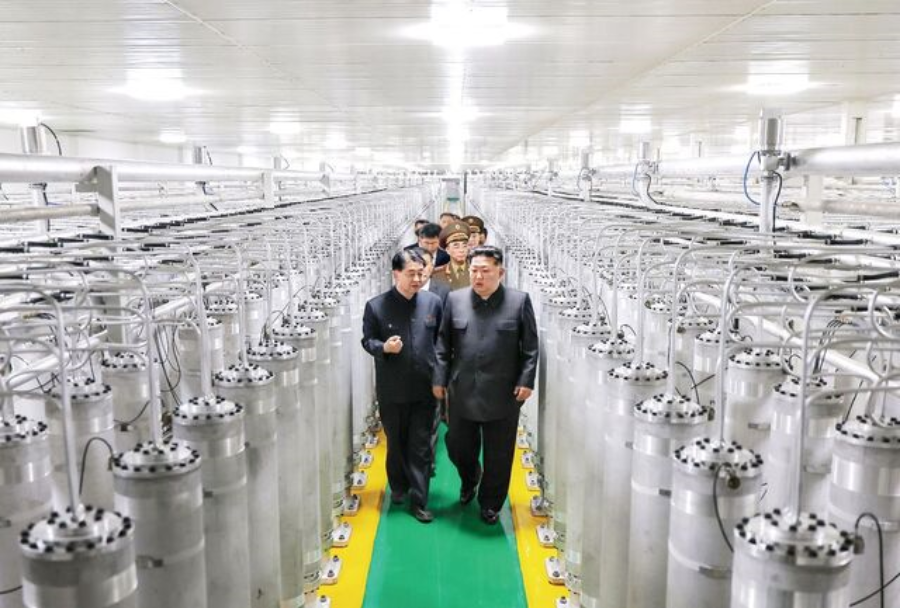
In the military domain, the most significant developments included the reported operation of a new uranium enrichment facility and Kim Jong-un's inspections of key defense-industrial enterprises. During these visits, he emphasized the expansion of nuclear materials production capacity and the strengthening of the defense industrial base, reaffirming his commitment to enhancing North Korea's nuclear deterrent.
While observing the sea trials of the naval destroyer Kanggon-ho, Kim also underscored the importance of naval modernization and improved maritime operational capabilities, illustrating North Korea's continued pursuit of parallel development in both strategic nuclear forces and conventional military capabilities. His observation of artillery weapons tests later in the month similarly reflected ongoing efforts to improve the performance and operational effectiveness of tactical weapons systems.
In the economic sector, Kim Jong-un reviewed progress in regional development initiatives through inspections of the Sinuiju Greenhouse Complex and the Vegetable Science Research Center. North Korea emphasized the adoption of modern agricultural technologies and reiterated its commitment to revitalizing regional economies and improving living standards.
The completion of rice planting in major agricultural areas nationwide, together with Premier Pak Thae Song's inspections of the agricultural and coal sectors, further underscored the regime's continued focus on food security and the maintenance of key industrial infrastructure.
Meanwhile, North Korea placed considerable emphasis on educating the next generation of Party cadres and youth through commemorative events marking the 80th anniversaries of the Party Central Cadre School and the Korean Children's Union. Kim Jong-un instructed Party officials to cultivate cadres with both revolutionary commitment and strong policy implementation capacity. At Youth League events, he underscored the role of younger generations as a driving force behind national development and the continuation of the country's revolutionary traditions.
These activities should be understood not merely as commemorative occasions but as part of a broader effort to reinforce long-term regime stability and ideological cohesion.
Overall, developments in June 2026 indicate that North Korea continued to pursue a dual-track strategy of strengthening strategic cooperation with China externally while advancing defense modernization, regional development initiatives, and leadership succession domestically. The regime also sought to integrate its diplomatic, military, economic, and social priorities in ways that reinforce both regime stability and policy coherence.
Taken together, these developments suggest that Pyongyang is likely to maintain its current policy trajectory, with continued emphasis on strengthening its nuclear and military capabilities alongside the implementation of regional development policies.
-
PREV [NK Inside]
-
NEXT [NK Inside]