

KWP Central Committee Plenary Meeting Reviews the First Half of 2026: Outcomes and Implications for Peaceful Coexistence on the Korean Peninsula

Yong-hwan Choi
Institute for National Security Strategy
Key Outcomes of the Second Plenary Meeting
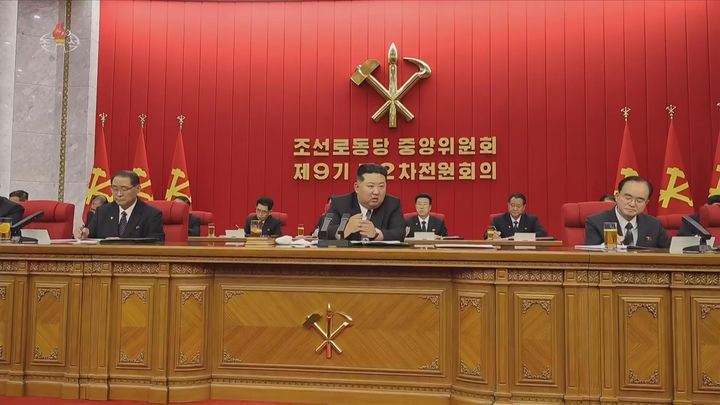
The Second Plenary Meeting of the Ninth Central Committee of the Workers' Party of Korea (WPK) was convened in Pyongyang from June 20 to 22, 2026. As the Party's highest decision-making and personnel body between Party Congresses, the Central Committee Plenary Meeting serves as the principal forum for reviewing policy implementation and establishing strategic priorities. The session assessed progress during the first half of 2026—the inaugural year of the five-year plan adopted at the Ninth Party Congress—and outlined policy priorities for the remainder of the year.
First, the meeting identified the coal industry as a strategic sector essential to both the Party and the state. Discussions focused on modernizing coal production through technological upgrades and improving miners' living conditions, including expanded housing construction. Kim Jong-un specifically called for transforming the Chonsong Youth Coal Mine into a model modern mining complex and establishing it as a showcase for the improvement of mining communities. The Korean Central News Agency (KCNA) reported on June 16—immediately prior to the plenary meeting—that the mine had achieved production equivalent to 106 percent of the previous year's output, while the July 6 edition of Rodong Sinmun announced that it had fulfilled 261 percent of its June production target.
The renewed emphasis on coal reflects its continued importance as the backbone of North Korea's energy system. Coal remains indispensable for electricity generation and serves as a critical input for agriculture, heavy industry, and light manufacturing. It has also historically been one of the country's principal sources of foreign currency earnings. Amid growing uncertainty in global energy markets resulting from international sanctions, the Russia–Ukraine war, and instability in the Middle East, Pyongyang appears to view domestic coal production as a strategic prerequisite for sustaining economic development.
Notably, this policy emphasis persists despite North Korea’s expanding strategic partnership with Russia, which has created greater opportunities for energy and resource imports. This suggests that Pyongyang continues to prioritize its longstanding doctrine of self-reliance (juche) by emphasizing the use of domestically available resources rather than reducing dependence on external supplies.
This development also carries potential implications for sanctions policy. Prior to the adoption of UN Security Council Resolution 2371, which imposed a comprehensive ban on North Korean coal exports, coal accounted for approximately 40 percent of the country's total exports. Consequently, an important question is whether expanded coal production is intended solely to meet domestic demand or is also designed to position North Korea for renewed exports should sanctions be eased in the future. Given that China was previously North Korea's largest coal importer, recent improvements in bilateral relations merit close attention as a potential indicator of future trends in sanctions implementation.
Second, the plenary meeting adopted a resolution entitled On Formulating Measures to Enhance the Functions and Roles of City and County People's Committees, placing renewed emphasis on strengthening local administrative institutions in support of regional development. This initiative is intended to facilitate the implementation of Kim Jong-un's "Local Development 20×10 Policy," first introduced during the Tenth Session of the Fourteenth Supreme People's Assembly in January 2024.
However, the meeting simultaneously criticized local authorities for “deviations from the Party’s intentions” and stressed that all local governance must remain fully aligned with the policies and principles established by the Party Central Committee. These statements suggest that, although local People’s Committees may receive expanded administrative responsibilities, meaningful political decentralization or greater local autonomy is unlikely. Rather, the initiative appears designed to strengthen implementation capacity while preserving centralized Party control.
Third, the plenary meeting reaffirmed North Korea's commitment to strengthening both its nuclear deterrent and conventional military capabilities. Citing an increasingly uncertain international security environment, the leadership emphasized the need to continuously expand its nuclear forces and fully exercise its status as a nuclear-weapon state. This assessment is broadly consistent with the strategic direction established at the Ninth Party Congress.
Specific defense tasks included accelerating the development and production of conventional weapons, constructing a 10,000-ton strategic guided-missile cruiser, and expanding naval infrastructure through the establishment of new fleet bases. These initiatives demonstrate the continued implementation of Pyongyang's strategy of simultaneously advancing nuclear capabilities and conventional military modernization. Under this approach, North Korea seeks to consolidate what it characterizes as its irreversible status as a nuclear-weapon state while also modernizing its conventional military capabilities, particularly its naval forces.
The meeting also reaffirmed the regime's position that inter-Korean relations constitute "the most hostile state-to-state relationship," underscoring the continued institutionalization of the "two hostile states" framework. In this context, the leadership announced the qualitative completion of the project to fortify the southern border, indicating that the military and political separation of the Korean Peninsula remains a strategic priority.
Fourth, the plenary meeting addressed organizational restructuring and efforts to reinforce Party discipline. At Kim Jong-un's recommendation, Jo Yong-won was relieved of his position as Chairman of the Standing Committee of the Supreme People's Assembly and reappointed as Secretary of the Party Central Committee and Director of the Organization and Guidance Department (OGD). Having assumed the parliamentary post only three months earlier at the Ninth Party Congress, Jo's rapid return to the OGD underscores the central importance Kim places on the Party's personnel management and organizational oversight functions.
Standing Committee of the Supreme People's Assembly would temporarily assume responsibility for the body's operations until a new chairman is elected at a subsequent session of the Supreme People's Assembly. Significantly, the official announcement explicitly cited Articles 90, 96, and 99 of the Constitution as the legal basis for these personnel changes. The unusual emphasis on constitutional procedures appears intended to reinforce the institutional legitimacy of these leadership decisions and project an image of governance operating within an established legal framework.
The leadership also implemented additional personnel changes aimed at strengthening organizational discipline within both the Party and the military. Kim Jae-ryong was removed from his positions as a member of the Presidium of the Political Bureau and Director of the Organization and Guidance Department, while Park Hui-chol, Deputy Director of the General Political Bureau's Organization Department, was dismissed on corruption-related charges. These personnel actions indicate that Kim Jong-un continues to rely on anti-corruption campaigns and organizational discipline as key instruments for maintaining elite cohesion and reinforcing centralized political control.
Assessment and Outlook
As noted above, the principal objective of the June Plenary Meeting was to assess the initial implementation of the decisions adopted at the Ninth Party Congress in February and establish priorities for the remainder of the year. From an economic perspective, one notable development was the plenary meeting’s markedly stronger emphasis on the coal industry. Whereas the Ninth Party Congress identified metallurgy, chemicals, electricity, coal, and machinery collectively as strategic sectors, the June meeting singled out coal as a distinct priority. This shift warrants close attention.
At a time when North Korea's strategic partnership with resource-rich Russia has reached an unprecedented level, Pyongyang's renewed emphasis on domestically available energy resources suggests that self-reliance remains the guiding principle of its economic strategy. Equally important is whether expanded coal production is intended solely to satisfy domestic demand or also to position North Korea for renewed exports should international sanctions be eased in the future. Given China's historical role as North Korea's primary coal importer, future developments in North Korea-China relations and sanctions enforcement warrant careful monitoring.
The plenary meeting also reaffirmed the regime’s commitment to implementing the “20×10 Local Development Policy,” including efforts to strengthen the administrative capacity of local People’s Committees. Nevertheless, it remains uncertain whether expanding the authority of local governments alone will be sufficient to ensure effective implementation of the policy. The initiative has gradually expanded beyond industrial development to encompass healthcare and cultural infrastructure, thereby increasing both its scope and resource requirements. However, persistent shortages of capital, industrial equipment, and operational capacity continue to constrain progress. Moreover, questions remain regarding the long-term sustainability of newly constructed facilities, including factories and hospitals. Although the policy reflects a genuine effort to improve living standards and reduce regional disparities, its feasibility and effectiveness within North Korea’s self-reliant development model remain uncertain.
In the security domain, North Korea is expected to continue pursuing an irreversible nuclear deterrent while maintaining its “two hostile states” framework for inter-Korean relations. Pyongyang continues to invoke the deteriorating international security environment as justification for expanding and modernizing its nuclear arsenal, while presenting its redefinition of relations with South Korea as a permanent strategic decision rather than a temporary policy adjustment. Given the limited external leverage available to constrain North Korea’s nuclear program, coupled with the continued improvement of its relations with both China and Russia, Pyongyang’s nuclear modernization efforts are likely to continue. Under these circumstances, the current stalemate in inter-Korean relations is also likely to persist over the medium to long term.
Challenges to Realizing Peaceful Coexistence
Since taking office, the Lee Jae-myung administration has consistently pursued a policy centered on peaceful coexistence with North Korea. It has articulated three guiding principles: respect for the North Korean regime, rejection of absorption-based unification, and the renunciation of hostile actions. Building on these principles, the administration announced its policy of peaceful coexistence on the Korean Peninsula in February 2026. The initiative pursues three overarching objectives: institutionalizing peaceful coexistence between the two Koreas, establishing a foundation for shared prosperity, and ultimately realizing a Korean Peninsula free from both war and nuclear weapons.
To date, however, Pyongyang has shown no indication of responding positively to these initiatives. Instead, it continues to maintain its hostile posture toward Seoul. Military and political tensions remain elevated, and even the inter-Korean military hotline—designed to prevent accidental escalation—has yet to be restored.
Given the current international environment and the state of inter-Korean relations, a comprehensive improvement in bilateral ties appears unlikely in the near term. Nevertheless, historical experience demonstrates that relations on the Korean Peninsula have repeatedly shifted in response to changes in strategic circumstances and political incentives. While optimism should be tempered, the possibility of future change should not be dismissed.
A critical starting point is understanding why North Korea currently sees little incentive to improve relations with South Korea. One central factor is Pyongyang’s persistent concern over the possibility of absorption-based unification, particularly given the widening gap in economic and national capabilities between the two Koreas. Addressing this concern ultimately requires a broader reconsideration of both the concept of unification and South Korea’s long-term unification strategy.
A second challenge involves recognition and mutual respect. At the symbolic level, this includes questions of official terminology—for example, how South Korea should refer to North Korea as Pyongyang increasingly uses the formal designation “Republic of Korea” rather than “South Korea.” More fundamentally, however, it raises broader questions about whether South Korea’s legal and institutional framework adequately recognizes North Korea as a counterpart for peaceful coexistence and dialogue.
A third challenge concerns the credibility and sustainability of South Korea’s North Korea policy. Effective engagement requires policy continuity that extends beyond changes in political administrations. It also requires sufficient strategic autonomy within the U.S.–ROK alliance to pursue dialogue when diplomatic opportunities emerge. Taken together, these structural challenges underscore the difficulty of achieving meaningful progress in inter-Korean relations under current conditions.
Recent developments—including the KWP Central Committee Plenary Meeting in June—also highlight the importance of understanding North Korea’s evolving foreign policy priorities. Since the collapse of the Hanoi Summit in 2019, Pyongyang has steadily shifted its diplomatic focus away from the United States and toward Russia and China. This strategic realignment helps explain North Korea’s limited interest in resuming negotiations with Washington while underscoring the growing importance of South Korea’s relations with both Moscow and Beijing.
To sustain the local development initiatives reaffirmed during the June Plenary Meeting, North Korea is likely to deepen its economic cooperation with China and Russia. Although the North Korean economy appears to have recovered from its most severe contraction, it has yet to establish a self-sustaining growth trajectory. Consequently, external economic support will remain essential if Pyongyang is to achieve tangible economic outcomes. For policymakers, this underscores the importance of accurately assessing North Korea’s evolving domestic priorities, external relationships, and strategic requirements when formulating policy responses.
At the same time, recent developments suggest that opportunities for limited engagement remain. The participation of a North Korean women’s football club in the AFC Women’s Champions League competition held in Suwon in May demonstrated that practical exchanges remain possible even amid heightened political tensions. Although the event also illustrated the limitations of inter-Korean engagement under current conditions, it nonetheless suggests that political hostility does not necessarily preclude functional interaction between the two sides.
From a policy perspective, effective crisis management remains indispensable. However, policymakers should move beyond an exclusive focus on North Korea’s nuclear capabilities and place greater emphasis on practical measures to reduce military threats and prevent escalation. Achieving this objective will require close coordination between Seoul and Washington while preserving opportunities for U.S.–North Korea dialogue should Pyongyang remain willing to engage. At the same time, any future U.S.–North Korea negotiations are unlikely to produce lasting improvements on the Korean Peninsula—including progress in inter-Korean relations—unless they are accompanied by a clear and consistent approach to the fundamental political and institutional issues outlined above.
-
PREV [NK Inside]
-
NEXT [NK Inside]