

Strengthening Policy Implementation Following the Party
Congress: Military Command Restructuring and Continued
North Korea–Russia Strategic Cooperation

Seung-hyun Lee
Ph.D in Public Administration
Research Fellow SAND Research Institute
In August 2026, North Korea intensified efforts to translate the decisions of the 9th Party Congress into concrete policy measures, while simultaneously accelerating defense modernization and restructuring its military command system. Externally, Pyongyang continued to deepen its strategic partnership with Russia while refraining from immediately responding to U.S. overtures for dialogue. Internally, it continued to pursue regional development while seeking to improve living standards and strengthen economic conditions for the population.
Economic Policy: From “Setting Goals” to “Assessing Implementation Capacity”
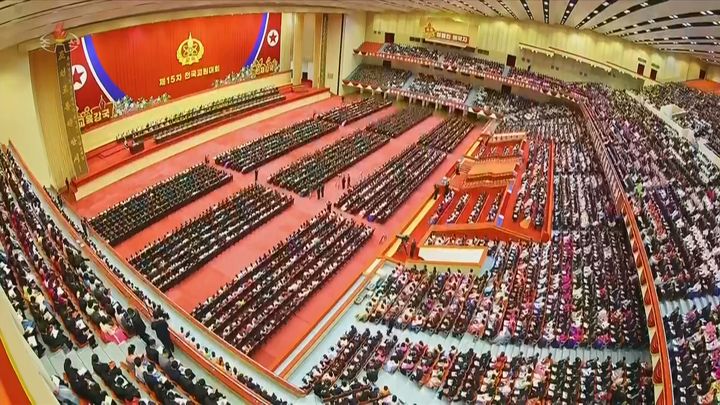
The 4th Plenary Meeting of the Political Bureau of the 9th Central Committee of the Workers’ Party of Korea, held on August 25, was the most significant political event in North Korea in August. The meeting reviewed progress in implementing major policy tasks adopted at the 9th Party Congress and subsequent plenary meetings. Kim Jong-un, meanwhile, criticized the operational and managerial capabilities of economic policymaking and leadership bodies, arguing that they had fallen short of the objectives set by the Party. This suggests that North Korea has moved beyond simply establishing new economic development goals following the Party Congress and is now focusing more explicitly on the administrative and economic management capabilities needed to translate those goals into tangible results.
It is particularly noteworthy that North Korea has framed shortcomings in the economic sector not simply as consequences of sanctions or adverse external conditions, but also as matters of leadership and institutional competence. The future effectiveness of North Korea’s economic policies therefore appears likely to depend less on the formulation of additional policy initiatives than on the regime’s capacity to implement existing policies effectively and ensure control and performance at the production level.
Military Modernization: Moving Beyond Weapons to Organizational Reform
In August, three instances of short-range ballistic missile launches were confirmed. On August 6, North Korea launched one short-range ballistic missile from the Wonsan area, followed by another launch on August 12. On August 20, approximately 10 short-range ballistic missiles were launched from the Pyongyang area. In particular, the August 20 launches coincided with the ongoing ROK-U.S. joint military exercises and were widely interpreted as a demonstration of North Korea’s military response capabilities.
More significant, however, was the restructuring of North Korea’s senior military leadership at the end of the month. On August 29, the Central Military Commission of the Workers’ Party of Korea reinstated Pak Jong-chon as Vice Chairman, transferred Ro Kwang-chol from Minister of National Defense to First Deputy Director of the Military-Industrial Department, and appointed Kim Song-gi as the new Minister of National Defense. The reshuffle suggests that North Korea increasingly views military modernization not simply as a matter of developing and deploying advanced weapons systems, but as an integrated effort involving the military command structure, the defense-industrial base, and defense science and technology.
North Korea-Russia Relations: From “War Cooperation” to “Generational Ties”
Liberation Day once again provided a symbolic opportunity to reaffirm North Korea–Russia relations. On August 14, Kim Jong-un visited the Liberation Monument to pay tribute to Soviet troops and emphasized the historical traditions and blood ties underlying the relationship between North Korea and Russia. President Vladimir Putin likewise underscored the two countries’ comprehensive strategic partnership in a congratulatory message and referred to the continuation of bilateral joint projects.
Of particular note was the presence of Kim Ju-ae during visits to the Liberation Monument and the Daesongsan Revolutionary Martyrs’ Cemetery. Following her appearance at the Victory Day commemorations in July, Kim Ju-ae again appeared at major historical and diplomatic events associated with Liberation Day in August. This may be interpreted as an effort by Pyongyang to convey that not only its revolutionary traditions but also its strategic relationship with Russia are intended to be carried forward by the next generation.
No Response to the U.S. Call for Dialogue
Another notable feature of developments on the Korean Peninsula in August was North Korea’s selective non-response to U.S. overtures for dialogue.
Although the United States scaled back the scope of the ROK-U.S. joint military exercises and signaled the possibility of renewed engagement with North Korea, Kim Jong-un did not issue a direct response. Instead, Kim Yo-jong downplayed the significance of the reduced scale of the exercises and continued to criticize the United States and South Korea. From Pyongyang’s perspective, North Korea appears to be assessing the implications of Washington’s changing posture while concluding that it remains advantageous to preserve its strategic leverage rather than immediately interpret the shift as a basis for resuming dialogue.
Accordingly, future U.S.-North Korea relations are likely to be shaped less by the immediate resumption of summit-level talks than by whether further adjustments in U.S. policy toward North Korea and Pyongyang’s demands can be brought into sufficient alignment to create conditions for substantive negotiations.
Continued Regional Development and Improvement of People’s Livelihoods
Despite continued external and military tensions, North Korea has maintained its focus on regional development and improving the livelihoods of its population. Prime Minister Pak Tae-song conducted a series of on-site inspections of factories and enterprises, and toward the end of the month, he inspected construction at the Samjiyon Mountain Tourism District, as well as factories and enterprises in Hamhung. These activities appear intended to link the economic objectives pursued since the 9th Party Congress with improvements in residents’ daily lives and the performance of local economies. For North Korea, regional development is significant not merely as an economic undertaking, but also as a political instrument through which the regime seeks to ensure that residents can directly perceive and experience the achievements of its governance.
In conclusion, following the 9th Party Congress, North Korea appears to have entered a phase in which it is placing greater emphasis on policy implementation in the economic and social sectors, restructuring its military organization and capabilities, and, in foreign affairs, assessing the prospects for engagement with the United States while further consolidating its strategic cooperation with Russia. Looking ahead to September, North Korean propaganda is likely to place particular emphasis on the achievements of the state system and internal unity, with National Foundation Day on September 9 serving as a central occasion for reinforcing these themes.