


- North Korea Responds to Trump’s Outreach: “Our Status as a Nuclear Power Must Not Be Weakened”
- Major Military Leadership Shuffle in North Korea: Pak Jong-chon Makes a Sudden Return
- North Korea Emphasizes Patriotism and Ideological Education for “Market Generation” Youth on Youth Day

Myongsung Kim
North Korea Responds to Trump’s Outreach: “Our Status as a Nuclear Power Must Not Be Weakened”
North Korea has reaffirmed that it will maintain its policy of responding to U.S. President Donald Trump with the “strongest possible measures,” asserting that there has been no fundamental change in Washington’s hostile policy toward Pyongyang. Although President Trump has repeatedly expressed his willingness to engage in dialogue with North Korean leader Kim Jong-un, Pyongyang has made clear that it is unlikely to enter negotiations as long as the United States maintains “complete denuclearization” as the objective of its North Korea policy. Against this backdrop, North Korea appears to be pressing Washington for a fundamental shift in its policy toward Pyongyang—including recognition of North Korea’s status as a nuclear-armed state, the suspension of ROK-U.S. joint military exercises, and an end to U.S. criticism of North Korea’s human rights record—as potential preconditions for a U.S.-North Korea summit.
In a statement carried by the Korean Central News Agency on August 31, a spokesperson for the North Korean Ministry of Foreign Affairs stated, “There is not the slightest change in our policy toward the U.S., which is to respond with the strongest possible measures to the U.S.’s unchanging hostile policy until the very end.”
The spokesperson stated, “The Republic will resolutely and clearly exercise its sovereignty to safeguard the supreme interests of national security on the premise that there has been and will be no change whatsoever in U.S. policy toward the DPRK.” The spokesperson further asserted, “The Republic’s current status as a nuclear-weapon state, which has been enshrined in the country’s supreme law, will not be weakened or diluted by the U.S.’s repeated statements on ‘denuclearization.’”
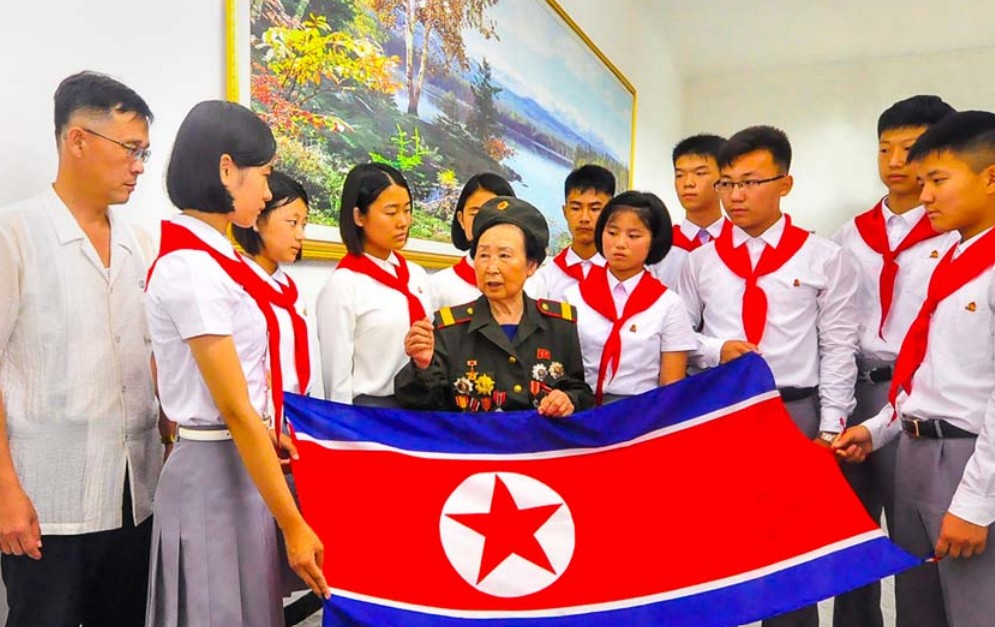
The statement appears to have been issued in response to Washington’s continued refusal to recognize North Korea as a nuclear-weapon state and its insistence that denuclearization remain the central objective of U.S. policy toward Pyongyang. On August 26, a U.S. State Department spokesperson stated that there had been no change in U.S. policy toward North Korea, which remains centered on denuclearization, and reaffirmed Washington’s commitment to that objective.
North Korea also adopted a hard-line position toward strengthened trilateral military cooperation among South Korea, the United States, and Japan. Referring to “Freedom Edge,” the multidomain exercise planned by the three countries to strengthen deterrence against North Korea, the spokesperson argued that “the Trump administration has reaffirmed its unchanging policy of hostility, which seeks to gravely infringe upon our nation’s sovereignty, political system, and security interests through ‘denuclearization’ hype, ‘human rights’ smear campaigns, and military threats.”
The spokesperson further asserted, “A delusional obsession with the past cannot, under any circumstances, grasp reality or restrain the future.” He added, “In this grave situation, where the U.S.’s persistent policy of hostility toward the DPRK is evolving into an even more dangerous form, it is meaningless to expect a reduction in regional tensions.”
North Korea’s statements can be interpreted as signaling that substantive dialogue would be difficult if Washington seeks to engage Pyongyang on essentially the same terms pursued during the first Trump administration. In particular, given North Korea’s self-identification as a nuclear-armed state, the statement represents another attempt to pressure Washington to adjust its policy in a manner that acknowledges the reality of North Korea’s nuclear capabilities. From Pyongyang’s perspective, such a shift appears to be a prerequisite for meaningful negotiations.
North Korea also reiterated its stated rationale for maintaining and expanding its nuclear arsenal. The spokesperson asserted, “Our nuclear weapons are the absolute guarantee of our sovereignty, and the Republic’s possession of nuclear weapons and their continued strengthening are the most responsible and correct choices for ensuring regional peace and security.”
The spokesperson cited the United States’ strengthening of its nuclear capabilities, growing trilateral military cooperation among the United States, South Korea, and Japan, Japan’s rearmament, and South Korea’s military buildup as factors underpinning North Korea’s nuclear policy. He argued, “The unstable regional security environment caused by the U.S. nuclear posture becoming more aggressive and by Japan’s rearmament and South Korea’s military buildup—which are intensifying within the framework of the U.S.-Japan-South Korea trilateral military cooperation—explains our choice.”
The statement was issued as President Trump again raised the possibility of holding a summit with Kim Jong-un. Analysts interpret the statement not as an outright rejection of dialogue with Washington, but rather as an effort to strengthen North Korea’s negotiating leverage by making a change in U.S. policy toward Pyongyang a prerequisite for engagement. If working-level or back-channel contacts between North Korea and the United States intensify in the future, the competing positions of the two sides on “denuclearization” and recognition of North Korea as a nuclear-weapon state are likely to emerge as the central issues in any negotiations.
Major Military Leadership Shuffle in North Korea: Pak Jong-chon Makes a Sudden Return
North Korea has undertaken a significant reorganization of its military command structure, replacing or reassigning a number of senior military officials. Most notably, Pak Jong-chon, who stepped down from several senior Party positions at the 9th Workers’ Party Congress last February, has returned approximately six months later as Vice Chairman of the Party’s Central Military Commission and a member of the Political Bureau. With the replacement of the Minister of National Defense and changes to key positions responsible for internal military oversight and political control, the personnel changes are being interpreted as an effort to strengthen both defense modernization and military discipline.
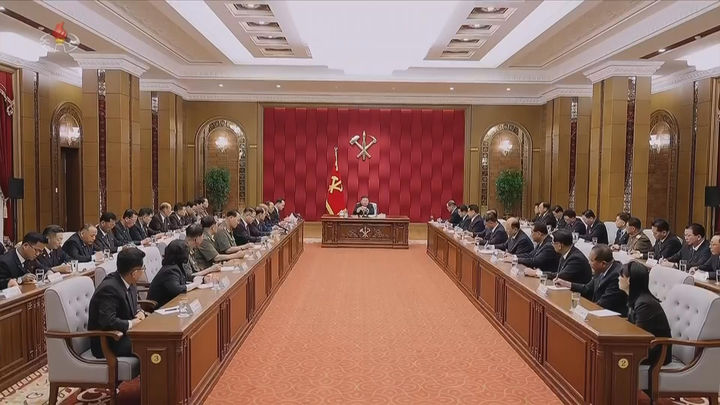
On August 30, the Korean Central News Agency reported that the 2nd Meeting of the 9th Central Military Commission of the Workers’ Party of Korea, held the previous day under the leadership of State Affairs Commission Chairman Kim Jong-un, discussed organizational matters and changes in the responsibilities of key military commanders.
The most significant personnel change was the return of Pak Jong-chon. Under the reshuffle, Pak was reappointed as Vice Chairman of the Party’s Central Military Commission and returned to the Political Bureau of the Party’s Central Committee. Kim Jong-un serves as Chairman of the Party’s Central Military Commission.
Pak stepped down from his positions as a member of the Political Bureau and Party Secretary at the 9th Party Congress last February and subsequently left his position as Vice Chairman of the Central Military Commission. At the time, his departure prompted speculation that he was being removed from the military’s front-line leadership because of his age. His latest appointment, however, brings him back into the core command structure of the North Korean military.
Pak’s return can be viewed as an effort by North Korea to place a senior figure with extensive experience in the development and operational employment of advanced weapons—including missiles and artillery—in a key leadership position. Given Pyongyang’s recent emphasis on defense science and technology and the development of sophisticated weapons systems, the decision to restore a senior official with expertise in military operations and weapons development to key Party and military positions suggests an effort to reinforce the operational experience and technical expertise of the military leadership.
Meanwhile, Defense Minister Ro Kwang-chol has been removed from his post. Following his departure as Minister of National Defense, Ro was transferred to the position of First Deputy Director of the Military-Industrial Department of the Party’s Central Committee. His apparent removal from the Party’s central leadership further indicates that he has been excluded from the senior military command structure.
Ro’s reassignment, however, does not constitute a complete retirement from public service. As First Deputy Director of the Party’s Military-Industrial Department, which oversees the broader defense-industrial sector, he is expected to remain an important working-level official involved in weapons production and the defense-industrial base. His transfer from the Ministry of National Defense to the military-industrial sector may therefore indicate that Pyongyang regards the defense-industrial base and weapons production as central components of its broader effort to strengthen national defense capabilities.
Kim Sung-gi, Director of the General Political Bureau of the Korean People’s Army, who was recently promoted to the rank of General, was appointed as the new Minister of National Defense. The transfer of the official responsible for the military’s political and ideological affairs to the country’s top defense position suggests an effort to strengthen the linkage between political control of the armed forces and defense administration. Following his appointment, the position of Director of the General Political Bureau of the Korean People’s Army was left vacant.
Positions responsible for internal military control and inspection also underwent significant changes. Ryu Kwang-u, who had served as Director of the People’s Army Security Bureau, was transferred to the position of First Deputy Director of the General Political Bureau, while Om Ju-ho, who had served as Political Commissar of the Air Force, was appointed as the new Director of the Security Bureau. Ryu was also elected to the Party’s Political Bureau, while Om was elected as a member of the Party’s Central Committee.
These personnel changes appear designed to strengthen the military’s internal oversight and counterintelligence functions while reinforcing political and ideological control. The decision to move an official with experience in internal military affairs and security oversight into a senior position within the General Political Bureau, while appointing a figure with a background in political and ideological affairs to head the Security Bureau, can be interpreted as an effort to further consolidate Party control over the military.
North Korea’s recent public criticism of corruption and lax discipline within the military, accompanied by indications of tighter internal control, is also likely to have contributed to the reshuffle. The personnel changes appear intended to increase oversight of military commanders and officials, reinforce discipline within the armed forces, and strengthen control over the military leadership.
In parallel with the military leadership reshuffle, Kim Jong-un personally met with scientists, researchers, and officials from defense research institutions who had contributed to the development of new weapons systems and improvements in weapons performance, and presented them with awards. He recognized their contributions to defense science and technology by conferring hero titles, medals, and state orders.
The Korean Central News Agency emphasized advances in military technology, stating that North Korea’s defense science and research sector had recently developed technologies capable of enhancing war-fighting capabilities and strategic deterrence. It did not, however, identify the specific weapons systems or technologies involved.
Kim Jong-un referred to the recently introduced “patented military scientific and technological achievements” and assessed them as technical accomplishments capable of significantly enhancing the modernization of the military’s weapons systems. This underscores North Korea’s determination to regard advances in defense science and technology and improvements in the performance of sophisticated weapons systems—not simply an expansion in the volume of weapons production—as core components of its military modernization strategy.
North Korea Emphasizes Patriotism and Ideological Education for “Market Generation” Youth on Youth Day
On August 28, marking Youth Day, North Korea portrayed the younger generation as a central source of national strength and a key component of the country’s future governance, while repeatedly emphasizing patriotism and ideological education. This emphasis appears intended to reinforce the political loyalty of young people, particularly those belonging to the so-called “market generation”—the cohort that came of age during the “Arduous March” of the mid-1990s and subsequently became increasingly familiar with market-based economic activity.
In a front-page editorial published on the occasion, Rodong Sinmun, the official newspaper of the Workers’ Party of Korea, emphasized that “the vast army of youth, possessing unparalleled revolutionary spirit and patriotic loyalty, is the pride and strength of our Party and state.” The newspaper described young people as “the Party’s loyal vanguard and reliable reserve force,” asserting that “loyalty to the Party is the foremost ideological and spiritual trait of our youth.”
Rodong Sinmun also portrayed young people as a key source of momentum for national development. The newspaper stated, “Our youth are the creators of miracles who are illuminating this new era of national rejuvenation with their heroic deeds,” highlighting their participation in a range of national projects, including efforts to strengthen defense capabilities, increase cement production, and construct power-generation facilities.
It also portrayed young people as a key source of momentum for national development. Rodong Sinmun stated, “Our youth are the creators of miracles who are illuminating this new era of national rejuvenation with their heroic deeds,” highlighting their participation in a range of national projects, including efforts to strengthen defense capabilities, increasing cement production, and constructing power-generation facilities.
In particular, the newspaper credited young people with playing a leading role in construction projects that North Korean authorities have recently promoted as major national achievements, including Vanguard Street in a new development area of Pyongyang and the Sinuiju Greenhouse Complex Farm. This appears consistent with Pyongyang’s longstanding practice of mobilizing young people for large-scale construction and production campaigns, including during periods of economic hardship.
North Korea also sought to reinforce the perceived superiority of its political and social system by contrasting its youth with young people in other countries. Rodong Sinmun claimed that, in the outside world, “youth steeped in extreme misanthropy, the poison of the worship of money, and decadence and pessimism” are contributing to social problems, while North Korea has “pure and steadfast youth who are loyal to society and the collective and devote themselves to the future.”
The newspaper further emphasized that “today, as we must transform the pioneering period of the comprehensive development of socialism in our own style into a period of great upsurge,” young people are expected to remain at the center of the Party’s major national projects.
It also introduced the concept of “youth-centered politics” in a separate section explaining political terminology. The newspaper defined the concept as “the politics of our Party, which always firmly trusts and promotes young people in revolution and construction, and accomplishes everything by relying on their strength.”
Various commemorative events were held in Pyongyang to mark Youth Day. On August 28, the Korean Central News Agency reported that the “National Youth Science and Technology Achievements Exhibition” had opened the previous day at the Science and Technology Palace. The exhibition featured more than 1,800 entries showcasing scientific and technological achievements produced by young people from across the country.
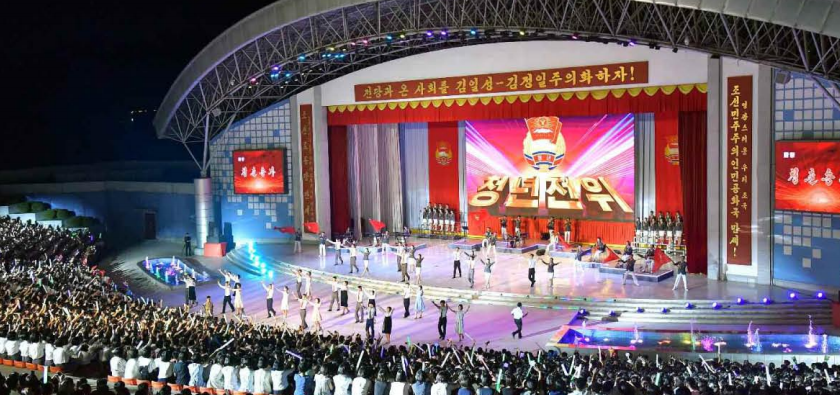
On August 27, the Central Youth Art Propaganda Troupe held a performance titled “Youth, Let Us Uphold Our Party” at the open-air theater in Pyongyang Youth Park. On the same day, officials from the Socialist Patriotic Youth League visited the Youth Movement History Museum, which commemorates the history of the youth movement under Kim Il-sung and Kim Jong-il.
North Korea claims that Kim Il-sung founded the Korean Communist Youth League on August 28, 1927, and has commemorated the date annually as Youth Day since 1991.
Analysts suggest that the authorities’ emphasis on patriotism and loyalty to the Party on Youth Day is closely linked to changing social and economic attitudes among North Korean youth. A significant portion of North Korea’s current younger generation grew up following the “Arduous March” of the mid-1990s and gained experience with economic activity through markets and informal marketplaces rather than relying exclusively on the state rationing system.
This generation is generally considered to have greater familiarity with market-oriented economic behavior than previous generations and to have had relatively greater opportunities to encounter outside cultural influences. Against this backdrop, the authorities’ recent intensification of ideological education and restrictions on young people’s exposure to foreign culture appear to be closely connected to these generational characteristics. The emphasis on patriotism and Party loyalty therefore appears to serve not only as a means of political socialization but also as an effort to manage the potential social and ideological effects of greater exposure to market activity and outside information.