


By Lee Ki-tae
Korea Institute for National Unification, KINU
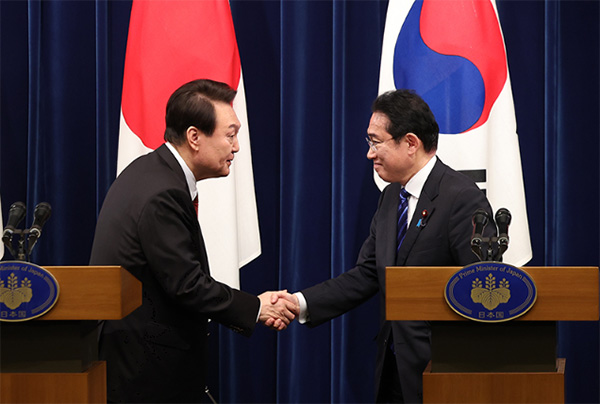
The recent summit meeting between President Yoon Suk-yeol and Prime Minister Kishida Fumio, which marked the restoration of shuttle diplomacy between South Korea and Japan in March and May 2023, underscored the perceived global threat posed by North Korea's nuclear and missile development. Building on this recognition, the forthcoming trilateral summit between South Korea, the United States, and Japan during the Group of Seven Summit in Hiroshima aims to enhance close communication and collaboration among the leaders to address the challenges to peace and stability.
Meanwhile, Prime Minister Kishida Fumio expressed his appreciation for the South Korea-Japan Forced Labor Deal announced by the South Korean government on March 6th, acknowledging, "I was deeply moved by the resilience of those who remember the painful past while keeping their hearts open for the future."
Furthermore, he added, "It deeply saddens me to think of the immense pain and sorrow endured by many individuals in such challenging circumstances." He also underscored his unwavering commitment to upholding the historical perspectives of past Japanese administrations, including the 1998 Kim Dae-jung-Obuchi Declaration between Japan and South Korea.
The Republic of Korea-Japan Summit presented a pragmatic and forward-looking direction for bilateral relations by emphasizing security cooperation in response to North Korea and the resolution of historical issues, particularly the matter of forced labor victims. This agreement between the two nations will have significant implications for future North Korea-Japan relations, especially from a long-term perspective.
In recent years, North Korea has consistently engaged in provocative actions, such as ballistic missile launches, prompting both the South Korean and Japanese governments to explore avenues for security cooperation centered around North Korea's denuclearization. Recognizing the importance of fostering trust and strengthening their bilateral relationship, both South Korea and Japan have been actively pursuing security policies based on their alliances with the United States. Furthermore, they have been united in their shared concerns regarding the security threats posed by North Korea's nuclear and missile programs. Hence, in the context of the urgent need for a trilateral coordination framework between South Korea, the United States, and Japan to address the North Korean nuclear threat, Prime Minister Kishida Fumio's approach to nuclear weapons and missiles underscores the crucial role of cooperation with both South Korea and the United States. The South Korean government, too, acknowledges that without improving its relations with Japan, there exist inherent limitations in successfully resolving the North Korean problem.
In the April summit between President Yoon Suk-yeol and President Joe Biden, South Korea and the United States had come to a mutual agreement to establish the Nuclear Consultative Group (NCG). At the May Republic of Korea-Japan Summit, President Yoon Suk-Yeol acknowledged that initiating immediate discussions on the formation of the Nuclear Consultative Group (NCG) with the United States might be premature. However, he underlined that Japan's potential future participation should not be disregarded. It seems that Japan is set to embark on an assessment of the trilateral NCG establishment involving South Korea, the United States, and Japan, while concurrently engaging in focused deliberations on extended deterrence with the United States.
Furthermore, within the trilateral cooperation of South Korea, the United States, and Japan, there will be an intensified response to North Korea's illicit cyber activities, illegal maritime transfers, and other violations of sanctions. Real-time sharing of ballistic missile warning information and joint exercises to counter submarine threats will be strengthened.
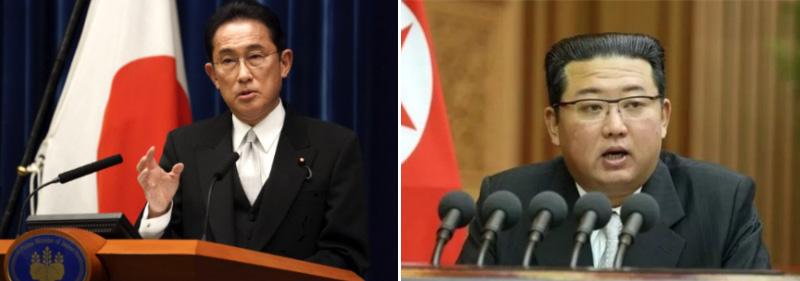
Meanwhile, the relationship between North Korea and Japan has reached a standstill since Japan intensified its sanctions following North Korea's fourth nuclear test in 2016. The non-implementation of the 2014 Stockholm Agreement has further complicated matters, leading to a halt in official contacts and negotiations. However, the conflict over forced labor between South Korea and Japan stems from a difference in perception rooted in the legality of Japan's colonial rule over the Korean Peninsula and the issue of cause of action between the two countries. Despite the 1965 Agreement on the Settlement of Problem concerning Property and Claims and the Economic Cooperation between the Republic of Korea and Japan, which aimed to address these issues, the disagreement persists.
The Japanese government has consistently criticized the Supreme Court ruling on forced labor, asserting that it could potentially undermine the established diplomatic framework of the 1965 Treaty on Basic Relations between Japan and the Republic of Korea, widely known as the '1965 Treaty'. Consequently, in pursuit of restoring relations with Japan, the Yoon Suk-yeol administration has put forth a diplomatic resolution referred to as the 'third-party mediation'. This proposed approach aims to navigate a mutually acceptable path, facilitating diplomatic reconciliation while duly recognizing the judicial ruling. However, the 1965 Treaty is intricately intertwined with the 2002 Japan-North Korea Pyongyang Declaration. This declaration, mirroring the principles of the 1965 Treaty, prominently features North Korea renouncing its claims and Japan's ODA.
Former Prime Minister Koizumi Junichirō embarked on a momentous visit to Pyongyang on September 18, 2002, where he jointly announced the Japan-North Korea Pyongyang Declaration with Kim Jong-il, the former Chairman of the DPRK National Defense Committee. Drawing upon the provisions outlined in Article 2 of the Japan-North Korea Pyongyang Declaration, Japan aimed to circumvent individual claims by following a similar approach to the Agreement on the Settlement of Problem concerning Property and Claims and the Economic Cooperation between the Republic of Korea and Japan. Article 2 of the Japan-North Korea Pyongyang Declaration states: "Both parties, in achieving the normalization of relations, have agreed in the normalization talks to the fundamental principle of relinquishing all property and claims of the two countries and their peoples arising from events prior to August 15, 1945." In essence, Japan sought to secure relinquishment of claims from North Korea in exchange for economic support, as indicated.
After the 1965 Agreement between Japan and Korea, Japan seems to have sought to disregard individual claims raised both domestically and internationally by explicitly referencing Article 2 of the Japan-North Korea Pyongyang Declaration.However, as evident from the Supreme Court ruling on the South Korea-Japan Forced Labor Deal, it is clear that the matter of compensation and individual claims arising from Japan's coercive and unlawful rule during the colonial era, which commenced in 1910, cannot be disregarded.
Even if a normalization of diplomatic relations between North Korea and Japan based on the Japan-North Korea Pyongyang Declaration, specifically Article 2, were to take place in the future, it is certain that the victims and their families of forced labor would eventually demand individual claims, similar to the Supreme Court ruling on the forced labor deal, to be addressed to Japan. Therefore, any attempt by Japan to pursue a "waiver of claims" during the process of normalizing relations with North Korea would undoubtedly result in conflicts between a unified Korean Peninsula and Japan.
The future reconstruction and amendment of the 1965 Treaty between Japan and Korea could have implications on the 2002 Japan-North Korea Pyongyang Declaration, and consequently, the issue of forced labor may be addressed in the future process of ‘normalization talks’ between North Korea and Japan. Hence, Prime Minister Kishida Fumio's acknowledgment of historical issues and the Yoon Suk-yeol administration's respect for the judicial ruling, along with their efforts to address the forced labor victims and the Japanese government through a third-party mediation proposal, hold great importance. It serves as a crucial guideline for the future development of South Korea-Japan relations and the long-term process of normalizing diplomatic relations between North Korea and Japan.
-
PREV [Guest Essays]
-
NEXT [North Korea Glossary]