

Kim Yo-jong's Use of "Republic of Korea": A Sign of Changing Two Koreas' Policies?

Choi Kyong-hui,
Director of SAND Research Institute
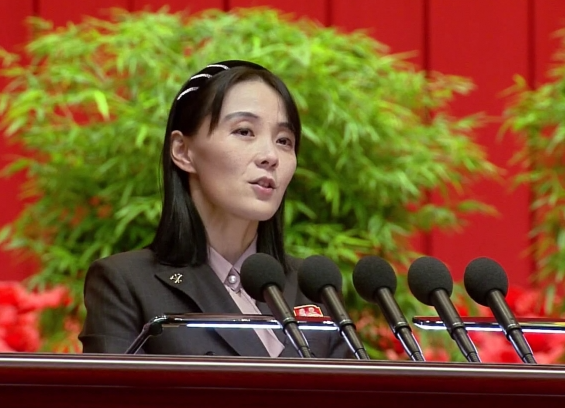
On the occasion of the 70th anniversary of the Armistice Agreement on July 27, 1953, Kim Yo-jong, the Deputy Director of the Central Committee of the Workers' Party of Korea, delivered consecutive speeches via the Korean Central News Agency on the 10th and 11th of the preceding month. While the initial focus of the speeches was to criticize the reconnaissance activities of the US Air Force in North Korea, they mainly centered on South Korea. Notably, Kim Yo-jong opted to use the official term "Republic of Korea" instead of the previously employed "South Korea." Despite containing elements of ridicule and mockery directed towards South Korea, the speeches were interpreted as a platform for the North Korean government and the Workers' Party of Korea to express their official standpoint on domestic and international socio-political matters. This suggests their intentions and strategic approach in the context of relations between North and South Korea as well as between North Korea and the United States.
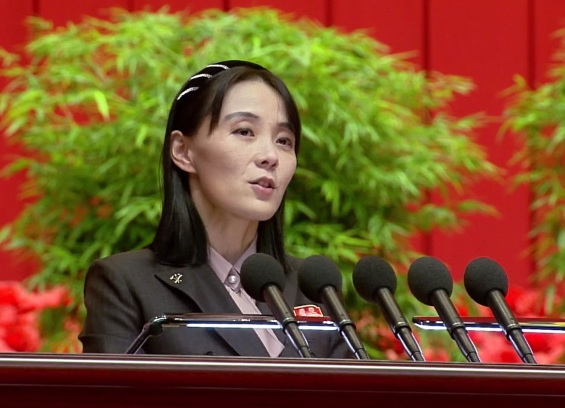
Kim Yo-jong, Deputy Director of WPK, speaking at the National Emergency Disease Control Rally held in Pyongyang on August 10 last year / Photo by Korean Central Television
Kim Yo-jong's decision to use the term 'Republic of Korea' was not simply a hasty reaction to the actions of the US Air Force but rather rooted in North Korea's pursuit of the principle known as 'Our State First.' This nationalist ideology, encapsulated in 'Our State First,' was initially introduced in an editorial published on November 30, following the launch of the intercontinental ballistic missile (ICBM) 'Hwasong-15' on November 29, 2017. The editorial declared the achievement of the "country's nuclear deterrent." Since then, 'Our State First' has become a prominent concept in North Korean media, publications, and studies across various fields, including philosophy and social politics. It represents a new framework for reestablishing national identity and shaping future strategies under the Kim Jong-un regime. North Korea defines 'Our State First' as "a new era of self-esteem and prosperity, born through unwavering struggles to elevate the country's dignity and status as a nuclear-armed state."
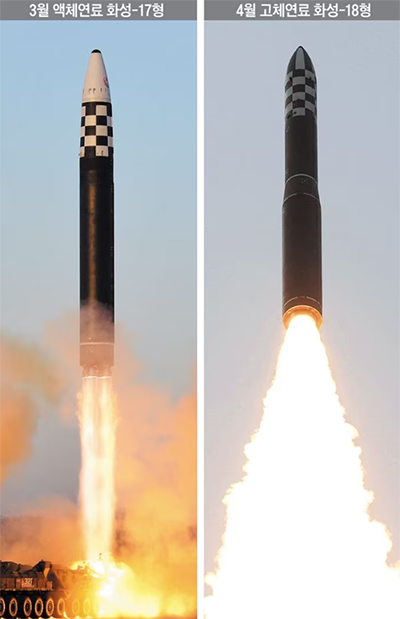
Liquid fuel produces a flame resembling a red candle, while solid fuel creates a fan-shaped white flame – The 'Hwasong-18' Intercontinental Ballistic Missile (ICBM) using solid fuel, with a flame that takes a fan-shaped form in white, compared to the 'Hwasong-17' which uses liquid fuel with a flame in a red hue resembling a torch shape. / Korean Central News Agency, Yonhap News Agency
It reflects a nationalistic ideology rooted in nuclear-powered nationalism, which serves to divide North and South Korea and replaces the concept of a shared "nation" that once served as a common bond and lineage between the two Koreas. It is a clear manifestation of the core principles underlying North Korea's pursuit of 'Our State First'.
The primary objective behind this decision is to maximize the value of nuclear weapons and missiles. Following Kim Yo-jong's use of the term 'Republic of Korea' in her speeches, North Korea proceeded to launch the new intercontinental ballistic missile (ICBM) 'Hwasong-18' on the 12th. The Rodong Sinmun stated on the 13th that strengthening legitimate
defense rights is crucial for reliably safeguarding the security of the country and regional peace, while effectively suppressing the provocative actions of hostile forces. The recent launch of the 'Hwasong-18' aims to further enhance North Korea's strategic nuclear capabilities and assert its position as a strategic weapon capable of overpowering the military might of South Korea and the United States. It is important to note that North Korea adopted its nuclear doctrine in September of the previous year, explicitly indicating the offensive use of nuclear weapons beyond defensive purposes. The regime's obsession with attaining the recognized status of a strategic state has reached an alarmingly dangerous level, as demonstrated by its self-proclamation as a nuclear-armed state. However, this goal is not a recent development. As early as December 28, 2011, North Korea had already established the long-standing objective of becoming the first of the 'Three Revolutions Legacy' as a nuclear-armed state.
Additionally, the use of the term 'Republic of Korea' by Kim Yo-jong appears to underline the distinction between North and South Korea. It is a continuation of North Korea's longstanding efforts to create cultural and emotional separation from South Korea. This differentiation is also evident in their deliberate choice to use the official title to assert the superior status of being a nuclear-armed state. Such behavior aligns with North Korea's consistent distortion of historical facts regarding the two Koreas, such as enshrining the term 'Kim Il-sung Nation' in their constitution or implementing 'Pyongyang Time' (PYT) from August 15, 2015, to May 5, 2018, to manipulate the temporal and spatial aspects of inter-Korean relations and national history. The emphasis on establishing a 'national style' through North Korean media and the chanting of 'patriotic songs' at WPK events can also be interpreted within the same context.
Moreover, the use of the term 'Republic of Korea' serves as a defense and deterrent against interference in South Korea's internal affairs. North Korea, facing severe economic challenges and growing discontent among its population, has been emphasizing the need for internal unity and reinforcing the legitimacy of Kim Jong-un's regime. However, in recent times, these efforts have intensified significantly. North Korea has enacted several laws, such as the 'National Secret Protection Law' (2023), 'National Symbols Law' (2023), 'Pyongyang Cultural Language Protection Law' (2023), and 'Youth Education Guarantee Law' (2021), aimed at strengthening internal cohesion and isolating external influences, especially from South Korea. These laws demonstrate a resolute determination to eradicate values, information, and cultural elements associated with 'freedom' that might infiltrate North Korea and prevent their access. Such governing measures shed light on Kim Jong-un's perception of South Korea and the imperative to otherize the 'Republic of Korea.'
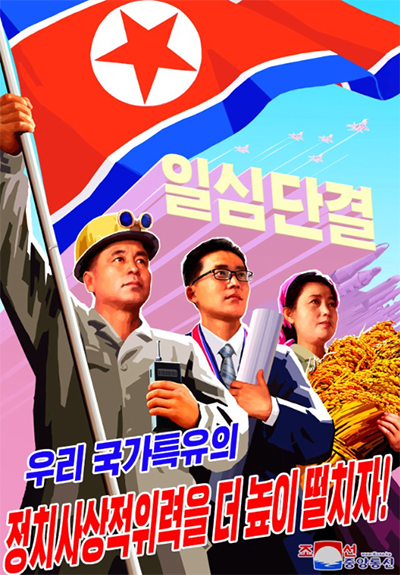
North Korea's propaganda. North Korean authorities enforce strict 'ideological control', presenting a 'struggle against anti-socialist forces and take measures to eradicate the use of the South Korean language. / Photo by Yonhap News Agency
In the past, particularly during Kim Il-sung's era in 1986, when many communist countries were embracing openness, Kim Jong-il introduced the concept of the nation as an "organic entity in social politics," which laid the foundation for the emergence of 'Our Nation First' ideology. At a time when communist ideologies were facing challenges in the late 1980s, Kim Jong-il sought to revive nationalism and initiated exchanges with South Korean officials. In the late 1990s, North Korea received substantial economic assistance and regime security from South Korea, which helped maintain a favorable environment despite internal and external hardships, commonly known as the 'march of suffering' and the end of the Cold War. However, the current situation shows a departure from that era of nationalism. Kim Yo-jong's adoption of the 'Two Koreas' concept, which North Korea had long opposed, and the abandonment of the nation-centered approach during the Moon Jae-in era signify a significant shift in their stance.
However, like everything else, there are two sides to this situation. Kim Yo-jong's use of the term 'Republic of Korea' also serves as a justification for establishing a new order in inter-Korean relations. Currently, inter-Korean relations are in a temporary state of truce and are defined as a special relationship between the people aimed at reunification, without the establishment of mutual national relations. This arrangement was simultaneously acknowledged by the United Nations on September 17, 1991. After enduring the pain of national division for three decades following the Korean War and successfully achieving industrialization, democratization, international recognition, and prosperity, the Republic of Korea finds itself at another critical juncture. In order to effectively manage North Korea as a factor in the surrounding environment, it is necessary to reduce the ambiguity surrounding the special nature of inter-Korean relations and establish a new order based on a more rational, mutually beneficial, and pragmatic perspective.