

Insights into North Korea's Nuclear Ambitions from My Experiences There

Park Choong-kwon, Research Engineer at Hyundai Steel Company,
Specialized in Materials Engineering for ICBMs at Kim Jong Un National Defense University,
Ph.D. in Materials Science and Engineering from Seoul National University
The inaugural North Korean defector recruited for political talent
The nuclear menace posed by Kim Jong-un's regime escalates by the day. Following the death of Kim Jong-il in December 2011, Kim Jong-un assumed power and, by December 2013, had solidified his rule by executing his influential uncle, Jang Song-thaek, thereby establishing a totalitarian regime. With internal stability achieved, Kim Jong-un turned his attention outward. This new focus was underscored by the debut test of a submarine-launched ballistic missile (SLBM) in May 2015. The March 2017 trial of the Paektu engine (a high-thrust liquid fuel engine, producing a thrust of 100 tons) marked a significant achievement in North Korea's liquid fuel engine capabilities.
Subsequently, North Korea tested the Hwasong-12 in April 2017, Hwasong-14 in July, conducted its sixth nuclear test (a hydrogen bomb) in September, and launched the Hwasong-15 in November. By March 2022, it introduced the Hwasong-17, a Multiple Independently Targetable Reentry Vehicle (MIRV) ICBM, demonstrating the maturity of its liquid fuel ICBM technology and securing one of the three pillars of its nuclear capability: the ICBM.
October 2019 saw the stable test launch of the Pukguksong-3, heralding the completion of its SLBM development and securing another cornerstone of its nuclear triad. The regime is currently advancing the construction of a ballistic missile submarine to finalize this capability.
Nonetheless, North Korea's ambition doesn't end here. It seems to be reinforcing the remaining two components of its nuclear triad, given that acquiring long-range bombers would be geopolitically and economically impractical.

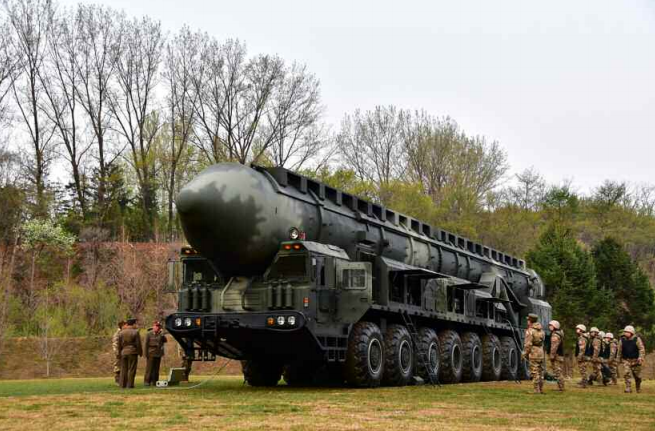
On April 14, 2023, Rodong Sinmun reported that Kim Jong-un oversaw the test launch of a new ICBM type, "Hwasongpho-18 (HS-18)" on the 13th, poised to become a pivotal strategic asset and fulfill a critical deterrence role. (Photo by Rodong Sinmun)
The initial effort is directed at further advancing its ballistic missile capabilities, a key element of its nuclear triad. April 2023 showcased the Hwasong-18, a solid-fuel ICBM, matching the range of the liquid-fuel Hwasong-15 and capable of targeting the entirety of the US. The advantages of solid-fuel missiles include shorter launch times and enhanced stealth and mobility over their liquid-fuel counterparts.
The advancement doesn't stop there. Beginning in September 2021, North Korea started unveiling hypersonic missiles, testing two variants. The glider-type warhead version, Hwasong-8, is believed to have failed, while the new type of hypersonic missile with a cone-shaped warhead reportedly reached speeds of up to Mach-10, suggesting some success. This missile, however, is assessed as a Maneuverable Reentry Vehicle (MARV), essentially utilizing the Hwasong-12's liquid fuel engine as its first stage, with the second stage and warhead resembling North Korea's Iskander-equivalent, the Hwasong-11 (KN-23). Essentially, it's a nascent hypersonic missile.
The development of hypersonic missiles, demanding cutting-edge technology, poses a challenge even for advanced nations, with only a handful achieving operational deployment – the United States, China, and Russia. The efficacy of China and Russia's hypersonic missiles remains unproven, hindered by the need to develop materials that can withstand the intense heat and shock from aerodynamic heating at hypersonic speeds, and the complexity of accurately controlling such swiftly moving objects.
However, it is assumed that Kim Jong-un's regime will not halt its endeavors here. While the currently showcased missiles have a range of roughly 1,000km, future iterations might incorporate engines from the Hwasong-15 or 17, or possibly feature a hypersonic missile powered by the solid-fuel engine used in the Hwasong-18. Essentially, they might standardize the hypersonic warhead while interchanging the engines.
Certainly, numerous technical obstacles remain, suggesting that such advancements may not occur swiftly. Initially, they might forgo using an ICBM-level engine like that of the Hwasong-18. Immediate testing could be viable with shorter-range solid-fuel engines like those in the Pukguksong-2, 3, and 4, significantly enhancing stealth and mobility compared to the liquid-fuel Hwasong-12 engine.
In November 2023, the launch of the reconnaissance satellite Malligyong-1 into orbit unveiled North Korea's intent to target mobile objectives. This move signals a strategy to counter the deployment of the US Carrier Strike Group near the Korean Peninsula. The cruise missiles tested since the start of the year are also intended to deter the US Carrier Strike Group (CSG).
The rationale behind developing missiles with an approximate range of 2,000km is to thwart the CSG from nearing the Korean Peninsula within the operational range of its aircraft. Possessing strategic nuclear submarines could escalate North Korea's threat further. The regime has long endeavored to counter the US Carrier Strike Group, incorporating hacking to disrupt its command systems. Additional measures might include the underwater drone "Haeil," the North Korean equivalent of ATACMS Hwasong-11Na, super-large multiple rocket launchers, drones, and beyond.
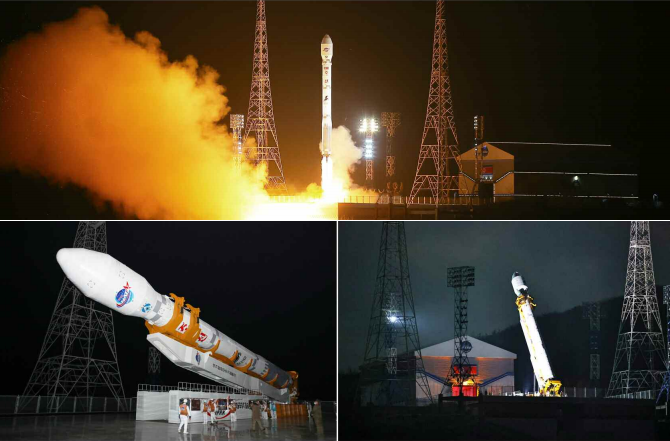
On November 21, 2023, North Korea's National Aerospace Development Administration announced the successful launch of the reconnaissance satellite 'Malligyong-1' aboard the new satellite carrier rocket 'Chollima-1' on November 22. (Photo by Rodong Sinmun)
While our policy towards North Korea has been indecisive, the regime's nuclear arsenal has alarmingly grown in diversity and sophistication. It's crucial to acknowledge that Kim Jong-un's pursuit of weapons development is far from over. We must wisely assume that their technology is at least 5 to 10 years ahead of our current understanding and tailor our responses accordingly.
North Korea's ICBM program was nearing completion back in 2006 and 2007 when I was there; the development finalized under Kim Jong-il was essentially a legacy gift passed to his son, Kim Jong-un. This context clarifies the baffling speed of technological progress North Korea displayed starting in 2015. Without this insight, the rapid succession of unveiling a new ICBM engine in March 2017, followed by the launches of Hwasong-12 in April, Hwasong-14 in July, and Hwasong-15 in November, would be perplexing. Each missile test represented technological leaps, effectively skipping developmental stages. For instance, although Hwasong-18 was only revealed in April 2023, North Korea had already established the infrastructure for solid-fuel production while I was there.
Another worrying development is the resurgence of North Korea-Russia exchanges, triggered by the Russia-Ukraine conflict. North Korea is supplying weapons to Russia and expects compensation in return. The possible rewards are both numerous and concerning. Critical technologies, such as high-resolution cameras for reconnaissance satellites, early warning aircraft systems, Aegis Combat System, techniques for building strategic nuclear submarines, and weapons manufacturing equipment, should never fall into Kim Jong-un's hands. Close monitoring and strict control of the North Korea-Russia dealings are crucial. The question remains: How has North Korea managed to significantly advance its nuclear capabilities?
To be continued in the next issue…
-
PREV [Defectors' Podium]
-
NEXT [Opinion]