

Escalating Russia-North Korea Relations Raise Concerns over Human Rights Violations against North Korean Workers in Russia

Oh Gyeong-seob
Korea Institute for National Unification (KINU)
Number of North Korean Workers Sent to Russia
As of 2024, it's challenging to pin down the exact count of North Korean workers living in Russia. The situation is complicated by the fact that many workers returned to North Korea by 2019 following the adoption of UNSCR 2397. Russia reported to the UNSC that by the end of 2019, it had repatriated most North Korean workers, leaving only about 1,000.
[reference: Lee Sang-keun, "Challenges and Solutions for Increased North Korean Workers in Russia," published in "Institute for National Security Strategy (INSS) / Notes on Strategy," 2023, vol. 11, no. 232, p. 5.]
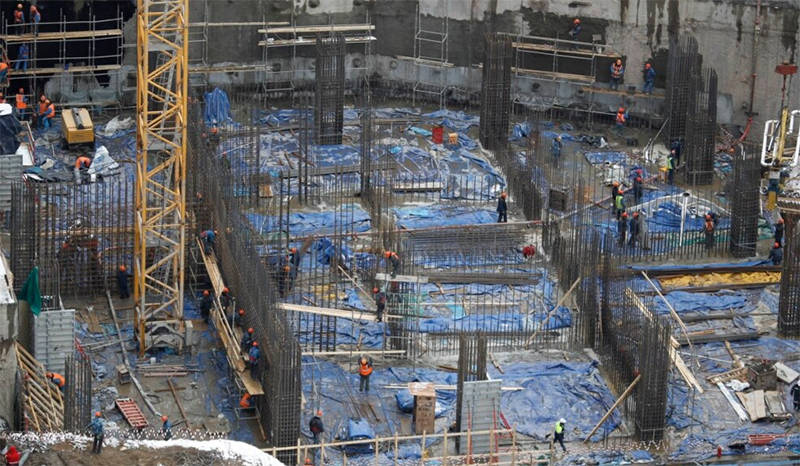
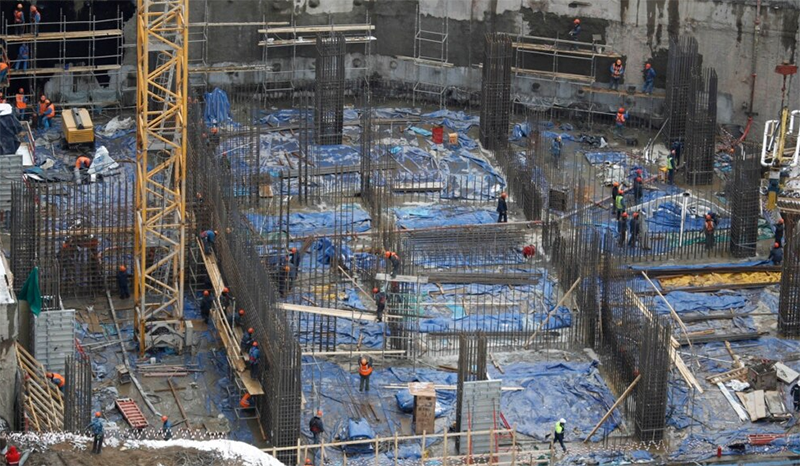
Construction site in Moscow, Russia / Photo by Voice of America (VOA)
However, doubts linger about the accuracy of Russia's report. According to the U.S. State Department's annual "2023 Trafficking in Persons Report", it was revealed that "the Russian government issued or reissued 4,723 visas to North Koreans in 2022 to circumvent UNSCR banning North Korean overseas labor."
[reference: "Closer Ties between North Korea and Russia Raise Concerns about North Korean Defectors in Russia" VOA, September 6, 2023.]
The majority of these workers are engaged in construction and logging industries in the Far East, with thousands more employed in construction in Moscow and Saint Petersburg.
[reference: Lee Aelia, Bang Il-kwon, Lee Chang-ho, "North Korean Workers in Moscow and Saint Petersburg, Russia," KINU 2017 Commissioned Project, pp. 32-33.]
Given the tightening bond between North Korea and Russia, it's estimated that the number of North Korean workers expected to remain in Russia will surge to approximately 30,000 to 50,000. This projection is supported by the quota of North Korean labor allocated to Russian companies in 2015. The Ministry of Labor and Social Protection of Russia disclosed that the quota for North Korean labor allocated to Russian companies in 2015 was 47,279. However, according to statistics on foreign residents released by the Russian Federal Immigration Service on July 16, 2015, there were 34,020 North Korean residents, of whom 33,682 were over the age of 18 and thus eligible for employment.
[reference: Russian Federal Immigration Service, Statistical Yearbook (July 16, 2015), Choi Young-yoon, "Status of North Korean Overseas Workers; Focusing on Statistical Data, KDI North Korean Economy Review, February 2017, recitation: p. 109.]
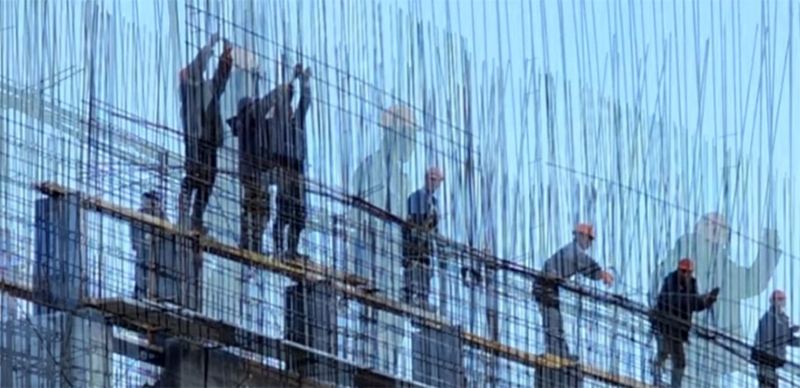
North Korean workers assembling steel bars on a construction site in Russia
A North Korean defector interviewed by KINU attested that there were over 30,000 North Korean workers dispatched to Russia.
[reference: Lee Sang-sin, Oh Gyeong-seob, Rim Ye-joon, "Status of North Korean Overseas Workers" (Seoul: KINU, 2017), pp. 15-16.]
There's a possibility that the number of North Korean workers sent to Russia could reach the level of 2015.
Violation of Sanctions against North Korea
Russia's employment of North Korean workers violates the sanctions imposed by the United Nations Security Council. UNSCR 2397 requires member states to repatriate all North Korean workers with earnings within 24 months and report to the sanctions committee within 27 months. Additionally, the resolution mandates an interim report after 12 months, with reasons provided if repatriation falls below half. Despite these regulations, it's been reported that Russia and North Korea find ways to evade or circumvent the sanctions, avoiding the obligation to repatriate North Korean workers and continuing to engage in new hiring. One of the reasons for this is the severe labor shortage in Russian localities such as the Primorsky Krai, where young people migrate to major cities like Moscow and are also involved in the war in Ukraine, particularly in the construction sector.
Russia is utilizing North Korean labor to address the shortage of low-wage workers in regions like the Primorsky Krai. Marat Khusnullin, the Russian Deputy Prime Minister, revealed plans in a September 2022 interview with Russian media (RBC TV) to deploy up to 50,000 North Korean workers to alleviate the labor shortage in the Russian construction market. Khusnullin emphasized the ongoing discussions and stated that attracting 20,000 to 25,000 North Korean workers would be a viable option.
[reference: "Russia Plans to Attract Up to 50,000 North Korean Construction Workers," Yonhap News Agency, September 15, 2022.]
The influx of North Korean workers has increased following the resumption of regular flights by North Korea's Air Koryo to Vladivostok, Russia, in August. To circumvent North Korea sanctions, Russia frequently issues student visas to North Korean workers and allows them to stay under the guise of tourism or technical visas. In October 2023, job postings targeting North Korean workers appeared on Russian government recruitment websites. For instance, the North Korean construction company "Bugan" posted notices on the employment portal operated by the Russian Ministry of Labor, seeking workers and translators fluent in the North Korean language for construction projects in various locations including Nizhny Novgorod. The recruitment announcement specified the need for various skilled workers proficient in the North Korean language.
[reference: "Open Recruitment of North Korean Workers in Russia, Violating UN Sanctions," Yonhap News Agency, October 26, 2023.]
It is anticipated that the issue of North Korean workers in Russia was discussed during the summit between Kim Jong-un and Vladimir Putin held at the Vostochny Cosmodrome in Russia on September 12, 2023. The National Intelligence Service stated that they are closely monitoring the recent moves by North Korea to dispatch workers to Russia.
[reference: "Why North Korea and Russia are Sending Workers to Primorsky Krai," BBC NEWS Korea, December 15, 2023. (https://www.bbc.com/korean/articles/cd1jy0d677yo, on February 4, 2024.)]
Dmitry Peskov, the Kremlin spokesperson, stated before and after the September 2023 North Korea–Russia summit that Russia is open to discussing UN sanctions with North Korea if necessary. He emphasized that while Russia maintains its position in the UN Security Council, it should not hinder further development of Russia-North Korea relations.
[reference: "North Korea Relies on Russia to Overcome Economic Crisis... Sending Workers for Food and Fuel," Yonhap News Agency, September 13, 2023. (https://www.yna.co.kr/view/AKR20230913144400504, accessed on February 4, 2024.)]
Despite UN sanctions, the dispatch of North Korean workers to Russia is expected to continue increasing steadily. North Korea needs to maintain foreign currency earnings through the dispatch of overseas workers, while Russia needs to accept North Korean workers to fill labor shortages caused by the war in Ukraine and vacancies in regional cities.
Human Rights Abuses of Dispatched Workers
North Korean workers sent abroad face various human rights violations, including the right to fair pay, safe working conditions, and protection from forced labor. Firstly, they are denied fair compensation, earning only around $2,000 to $3,000 annually, which is significantly lower than both local workers and those from other countries, often falling below 50% of the standard. The primary reason for North Korean workers not receiving fair compensation lies in excessive state deductions, embezzlement by middle managers, and illegal practices by employers such as wage withholding. In 2016, a North Korean laborer working in construction in Russia testified that they had to pay the state $7,000 annually, making it challenging to earn more than $2,000 a year.
(reference: Lee Sang-sin, Oh Gyeong-seob, Rim Ye-joon, "The True Reality of North Korean Overseas Workers" (Seoul: KINU, 2017), pp. 52-54.)
Secondly, North Korean workers are deprived of the right to work in safe conditions. They perform strenuous and dangerous tasks like logging and construction in Russia. Defectors from North Korea testify that although they receive basic safety training and equipment like helmets, it is often insufficient to protect them from various accidents. North Korean workers find it challenging to receive proper medical treatment when they are injured or fall ill. Due to the poor and hazardous working environment, accidents are frequent among North Korean workers. However, even if they suffer accidents or disabilities, they often do not receive proper compensation. Minor treatments are usually paid for by the workers themselves, while those with serious injuries often cannot afford the high medical expenses and are repatriated to North Korea.
(reference: Lee Sang-sin, Oh Gyeong-seob, Rim Ye-joon, "The True Reality of North Korean Overseas Workers" (Seoul: KINU, 2017), pp. 61-68.)
To cover the required payments, North Korean workers often take on additional jobs outside of their regular working hours. This practice infringes upon their fundamental right to enjoy safe and healthy working conditions, as North Korean authorities impose excessive fees on workers in Russia. Furthermore, North Korean managers frequently disregard local labor regulations and compel workers to undertake arduous tasks. A defector who worked in Magadan Oblast, Russia, until 2014 testified that they were required to work 16-hour shifts daily.
(reference: "North Korean Overseas Workers," Ministry of Unification North Korean Human Rights Portal, Searched on February 4, 2024.)
In May 2023, North Korean workers at a construction site in Vladivostok were reported to work until 10 p.m. without dinner breaks, engaging in risky steelwork at heights without proper safety gear.
(reference: "North Korean Workers Flourish in Russia," The JoongAng, May 3, 2023.)
Thirdly, North Korean workers are denied the right to refuse forced labor. Article 8(3) of the International Covenant on Civil and Political Rights prohibits forced labor, encompassing any work or service extracted under threat of punishment. North Korean overseas workers are subject to surveillance and control by North Korean authorities, facing punishment if they disobey state directives. Most North Korean workers live collectively near their workplaces, enduring poor living conditions. North Korean authorities dispatch supervisors and security personnel to monitor the workers. These supervisors and security personnel enforce a centralized control system, monitoring and controlling the workers even in local settings. North Korean workers have their identification documents, such as passports, confiscated and are forced into communal living situations with restricted access to the outside world, working long hours, often 16 hours a day, without control over their schedules. Moreover, even those workers who wish to return to North Korea upon contract completion are often compelled to remain overseas.
(reference: "North Korean Overseas Workers," searched on February 4, 2024, from the Ministry of Unification's North Korean Human Rights Portal; https://unikorea.go.kr/nkhr/current/matters/worker/forcedlabor/)
The foreign currency is believed to be primarily used for nuclear and missile development. North Korea sends workers to Russia to earn foreign currency and it's estimated that in 2017, North Korea imposed hefty taxes on around 80,000 workers sent to China (about 50,000) and Russia (about 30,000), garnering over $500 million annually (approximately 671 billion won).
(reference: "FACT SHEET: UN Security Council Resolution 2397 on North Korea," United States Mission to the United Nations, Dec. 22, 2017, searched on Feb. 4, 2024, from https://usun.usmission.gov/fact-sheet-un-security-council-resolution-2397-on-north-korea/)
North Korean workers remit 70% of their monthly salaries to the North Korean authorities, 20% to local management, and receive only about 10%.
(reference: "North Korean Workers Making Waves in Russia with Foreign Currency Earnings," The JoongAng, May 3, 2023.)
The UN Security Council Sanctions Committee on North Korea has stated that funds earned through cryptocurrency theft and the dispatch of overseas workers are diverted into nuclear development. According to a report by expert panels, North Korea's cryptocurrency theft in 2022 amounted to over $17 billion. It has been revealed that North Korea uses the foreign currency earned through cryptocurrency hacking and the dispatch of overseas workers to finance the development of nuclear weapons and mass destruction weapons.
(reference: "North Korea Utilizes Cryptocurrency Hacking for Nuclear Development Funding," Yonhap News Agency TV, October 28, 2023, searched on February 4, 2024/ https://m.yonhapnewstv.co.kr/news/MYH20231028009100641.)
The UNSC should strongly urge Russia, as a permanent member of the UNSC, to comply with UNSCR, which prohibits the further employment of North Korean workers.
-
PREV [Defectors' Podium]
-
NEXT [SAND Column]