

Kim Jong-un's Disdain for South Korea While Imitating Its Innovations
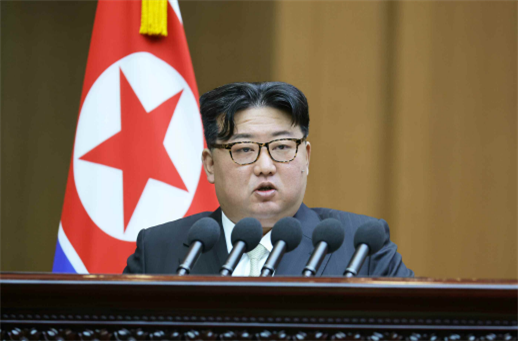
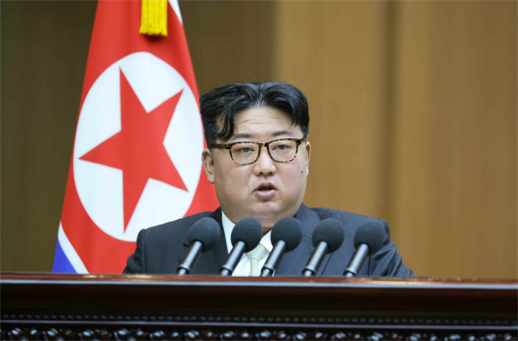
On January 15, 2024, Kim Jong-un delivers a policy speech at the 14th Supreme People's Assembly's 10th session. (Photo by Rodong Sinmun)
North Korean leader Kim Jong-un has resolutely implemented measures after defining relations with South Korea not as ties between people of a shared country but as adversarial, during the 9th Plenary Meeting of the 8th Central Committee of the WPK at the end of last year. In a speech to the SPA on the 15th of the previous month, Kim emphasized his hostility toward South Korea, advocating for the complete elimination of the concepts of unification, reconciliation, and kinship. Since December 2020, North Korea has embarked on a campaign to purge South Korean cultural influence within its territory by enacting the 'Reactionary Ideology and Culture Rejection Law.'
Yet, it's clear that despite these strict policies aimed at isolating South Korea, North Korea has been subtly adopting many of South Korea's practices.
Kim Jong-un vacated his deputy role at the Supreme People's Assembly (SPA) and updated his title from 'Chairman' to 'President.' Remarkably, Kim abstained from contesting in the March 2019 elections for the 14th term, marking the first occurrence since North Korea's inception in 1948 that its top leader did not participate in SPA elections. The SPA, defined by the North Korean constitution as the ultimate sovereign authority with a five-year tenure, holds the legislative power and the capacity to appoint or dismiss the Chairman.
In June 2016, at the 4th Session of the 13th SPA, Kim Jong-un first assumed the newly established role of Chairman while serving as an SPA deputy. However, in 2019, he chose not to pursue the deputy position again and was instead re-elected as Chairman.
This action seems to mirror the South Korean system where the President is not a member of the National Assembly. Mimicking this, Kim Jong-un did not serve as an SPA deputy and instead chaired the State Affairs Commission as Chairman.
Additionally, Kim Jong-un's practice of taking a central seat at SPA meetings, positioning him above the SPA’s Standing Committee Chairman and Vice Chairmen, likely aims to underscore the SPA's ostensible autonomy by addressing this unusual protocol.
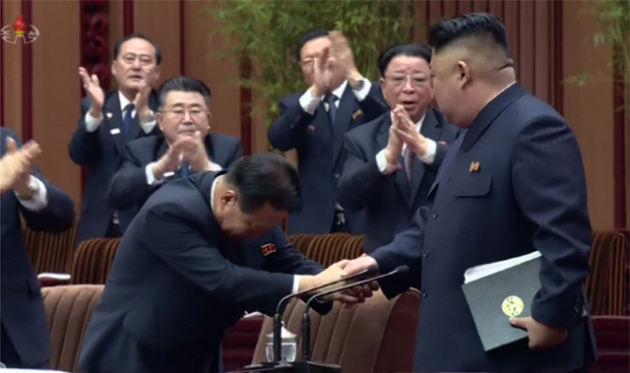
Kim Jong-un at the 1st Session of the 14th SPA on April 12, 2019, where he's seen engaging with Choe Ryong-hae, the SPA’s Standing Committee Chairman, following a policy address. (Photo by Yonhap News Agency)
In a historic move in February 2021, following the 8th Congress of the WPK —often dubbed imperial crowning event for Kim which is made on his own—the 'Chairman' title was updated to 'President’. It is interpreted as Kim Jong-un's bid to consolidate his autocratic rule, aligning himself with his grandfather's legacy. Concurrently, the 'Chairman' title continues to be used for the SPA’s Standing Committee Chairman, akin to South Korea's National Assembly Speaker.
Previously, in a move to mirror a more conventional state apparatus similar to South Korea, North Korea renamed the Ministry of the People's Armed Forces to the Ministry of National Defence in October 2020.
North Korea's emulation extends to the cultural realm, blatantly copying South Korean girl group songs while outwardly rejecting them. Last January, allegations surfaced that Chong Hong-ran's performance of 'Should envy us' at a New Year's Concert plagiarized 'FINGERTIP' by the South Korean girl group GFriend.

At the 2023 New Year's Concert, North Korean singer Chong Hong-ran (right) gave a performance reminiscent of 'FINGERTIP' by the South Korean girl group 'GFriend' (left). (Photo by Professor Kang Dong-wan)
According to Professor Kang Dong-wan from Dong-A University, following last year's incident where North Korea was accused of copying a hit song from a famous South Korean girl group, in the 2020 September 9th celebration, singers Kim Yu-kyong and Chong Hong-ran similarly performed songs styled after South Korean R&B.
Professor Kang remarks that there's a growing fascination with South Korean music among North Korea's youth but the regime cannot solely rely on repression and control. He sees that blending South Korean girl group songs into North Korea's popular tracks is a deliberate strategy to make them seem more familiar.
North Korea's penchant for mimicking South Korea now encompasses food and characters.
Taking cues from South Korean products, like ramen and snacks, Kyonghung, a leading North Korean food manufacturer, has launched a 'Spicy Chicken Flavor Stir-fried Noodles' product, closely imitating South Korea's widely celebrated 'Buldak Hot Chicken Flavor Ramen.' The similarity in packaging design makes it challenging to tell them apart at first glance.
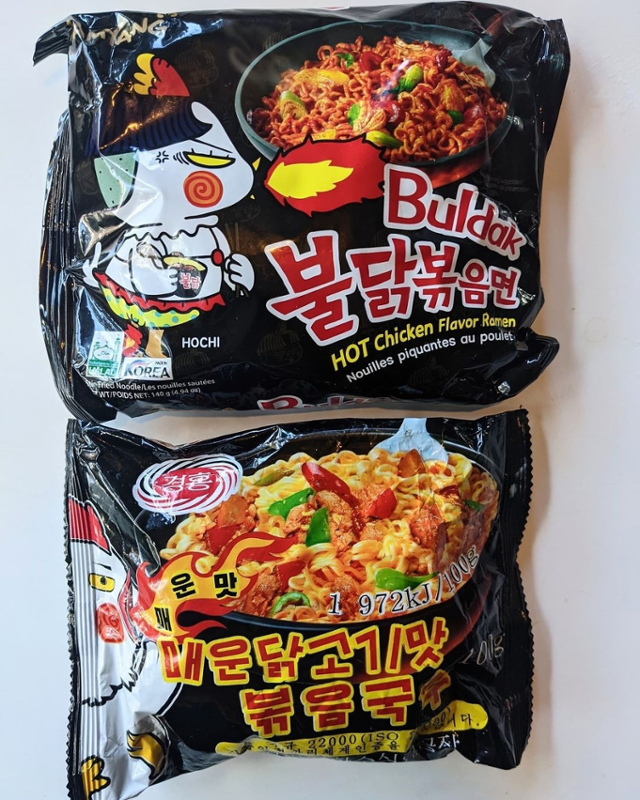
The packaging of South Korea's 'Buldak Hot Chicken Flavor Ramen' (above) and the North Korean product 'Spicy Chicken Flavor Stir-fried Noodles' (below) are strikingly similar. (Photo by X (formerly Twitter))
North Korea's take on South Korea's Shin Noodle Soup and Sogokimyun (Beef Ramen), dubbed 'Beef Instant Noodles,' have also gained notoriety. The trend extends to snacks, with South Korea's Jolly pong replicated as ‘Puffed Rice Snack,' Onion Flavored Rings as 'Onion Flavored Fried Snack,' Shrimp Crackers as 'Shrimp Flavored Fried Snack,' and Pepero as ‘Long biscuits with nuts.' The mimicry includes not just the packaging but the shape of the snacks themselves.
In North Korea, the South Korean Choco Pie has been rebranded as 'Sweet Chocolate Bread,' inspired by its popularity boost from distribution in the Kaesong Industrial Region and its assimilation into the North Korean market. This heightened interest in South Korean products spurred the imitation of South Korean brands and designs, particularly after the 2014 launch of the Socialist Enterprise Responsibility Management System (SERMS), which stimulated competition among companies.
Furthermore, the local infrastructure and rural development initiatives launched by North Korea since 2022 bear a striking resemblance to South Korea's 'New Community Movement (Saemaul Undong),' a significant campaign for rural modernization and community development from the 1970s.
Imitation is often the first step towards development. North Korea's recent initiatives in areas such as state governance, policy-making, socio-cultural aspects, and the economy reflect South Korean models. This approach appears to be aimed at securing rapid economic gains without extending broader freedoms, subtly integrating South Korea's development blueprint into North Korean society.
However, the 'development with limiting freedom' approach promoted by North Korean leadership is just a continuation of previously failed strategies. True progress depends on embracing South Korea's holistic development model, which emphasizes the recognition of citizen freedoms and property rights, along with an open national policy.