

Examining Women's Status in North and South Korea
on International Women's Day
Chae Su-lan
Korea Maritime Institute (KMI) Research Specialist
International Women's Day in North Korea
North Korea celebrates International Women's Day, designated by the United Nations on March 8th, as a public holiday. According to reports from Rodong Sinmun, the country organizes various events like sports competitions, martial arts demonstrations, and celebratory performances during this time. On this day, North Korean men honor their wives, mothers, sisters, female teachers, and colleagues with flowers and gifts, often cooking meals for them. Women in vibrant traditional attire, holding flowers, grace the streets with smiles.
North Korean media portrays their nation as a women's paradise, highlighting women's crucial role in advancing the revolution. Coined by Kim Il-sung, the phrase "one side of the revolution's cartwheel" symbolizes gender equality, but in reality, it was a facade to acknowledge women's essential contribution to the nation's development, especially during its inception. With the lack of male labor, women's active participation in industry and other sectors was indispensable for societal progress.
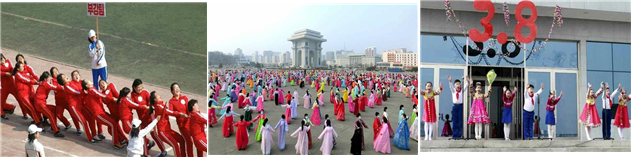
<North Korea's International Women's Day commemorative events in 2023 (Photo by Rodong sinmun)>
Women's Hectic Daily Lives in North Korea
In exploring whether North Korean women live on par with men, I conducted extensive interviews with over 300 defectors from North Korea between 2018 and 2019 for my dissertation. Through dedicated study, I gained insights into North Korea's socialist political economy, while these interviews provided a window into the realities of life and income in North Korea, offering a glimpse of the 'real North Korea.' It's noteworthy that seventy percent of the defectors were women, a gender ratio commonly observed among defectors (with a male to female ratio of 3:7 among over 30,000 defectors). My inquiries delved into the paths they took and the incomes they earned in North Korea, requiring a deep understanding of their lives spanning several years or even decades.
Interviews ranged from 40 minutes to over two hours, during which the emotional weight of their experiences became palpable, leading to shared tears. Their decision to defect to the South was driven by inevitable reasons, often rooted in the challenges they faced in North Korea. Many of the North Korean women I encountered had led profoundly demanding and busy lives.
North Korean women start their day early, managing household chores and sending family members off to school or work. They then head to local markets (Jangmadang), selling goods until dusk. Handling goods involves extra effort, time, and labor. With men earning minimal wages from state-run enterprises, women often participate in Jangmadang business to supplement income.
After concluding their tasks in Jangmadang and returning home, they immerse themselves in household chores and caring for their children. Additionally, they nurture small vegetable gardens and rear livestock. Weekly life review sessions and party-assigned tasks demand their labor, showcasing their versatility. Whether as traders, officials, farmers, or doctors, they prioritize their children's well-being, value education, and strive for better living standards. Despite similarities in managing households and earning supplementary income, North Korean women encounter tougher obstacles compared to their South Korean counterparts.
Due to the country's inadequate infrastructure, facilities in North Korea are rudimentary, posing challenges for women in balancing social activities and household chores. The absence of electricity and unreliable water supply prolong cooking times. Life in rural areas is particularly harsh, with lengthy walks replacing short car rides. Despite enduring rigorous trading in Jangmadang and barely saving, frustration arises as currency reform renders their savings worthless. North Korean women face more hardships than men.
Their Status and Position in North and South Korea
This article refrains from exploring the human rights situation of North Korean women. Over the 70-year division, the income gap between North and South Korea has widened significantly, with South Korea's GNI surpassing North Korea's by 30 times as of 2023 (Statistics Korea). While patriarchal elements persist in North Korean society, a simplistic comparison of women's status between the two Koreas falls short. However, noteworthy is the exceptional dedication of women from both regions in nurturing their families.
According to a recent report by the Ministry of Unification on perceptions of North Korean economic and social conditions, notable shifts include delayed marriages, increased divorce rates, lower birth rates, and an elevated status for women within households. Due to low wages in state-run enterprises, women bolster household economies through supplementary income from Jangmadang activities. Consequently, women with economic power are poised for increased status. Although an abrupt shift toward gender equality appears improbable within the confines of North Korea's patriarchal Confucian culture, the economic empowerment of North Korean women has the potential to instigate forthcoming societal transformations.
North Korean women exhibit diligence and bravery as they resiliently lead their households. Their dedication has propelled the expansion of comprehensive markets, serving as North Korea's unofficial economic backbone. Even upon resettling in South Korea, their commitment endures. Some traveled long distances for interviews, while others reached out as early as 6 AM. Diligence is deeply ingrained in their everyday existence. We anticipate that the perseverance of North Korean women will catalyze future political and social changes in their homeland.