

Contrasting North Korea's "Expropriation without Compensation"
with South Korea's "Compensated Expropriation"
: Understanding Land Reform Differences

Kim Yongsoon
Visiting Professor at Yonsei University's Graduate School of International Studies
Characteristics of Land Reform in North and South Korea
Land reform represents a fundamental overhaul of land ownership structures within a nation or society, aimed at addressing economic disparities and modernizing landlord-tenant systems. The land reforms undertaken in the aftermath of Korea's National Liberation in 1945, both in the North and South, exemplify this pursuit. However, the divergent goals and methodologies employed in each region, influenced by distinct ideologies and political frameworks, profoundly shaped the subsequent economic and social landscapes of North and South Korea.
In March 1946, the land reform in the northern region, overseen by the Soviet Civil Administration (SCA), was heavily influenced by socialist and communist ideologies. Initially, they introduced a "70-30 sharing arrangement" to distribute harvests between landlords and tenants. However, influenced by Cho Man-sik's growing popularity, the Soviet Union and Kim Il-sung swiftly abandoned this system and adopted a Soviet-style approach.
The reform aimed to achieve a fairer distribution of resources among landlords while emphasizing social equality and bolstering the economic standing of peasants. Its ultimate aim was to forge a new social structure with a rural focus. By redistributing land, the reform sought to boost agricultural productivity by granting land to small tenant farmers, thus promoting social equality among peasants. However, it was unilaterally implemented without seeking residents' consent, completed in just over 20 days, facilitated by the strong policing powers and meticulous control of the Soviet authorities.
Having experience in conducting land reforms while integrating neighboring countries, the Soviet Union executed the reform with considerable force and coercion under the program of “expropriation without compensation and distribution for free”. But peasants were only granted cultivation rights instead of outright land ownership. Instead of paying rent to landlords, they were required to contribute 40% of their produce as taxes to the state.
With the establishment of the Democratic People's Republic of Korea in 1948, the concept of private property was abolished, and all land became state-owned. Following the Korean War in 1950, peasants lost their rights to cultivate land, transitioning into a state-employed workforce under the collective farm system.
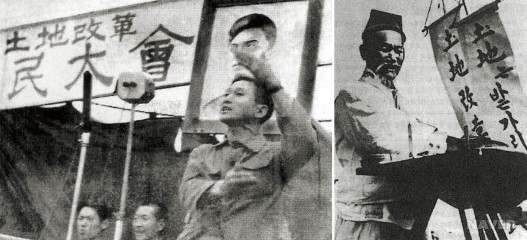
<North Korean peasants gather in support of the land reform in March 1945 (left), alongside a propaganda poster (right) / Photo by Naver Encyclopedia>
On the other hand, land reform in the southern region began in March 1948 under the United States Army Military Government in Korea, emphasizing democratic values. Following the establishment of the Republic of Korea government in August 1948, the constitution explicitly stated the “Land to the Tiller” principle, leading to the state confiscating land from landlords and redistributing it to small tenant farmers. This aimed to crack down on landlords' illegal actions while granting economic independence to tenants through land distribution. Alongside promoting a free-market economy, efforts were made to stabilize agricultural regions and support farmers' livelihoods.
In June 1949, a land reform law was enacted to respect landowners' property rights, instituting “compensated expropriation and distribution”. However, progress was slow until the early 1960s, post the Korean War. Compensation for expropriation was fixed at 150% of annual produce for both acquisition and distribution. Landowners relinquishing their land received government bonds matching this amount, while tenant farmers receiving land had to allocate 30% of their annual produce for five years to secure ownership rights.
By parceling out vast tracts of land among small tenant farmers, the reform fostered more equitable income distribution within local communities, thereby enhancing the fairness of rural economies and fortifying the economic autonomy of farmers. Various factors, including the punitive measures against landlords and the considerable loss of land and property records amidst the upheaval caused by the Korean People's Army's occupation, facilitated the land reform process with minimal resistance.
The Impact of Land Reform in North and South Korea
Advancing with little opposition, land reforms implemented on the Korean Peninsula resulted in positive outcomes, such as reducing rural poverty and enhancing the living conditions of peasants. However, they also brought about negative consequences, including instability in agricultural production systems and increased political conflicts. In North Korea, the rushed and arbitrary land reform had serious consequences. Forced land distribution gradually decreased agricultural productivity, worsening rural food shortages and threatening food security.
Furthermore, the reform process involved coercive collectivization without individual autonomy, which restricted economic freedom and rights. Landowners were compelled to surrender their land, diminishing incentives for individual effort and investment, thereby undermining economic stability and fostering an environment of instability. Inefficient land utilization due to forced redistribution lowered productivity, ultimately reducing overall economic efficiency. The government's strong control and coercive policies eroded trust among residents, leading to social unrest. Consequently, North Korea's land reform, aimed at achieving short-term goals, had negative implications for long-term stability and productivity.
Similarly, land reform in South Korea aimed at short-term gains but yielded various negative effects. During the reform process, landowners were forcibly required to transfer land, sparking disputes and conflicts that destabilized local communities. Forced land distribution restricted landowners' income and investment incentives, diminishing individual economic motivation and consequently reducing agricultural productivity. This decline in productivity had adverse implications for the nation's food security. Moreover, the government's strong intervention curtailed individual economic freedom, depriving citizens of property rights and hindering creativity and entrepreneurial spirit.
Inefficient land use and the loss of incentives for landowners' effort and investment led to decreased agricultural productivity, ultimately negatively impacting the country's economy as a whole.
The Legitimacy and Public Support of Land Reform
In any reform effort, legitimacy and public support are pivotal factors, given their crucial roles in ensuring effective policy execution, national stability, and social cohesion. Land reform, like any other reform, adheres to this principle. Legitimacy serves to bolster public confidence in governmental decisions and enhances the viability of policy implementation.
When land reform follows rational and equitable procedures, citizens are more inclined to place trust in governmental decisions, fostering greater consensus on government objectives and policies. Popular backing is indispensable for the successful execution of land reform. It's imperative for the government to value citizens' perspectives and facilitate their active involvement in the reform process. With citizens comprehending the necessity of land reform, sharing its objectives and rationale, and actively engaging, collaborative and effective reform becomes achievable.
Moreover, if citizens find the outcomes satisfactory and throw their support behind them, it can mitigate potential resistance in the future, thereby playing a pivotal role in the country's long-term development.
Nevertheless, both North and South Korea faced challenges regarding legitimacy and popular support in their land reform endeavors. Forced land redistribution, prevalent in both nations, raised concerns about individual property rights and economic freedoms. This approach had not only undermined individual initiatives and investments but also stifled economic efficiency. Furthermore, excessive government intervention curtailed citizens' economic liberties and hindered innovation. Such interventions impeded market functions and suppressed healthy competition among economic entities, thereby constraining overall economic growth and development. Additionally, inefficient land use exacerbated these challenges, contributing to a decline in agricultural productivity and posing threats to food security and economic stability.
Furthermore, social unrest and conflicts arising from differing policies between North and South Korea likely worsened doubts about popular support and legitimacy. In North Korea, while some citizens may have initially gained from land reform, widespread distrust and restrictions on freedoms due to forced distribution and government interference hindered broad support. Similarly, in South Korea, citizens faced confusion, especially those treated unfairly during land transfers. The decline in agricultural productivity due to forced distribution further fueled negative perceptions of the reform among some.
The Sustainability of Land Reform
To ensure the sustainability of land reform, it's crucial to consider several key principles and directions alongside achieving short-term successes. Above all, securing national consensus and participation is paramount. In the process of land reform, gathering the opinions of citizens and actively involving both field experts and the public are essential steps.
When citizens are directly engaged in the reform process and transparency prevails regarding the outcomes, reform policies stand to gain more support and trust. Moreover, the reform's goal should prioritize fair and efficient resource distribution. Establishing a distribution system grounded in consensus and compensation rather than coercion is imperative. Education and support play pivotal roles in ensuring the land's efficient utilization.
Introducing policies that promote sustainable agricultural practices by imparting agricultural techniques and management skills to residents is essential. Additionally, offering incentives for land conservation and sustainable management can bolster land productivity. Government intervention should prioritize fairness without impinging on the freedom of citizens and economic entities.
The government's role in actively utilizing market mechanisms is especially crucial, while also focusing on regulation, support, and compensation. Reform efforts should aim to promote and nurture the economic freedom and innovation of citizens. Moreover, it's vital for land reform to prioritize long-term vision and sustainability, ensuring short-term objectives align with broader national development goals. This approach aims to improve both efficient land use and the overall quality of life for citizens.