

Insights into North Korea's Nuclear Ambitions
from My Experiences There: Part 2

Park Choong-kwon
Research Engineer at Hyundai Steel Company,
Specialized in Materials Engineering for ICBMs at Kim Jong Un National Defense University,
Ph.D. in Materials Science and Engineering from Seoul National University
The inaugural North Korean defector recruited for political talent
In my previous column, I touched upon North Korea's advancements in nuclear capabilities, shedding light on the anticipated developments and responses that we should prepare for. The nuclear prowess of North Korea has significantly evolved and diversified since the era of Kim Jong-il. This evolution is not solely attributed to the Kim Jong-un regime but also reflects a longstanding commitment to nuclear armament and its refinement since the time of Kim Il-sung. So, how is it even possible for North Korea to advance its nuclear capabilities?
Deep within North Korea lies a highly secretive institution known as the National Defense University. Even among the populace of North Korea, the existence of this institution remained largely unknown, and I only became aware of it because I graduated from there before defecting in 2009.
Established by Kim Il-sung in 1963, the National Defense University was exclusively dedicated to missile development, with meticulous attention paid to details such as student uniforms and institutional regulations. Kim Il-sung even affectionately referred to the university as his "only son."
During the 1990s, Kim Jong-il intensified efforts in weapons development. To support this endeavor, a special admission system was implemented at the National Defense University, aimed at attracting the nation's most talented individuals. Substantial investments were made to enhance the quality of research personnel. Building upon this foundation, Kim Jong-un issued directives in 2015 to elevate the University to a "world-class institution above all others." The subsequent renaming of the university as the "Kim Jong Un National Defense University" in 2016 underscores the regime's unwavering focus and investment in nuclear armament and its advancement across three successive generations.
Until Kim Jong-il's era, the National Defense University operated with such secrecy that even the general population remained unaware of its existence. Upon leaving the university, faculty and students adopted the guise of soldiers affiliated with the "852 military unit." The university's existence was a closely guarded secret, concealed from the outside world. However, during the reign of Kim Jong-un, significant changes occurred.
On June 13, 2016, coinciding with the university's founding anniversary, Kim Jong-un's on-site inspection marked the first public acknowledgment of its existence under the name "Kim Jong Un National Defense University." This acknowledgment signaled a newfound level of confidence within the North Korean regime regarding its nuclear armament and capabilities.
Prior to unveiling a new weapons system in early 2017, the regime strategically showcased the institution to the outside world. This move may have been intended to subtly indicate the reliability of the upcoming weapons, suggesting the presence of robust research and development capabilities spanning from R&D to mass production.
Kim Jong-un's regime clearly exhibits confidence, bolstered by my observations of North Korea's defense sector. Despite the country's general underdevelopment, it has a notably advanced military-industrial complex, with significant research personnel and infrastructure. This indicates a military capability that disproportionately exceeds its broader national development.
In a country where power outages are commonplace, any facility that maintains uninterrupted electricity supply round the clock is almost certainly tied to the military industry. My time at the National Defense University confirmed this; we never once faced a blackout. This unwavering power supply extends to all military-affiliated institutions and factories, underscoring their priority within the nation's infrastructure. During my visits to military factories, I observed their production infrastructure to be impressively advanced, with the latest imported manufacturing equipment and raw materials readily visible. This shows that, even under Western-led sanctions, North Korea has consistently secured the essential equipment and materials needed for weapons production.
Questions might arise about how North Korea manages to finance these operations. It's reasonable to assume that the funding stems from diverse sources, including illicit activities such as diverting humanitarian aid, dealing in drugs, arms trading, and exploiting mineral and marine resources.
During my time at the National Defense University, state-of-the-art computers supplied from South Korea were provided to both faculty and students. Interestingly, many students were engaged in studying Arabic, potentially to support them in roles related to technical support during arms and technology trade with Arab countries. This underscores the active nature of the arms trade relationship between Arab nations and North Korea.
Turning our attention back to the National Defense University, it stands out as a globally unique entity. Initially, it offered eight majors during my time there, but a recent restructuring has increased this number to 12. The framework of these majors is vastly different from what you'd find in typical universities across the free world, with a clear emphasis on specialized, defense-oriented disciplines.
The departments for the majors at this university include Aerospace Engineering, Electronics and Communication Engineering, Commercial Weapons Engineering, Optical Radar Engineering, Automatic Control Engineering, Satellite Engineering, Hypersonic Weapons Engineering, among others.
Each department highlights a specific area of expertise, with further subdivisions focusing on a range of weapon systems like Rocket Engine Engineering, Rocket Body Design, Maritime Weaponry, Sniper Weaponry, and more. This demonstrates the university's extensive dedication to defense-related disciplines.
Every year, this university produces between 500 to 700 specialists from its highly specialized departments. But that's not all. The university is connected to a wealth of resources, including the State Academy of Defense Sciences, which boasts 15,000 personnel and over 60 regional branches nationwide, as well as military factories under the Second Economic Committee, among others.
A closer look at the National Defense University's departmental structure reveals a telling pattern. With a focus on the detailed segmentation of weapon systems, the institution appears primarily aimed at developing technical skills rather than encouraging the growth of versatile, creatively minded talents. Indeed, researchers at North Korea's State Academy of Defense Sciences frequently refer to their institution as a “reverse engineering academy.” Instead of pursuing innovative weapon development projects, North Korea focuses on replicating advanced weapon systems from other countries.
Consider the "Songun-2" tank, for example, a North Korean replica of the U.S. M1A1 Abrams tank. This initiative was inspired by North Korea's analysis of how nine U.S. tanks were able to decisively defeat 80 Russian-made T-72 tanks during the Gulf War's Battle of 73 Easting, leading them to acquire and duplicate U.S. tank technology.
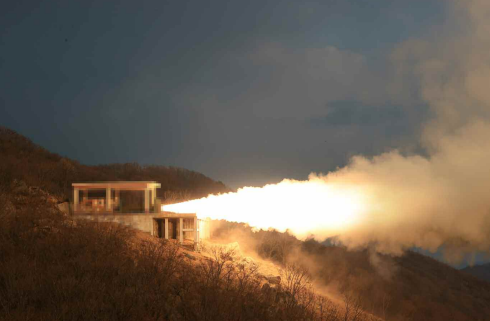
<On March 19, 2024, North Korea tested a solid-fuel engine for its new-type intermediate-range hypersonic missile / Photo by Rodong Sinmun>
Additionally, during my time there in 2006, there was ongoing development of portable 4th-generation night vision devices through reverse engineering. By April 2017, it was confirmed that the Korean People's Army Special Operation Force (KPASOF) showcased these devices at a military parade and had already deployed them in combat situations. At the same time, following Kim Jong-il's directives, North Korea's State Academy of Defense Sciences and its military factories were deeply involved in the development of anti-aircraft radar systems. Aimed at protecting North Korea's airspace, especially along the East and West coasts, these advanced radar systems were procured through black-market deals for the purpose of reverse engineering. It's believed that these systems have been fully developed and are now actively deployed for combat.
However, North Korea's fondness for copying extends far beyond radar systems. Examples include the Hwasong-11 (a replica of Russia's Iskander), Hwasong-11Na (a replica of the U.S. ATACMS), the Pukguksong series (a replica of the U.S. Polaris series), and Saetbyol-4 (a replica of U.S. RQ-4 Global Hawk), Saetbyol-9 (a replica of U.S. MQ-9 Reaper), Haeil-2 (a replica of Russia's Poseidon), Hwasong-8 (a replica of China's Dongfeng-17), Pongae-5 (a replica of Russia's S300), and more.
Given these circumstances, it's crucial to develop effective strategies to detect and block the channels North Korea uses to illicitly acquire foreign weapons technology and systems promptly.