

Launching Reconnaissance Satellites: A New Phase in Korean Rivalry
– Assessing the True Value of Korean Reconnaissance Satellites in the Space Age–

Lee Seung-hyun
Research Fellow at SAND Institute/Ph.D. in Public Administration
In 2021, at the 8th Congress of the Workers' Party of Korea, North Korea laid out a "Five-Year Plan for the Advancement of Defense Science and Development of Weapon Systems," setting its sights on advancing its nuclear arsenal, including the development of nuclear delivery mechanisms (missiles included) and reconnaissance satellites, to bolster its nuclear strike capabilities. After this announcement, North Korea focused its efforts on developing and planning to launch reconnaissance satellites, a project that was publicly announced both within the country and to the international community. Initially, the global community, including experts, viewed North Korea’s focus on reconnaissance satellites merely as a strategy to enhance their missile capabilities for nuclear armament.
Such assumptions were not unfounded, as North Korea announced that its 1998 launch of Taepodong-1 successfully carried the Kwangmyongsong-1 satellite, affirming its operational success. Up until 2016, North Korea professed to have launched a series of five Kwangmyongsong satellites, capable of carrying nuclear warheads. Thus, when the discussion of launching reconnaissance satellites surfaced in 2023, it was naturally perceived as an effort to acquire delivery systems for nuclear weaponry. However, it soon became evident that Kim Jong-un’s real ambition in acquiring reconnaissance satellites was to gain the necessary 'eyes' for the operational use of nuclear weapons. This meant using reconnaissance satellites to monitor military movements of South Korea and the US and to ascertain precise target specifications and confirm Battle Damage Assessment (BDA) capabilities.
The start of the Yoon Suk-yeol administration in 2022 further intensified the already strained relations between the North and South following the 2019 Hanoi summit. North Korea's dedication to launching reconnaissance satellites was part of its broader focus on developing new strategic and nuclear weapons. The South Korean government also revealed its significant advancements in defense technology. Notably, North Korea’s efforts to launch the Malligyong-1 on April 19, 2023, and subsequent attempts on May 31 and August 24 failed, which were promptly disclosed by North Korea. A pivotal moment occurred when Kim Jong-un, in September 2023, met Vladimir Putin at Russia’s Vostochny Cosmodrome, leading to a hinted military and technical cooperation for North Korea's space program. Consequently, North Korea declared the successful launch of its third reconnaissance satellite on November 21, 2023.
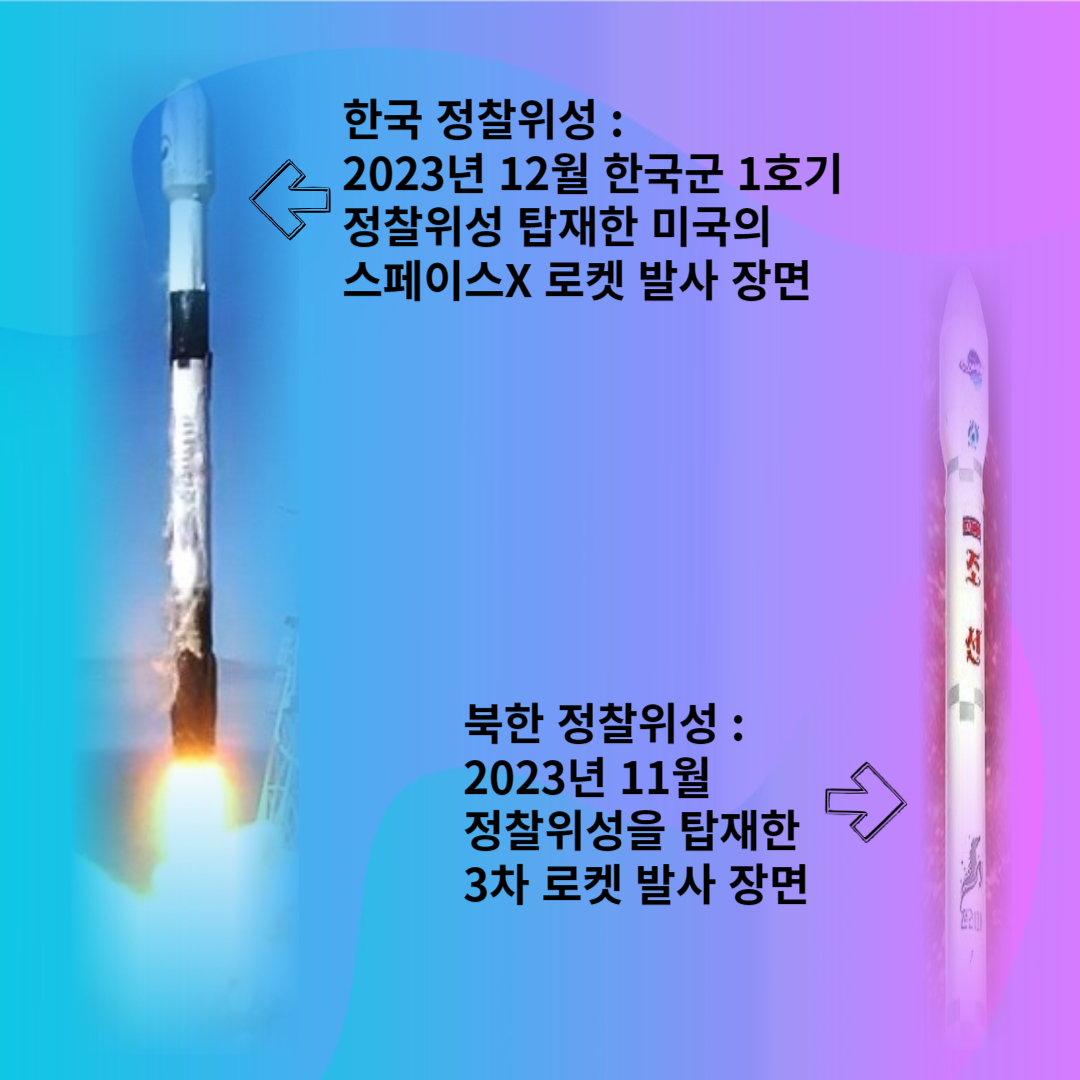
* South Korean Satellite: SpaceX Falcon 9, launched from Vandenberg Space Force Base, deploying Ireland's first satellite and a South Korean reconnaissance satellite in December 2023
North Korean Satellite: North Korea's third rocket launch, featuring the deployment of its own reconnaissance (or spy) satellite.
In response, the South Korean government and military analyzed the debris from North Korea’s Malligyong-1 launch in June, concluding its lack of military utility. On December 2, 2023, the South Korean satellite, known as 425 Project, was set to launch, representing the first step in a government-led project initiated in 2018. Plans for additional satellite launches in 2024 and 2025 were also revealed, marking an escalation of the North-South rivalry into space.
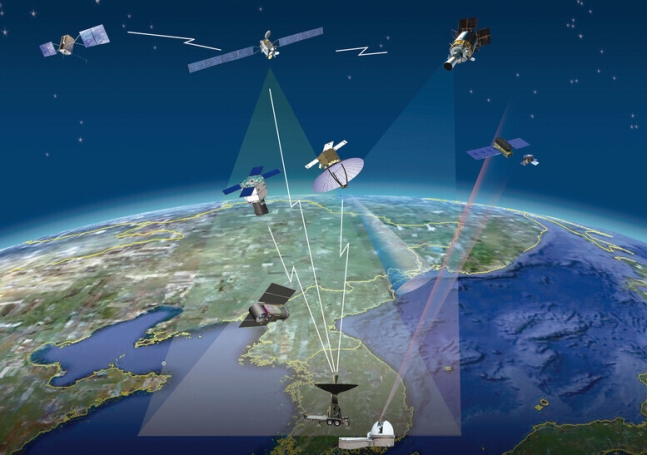
The competition in space development, driven by reconnaissance satellites over the Korean Peninsula, extends beyond North and South Korea, encompassing major global powers like the United States, China, Japan, and India. This rivalry reflects the quest for human survival and supremacy. Historically, space development has been dominated by governments due to its exorbitant costs. Only seven countries, including Korea, launched and maintained satellites in orbit. However, the emergence of SpaceX in 2002 catalyzed a shift towards private-led initiatives, slashing costs and timelines. This ushered in the era of 'New Space', revolutionizing satellite development and prompting initiatives like the United States' Space Development Agency (SDA), integrating Silicon Valley's business approaches.
This ‘New Space’ era seems poised to establish a new international rivalry reminiscent of the Cold War. Just as the Cold War was characterized by ideological divisions between the United States and the Soviet Union, the ‘New Space’ era is likely to be divided between liberal democratic nations and communist/socialist countries, with the United States and China at the forefront. This division is expected to limit the exchange and cooperation in space development between these two camps.
In this context, the reconnaissance satellite competition between North and South Korea appears to be creating a new framework of confrontation in line with the ‘New Space’ era. South Korea is expected to strengthen its capabilities through technological cooperation with allies such as the United States, Japan, and India, focusing on satellite launches, operation maintenance, and the construction of space communication networks. In contrast, North Korea will likely pursue limited technological cooperation with China and Russia.
Experts, both domestic and international, analyzed North Korea's "Malligyong-1," launched in 2023, scrutinizing its surveillance equipment and resolution. The reconnaissance satellite's capabilities are estimated to lag behind South Korea's by approximately 20 years, with a speculated resolution exceeding 1 meter. Hence, its effectiveness as a surveillance tool is deemed limited compared to South Korea's Arirang-1 and Arirang-2 satellites launched since 1999.
On the other hand, South Korea's 425 satellite, boasting a resolution of 30cm and equipped with various optical instruments, is ready for practical use. Given the alignment within the new space era's camps, South Korea is poised to lead the space race against North Korea for the foreseeable future. However, this lead is not guaranteed to last indefinitely. The pace of technological advancement in the space industry is not steady but rapid, making it impossible to declare that South Korea's current superiority will persist over the next decade or two. While South Korea's technological prowess is expected to surge through cooperation within the new camp, expanding the usable space infrastructure of its allies, the technological gap with North Korea could either narrow or widen depending on North Korea's hacking capabilities and its demonstrated rapid technology acquisition, particularly in nuclear development.
With the rapid advancement of hardware technologies related to launch vehicles, satellites, and their onboard equipment, the technology for the software used in satellites and ground stations is also evolving. Additionally, security measures to protect this software are being strengthened. Therefore, despite North Korea's proficient hacking abilities, it will find it challenging to exfiltrate all technical information, and it's unlikely that China and Russia will fully transfer their key technologies to North Korea. This makes it difficult for North Korea to surpass South Korea's technological achievements in the short term. Also, while South Korea can boost its tech and expand its capabilities through collaborations beyond the US, North Korea's tech partnerships are limited to China and Russia, making short-term progress challenging.
In summary, spurred by the launch of reconnaissance satellites in 2023, South Korea holds a lead over North Korea in the space competition. This is due to North Korea's technological limitations and constrained collaboration opportunities. Both countries plan to launch more satellites in 2024 to gain strategic advantage.
Technological superiority directly impacts military utility, especially in the realm of satellite applications like surveillance and power projection. With South Korea's advantageous alliances in the new space era, its expanded reconnaissance and satellite capabilities bolster its military strength. Therefore, South Korea must maintain its superiority in the space sector while preparing for potential threats and technology acquisition attempts.
-
PREV [Defectors' Podium]
-
NEXT [Defectors' Podium]