

[Opinion] Analysis and Outlook on North Korea's Public Disclosure of Nuclear Strike Drills

Moon Seong-mook
Director of the Center for Korean Unification Strategy
at the Korea Research Institute for National Strategy
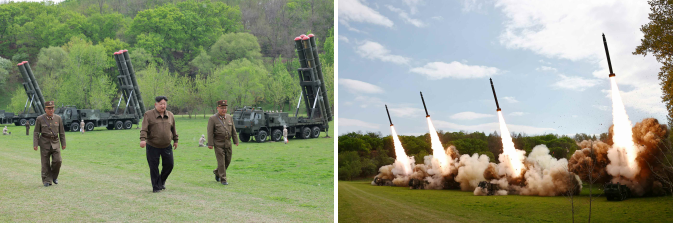
On April 23rd, the Korean Central News Agency reported that "units with the 600mm Super-large Multiple Launch Rocket Systems (MLRS) took part in their inaugural comprehensive nuclear retaliatory tactical exercise." It was also noted that Kim Jong-un supervised the prior day's training. The detailed report explained the sequence included transitioning to nuclear retaliatory readiness under the highest nuclear crisis alert, operational exercises of the command system, and culminated in firing drills using rockets equipped with mock nuclear warheads.
Rodong Sinmun reports that on April 22, Kim Jong-un attended the inaugural comprehensive nuclear counterattack drill, featuring the 600mm Super-large MLRS. (Image: Rodong Sinmun)
This second nuclear retaliatory drill involved North Korea's KN-23 short-range ballistic missiles, known as the North Korean Iskander, similar to last year's March exercise. State media reported that Kim Jong-un had reviewed "nuclear trigger" technology before furthering the nuclear weapons program. This drill was the first to use the term 'volcanic alert,' indicating the utmost nuclear crisis level.
The Korean Central News Agency reported that the exercise successfully hit island targets 352 km away. This range includes South Korea's military headquarters at Gyeryongdae and the Kunsan Air Base, sites of US-South Korea flying training. The report also escalated threats, stating that North Korea would "resolutely execute a significant mission" if confronted by enemy forces.
This article analyzes Kim Jong-un's public demonstration of nuclear exercises as intimidation toward South Korea, forecasts potential escalations of nuclear threats, and outlines appropriate responses.
What's Behind North Korea's Public Display of Nuclear Exercises and Expansion of Capabilities?
Firstly, North Korea aims to finalize its nuclear capabilities to ultimately achieve its strategy of coercive reunification with South Korea.
This goal aligns with Kim Jong-un's declaration at last year's Workers' Party meeting that inter-Korean relations are combative, not fraternal. In a speech earlier this year, he labeled South Korea as the primary enemy, pledging to use all means to dominate and devastate its territory. This also ties to efforts to erase the concepts of unification and nationalism handed down from Kim Il-sung and Kim Jong-il, rejecting peaceful unification for forced reunification through military power.
By completing its nuclear arsenal and being prepared to use nuclear weapons preemptively, North Korea aims to demonstrate its readiness to conquer South Korea and enforce reunification, asserting itself as the dominant force on the Korean Peninsula.
Secondly, North Korea's actions serve to sow discord within the US-South Korea alliance and stir up internal conflicts within South Korea. Officially, North Korea has expressed its displeasure at joint military exercises and enhancements in the allied deterrence capabilities.
The recent drills with the Super-large MLRS serve as warnings against US-South Korea joint exercises, highlighting North Korea's displeasure. These actions likely reflect North Korea's anxiety about enhanced US-South Korea deterrence, causing concern for Kim Jong-un as responses intensify.
As Kim Jong-un legalizes nuclear capabilities and threatens Seoul, the US and South Korea have strengthened their deterrence through measures like the Washington Declaration. This development sharpens Kim Jong-un's anxieties, prompting him to increase threats, stir unrest among South Koreans, and foster discord between the US and South Korea, aiming to intensify internal conflicts.
Thirdly, Kim Jong-un appears to be consolidating power and solidifying his regime amidst internal unrest. Who does he fear most? The US, Japan, South Korea? Probably it’s the North Korean citizens. In 2012, during Kim Il-sung’s centennial, he promised that North Koreans would no longer suffer hardship—a promise that remains unfulfilled, leading to mounting dissatisfaction among the populace.
In this context, Kim Jong-un can only showcase his greatest achievement—his nuclear missile capabilities. He seeks to project himself as a formidable leader thwarting supposed US and South Korean nuclear threats and warmongering, thereby urging North Koreans to persevere despite hardships. This also serves to intensify hostility towards South Korea, cutting off all ties as part of his strategic maneuver.
Lastly, this could also be part of North Korea's efforts to strengthen ties with Russia. In a meeting with Vladimir Putin at the Vostochny Cosmodrome last September, Kim Jong-un continued what some call 'a deal with the devil.' With Putin's aid, North Korea hopes to not only alleviate its severe economic woes but also to shield its illegal actions from global scrutiny and secure critical military technologies. The recently tested super-large MLRS, potentially useful in Ukraine, seems aimed at impressing visiting Russian military officials.
Prospects for Future North Korean Nuclear Threats and Our Response Directions
North Korea is focused on completing the five strategic weapons tasks set by Kim Jong-un at the 8th Party Congress in 2021. Meanwhile, South Korea and the US aim to refine their strategies during the Ulchi Freedom Shield (UFS) exercises in August this year, via the Nuclear Consultative Group (NCG). Kim Jong-un is expected to counter vigorously, showcasing his nuclear system's capabilities with additional exercises and announcing plans for three reconnaissance satellite launches.
Additionally, Kim Jong-un could conduct a seventh nuclear test at any time. He is exploiting the emerging new Cold War dynamics to bolster his nuclear capabilities. Both China and Russia are using their veto powers as permanent members of the UN Security Council to support North Korea and protect its unlawful actions.
The operations of the UN Sanctions Committee's expert panel on North Korea have been halted due to Putin's objections. For Kim Jong-un, this situation presents an ideal opportunity, particularly with Vladimir Putin's upcoming visits to China and then Pyongyang. North Korea is also expanding its interactions with China, with predictions circulating that Kim Jong-un will meet Xi Jinping in China later this year.
The Republic of Korea Joint Chiefs of Staff noted the exaggerated capabilities of North Korea's super-large MLRS and emphasized readiness to intercept any missile launches. They sternly warned that nuclear weapon use would doom the North Korean regime. The US Department of Defense confirmed ongoing consultations with allies like South Korea and Japan on regional security, ensuring that Kim Jong-un’s aggressive plans are countered.
We must ensure that Kim Jong-un's malicious intentions do not succeed. Our response requires a multi-faceted approach: Firstly, we need to assert that eliminating the concepts of nationality and unification won't eradicate these ideas; we must aim for unification based on constitutional principles. Secondly, as North Korea intensifies its nuclear threats, strengthening the US-South Korea alliance and enhancing trilateral security cooperation with Japan through regular military exercises is crucial. Thirdly, all South Koreans must acknowledge that North Korea is the origin of these threats and unite for national security. Finally, we must persistently pursue North Korea's denuclearization and transformative change through ongoing diplomatic efforts.
-
PREV [Opinion]
-
NEXT [Defectors’ Podium]